
Low-dose naltrexone,
does it really help with Improved fatigue and daily functioning in people with long COVID?
research showsLow-dose naltrexone receives a D for fatigue and daily functioning in long COVID. A systematic review and meta-analysis searching through May 2026 identified no randomized controlled trial and included only four small uncontrolled pre-post studies from the United States and Ireland, with 155 participants. Pooled pre-post effects for fatigue and daily function were positive, but without a control group they cannot separate treatment from natural recovery, regression to the mean, concurrent care, expectations, or attrition. One 36-person study combined LDN with NAD+ patches, and most investigators were employees of the company providing the intervention. This remains low-quality observational evidence before confirmation and yields D with 28 points. Evidence for standard-dose naltrexone in obesity or alcohol use disorder concerns different doses and conditions.
ads claimMarketing and testimonials turn anti-inflammatory or microglial hypotheses and uncontrolled questionnaire changes into a validated treatment for long-COVID fatigue. A mechanism and pre-post change are not placebo-controlled clinical efficacy, and efficacy of standard-dose naltrexone in another condition does not establish a low-dose long-COVID effect.
Useful facts when choosing a product
- Naltrexone is a prescription opioid-receptor antagonist. Doses of 1 to 4.5 mg for long COVID are off label rather than an approved regimen, and studies have used doses up to 6 mg daily.
- Low-dose formulations are often specially compounded, so dose, excipients, and release characteristics can differ from an approved standard-dose tablet. Results from one formulation cannot be assumed for every compounded product.
- Insomnia, vivid dreams, headache, nausea, abdominal discomfort, or diarrhea can occur. The absence of serious events in small long-COVID studies does not rule out rare or long-term harm.
- Concurrent opioid analgesics, cough medicines, or antidiarrheals may be blocked or may precipitate withdrawal, and emergency pain control can be affected. Current or recent opioid use, liver disease, and planned surgery must be discussed with the prescriber.
Chamgap Semantic Classification Code
Candidate index · review held
M.naltrexone.UNK.fatigue-and-daily-functioning-with-long-covid.improve.placeboMedicinal interventions > Naltrexone > Unknown > fatigue and daily functioning with long COVID > Improvement claim > Placebo
An automated migration candidate, not an issued permanent code; exact claim scope remains under review. This machine-generated migration candidate helps retrieval but is not a permanent assignment. The original verdict ID and URL remain authoritative.
What the research actually shows
The 2026 meta-analysis searched PubMed, Embase, the Cochrane Library, and trial registries through May 5, 2026. It included four pre-post studies from the United States and Ireland, totaling 155 participants, with doses from 1 to 6 mg daily. Pooled pre-post changes in fatigue, brain fog, sleep, pain, and daily function were favorable, but certainty was low. O'Kelly enrolled 52 patients, prescribed 1 mg in month one and 2 mg in month two, and obtained follow-up questionnaires from 36. Isman treated 36 participants with both LDN and transdermal iontophoresis NAD+ patches and reported improved Chalder fatigue and SF-36 scores after 12 weeks. No study used placebo and masking to control natural history or expectations.
Why this is classified as D (28)
The latest 2026 synthesis found zero randomized trials and only four uncontrolled pre-post studies with 155 participants. Fatigue and function signals were positive, but the studies could not control natural recovery, regression to the mean, concurrent treatment, subjective reporting, or attrition; one combined LDN with NAD+ and had commercial conflicts. This is low-quality observational evidence before confirmation rather than credible positive comparative evidence, yielding D with 28 points. Short-term tolerability and opioid interactions are separate safety issues.
Counterpoint. An individualized off-label trial discussed with a prescriber can be a different clinical decision from the evidence grade. Opioid use, liver status, and concurrent medicines should be reviewed first, benefit should be measured against a prespecified fatigue or function scale, and ineffective treatment should not continue by inertia.
Rejudgment record. New verdict — Applied D because systematic searches through May 2026 found zero randomized trials of LDN for long COVID and only four pre-post observational studies with 155 participants, leaving low-certainty subjective evidence unable to control natural history, expectations, concurrent care, or attrition
Sub-claim grades by effect
This ingredient is marketed for several effects. A single overall grade blends strong and weak claims together, so each effect is graded separately here. The overall grade reflects the strongest disconfirming or core claim.
| Effect (sub-claim) | Grade | Basis |
|---|---|---|
| Improved fatigue in long COVID | D | The pre-post meta-analysis was positive, but there were zero randomized trials and natural recovery, expectations, and concurrent care were uncontrolled. |
| Improved daily functioning in long COVID | D | The pre-post daily-function effect was large, but it came from small self-reported observational data without a comparator. |
| Sustained improvement of long-COVID fatigue and function from LDN alone | D | Long-term controlled data are absent, and one positive pilot combined NAD+ patches, preventing isolation of LDN alone. |
Cross-check — AI research and Codex final gate
Evidence Table
| Study | Design | Sample | Funding | Endpoint | Result | Weight |
|---|---|---|---|---|---|---|
| Byambasuren O et al. 2026 | Systematic review and meta-analysis of single-group pre-post studies | 397 records screened; zero randomized trials; four pre-post studies with 155 participants | No support for the submitted work or relevant financial relationships reported | Fatigue, quality of life, cognition, sleep, pain, and daily functioning | Pre-post effects favored fatigue at g -0.74 and daily functioning at g -0.93, but certainty was low and confirmatory randomized trials were required. | Key current synthesis confirming the absence of randomized trials |
| O'Kelly B et al. 2022 | Single-center uncontrolled interventional pre-post study | Fifty-two enrolled, 38 known to start treatment, and 36 completing the two-month questionnaire | Disclosed UCD Foundation fellowship support from Gilead, Pfizer, and GSK and support from the Irish Health Research Board | Self-reported recovery, activity limitation, energy, pain, concentration, sleep, and mood | Six of seven self-reported measures improved from baseline, but there was no control group and only 36 of 52 participants completed follow-up. | Direct positive signal at high risk of bias |
| Isman A et al. 2024 | Uncontrolled pre-post pilot of combined LDN and NAD+ | Thirty-six participants with moderate or severe post-COVID fatigue; 12 weeks | Sponsored by AgelessRx; six of seven investigators were AgelessRx employees | Chalder fatigue scale and SF-36 quality of life | Fatigue and quality of life improved from baseline, but concurrent LDN and NAD+ patches prevented isolation of the LDN effect. | Supportive signal limited by cointervention and commercial bias |
Receipt — 3 References
All 3 cited sources were verified for existence at the original page (as of 2026-07-22).
Final verification and publication gate: Codex · Evidence date: 2026-07-22 · Corrections: none
Cite this verdict
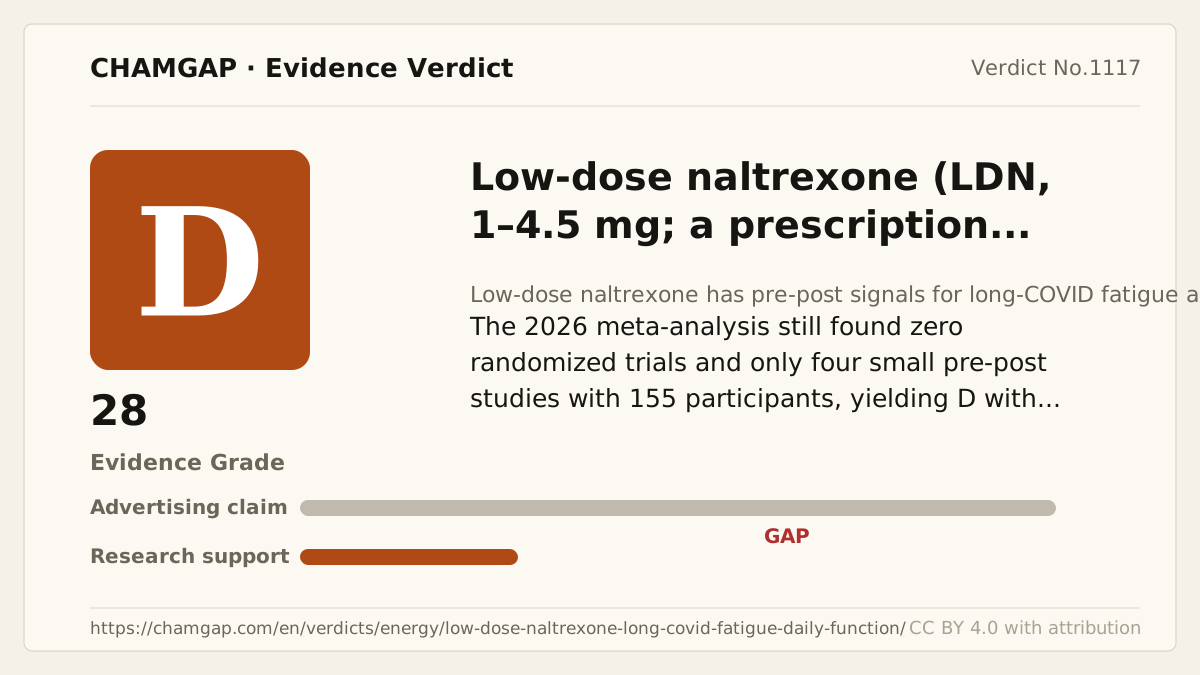
[Chamgap] Low-dose naltrexone x improved fatigue and daily functioning in long COVID — Evidence Grade D·28. 3 cited sources checked. Source: https://chamgap.com/en/verdicts/energy/low-dose-naltrexone-long-covid-fatigue-daily-function/ · CC BY 4.0CC BY 4.0 — free to use with attribution; do not distort grades, numbers, or verdict meaning.
What this document does and does not do
Chamgap is an information source. It reports what research has and has not confirmed; it does not tell readers what to take or buy. That decision belongs to readers and, when needed, medical or legal professionals. This verdict reflects literature available up to the search date and may change as new research appears. Nothing here is medical advice.