
Liquid chlorophyll,
does it really help with Increased everyday energy and improved fatigue recovery in healthy adults?
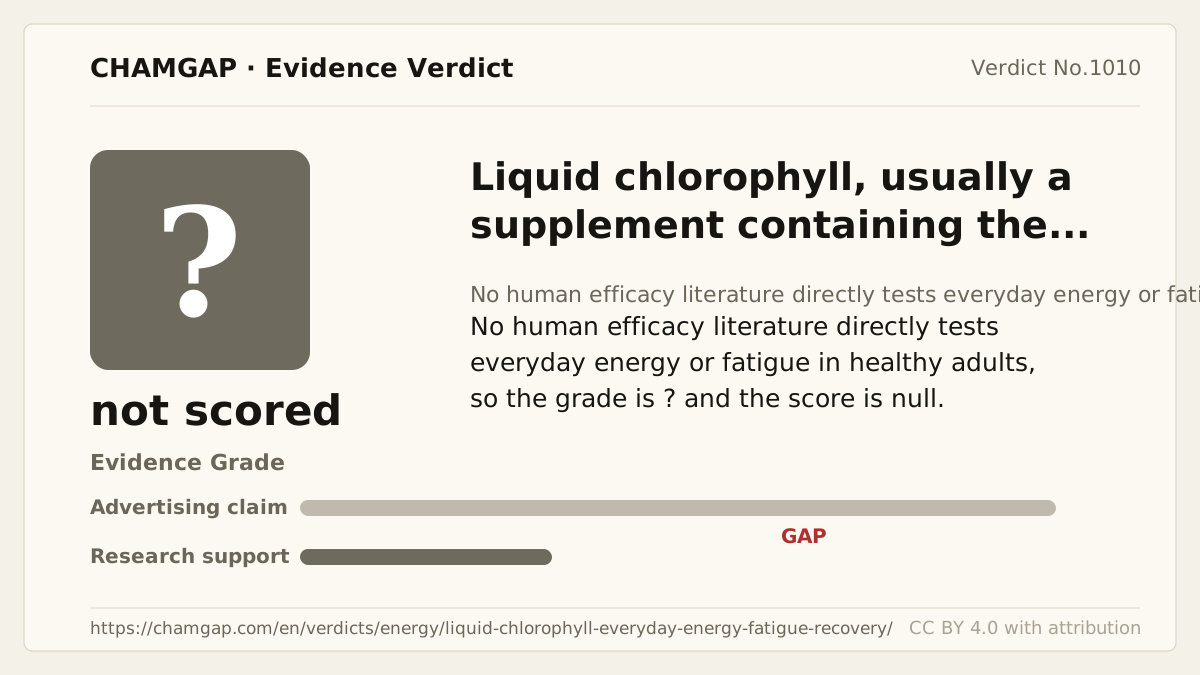
research showsLiquid chlorophyll is rated ? because no human efficacy literature was found that directly evaluated increased everyday energy or improved fatigue recovery in healthy adults. Systematic and umbrella reviews of human chlorophyll or chlorophyllin research included other outcomes, such as cancer-risk biomarkers, cardiovascular measures, and allergy, but no energy or fatigue outcome. A recent phase 1 study of high-dose sodium copper chlorophyllin assessed safety and pharmacokinetics rather than energy efficacy. Testimonials and the imagery of plant photosynthesis are not clinical evidence of human energy production. Absence of literature does not prove ineffectiveness; it means there is no direct trial to grade.
ads claimMarketing and testimonials connect green plant pigment, detox imagery, and photosynthesis with natural vitality or a fatigue reset. Humans do not photosynthesize from ingested chlorophyll, and sensations associated with color, mint flavor, or drinking more water cannot be assigned to the ingredient without a controlled trial.
Useful facts when choosing a product
- Many products sold as liquid chlorophyll use the water-soluble derivative sodium copper chlorophyllin rather than native plant chlorophyll. The actual ingredient name and amount per serving should be checked on the label.
- Chlorophyllin concentration, flavorings, sweeteners, preservatives, and other botanical ingredients vary among products. Testimonials or sensations from one product cannot be generalized to the ingredient category.
- Chlorophyll is a plant photosynthetic pigment, but consuming it does not enable human photosynthesis. No established clinical pathway connects its green color with increased everyday human energy.
- Chlorophyllin is generally tolerated, but green discoloration of stool or the tongue, loose stools, and abdominal discomfort can occur. Some chlorophyll-related compounds may cause photosensitivity, so a new skin reaction warrants stopping the product and seeking advice.
Chamgap Semantic Classification Code
Candidate index · review held
S.liquid-chlorophyll.UNK.everyday-energy-and-improved-fatigue-recovery.increase.UNKSupplements and nutraceuticals > Liquid chlorophyll > Unknown > everyday energy and improved fatigue recovery > Increase claim > Unknown
An automated migration candidate, not an issued permanent code; exact claim scope remains under review. This machine-generated migration candidate helps retrieval but is not a permanent assignment. The original verdict ID and URL remain authoritative.
What the research actually shows
The 2014 evidence-based systematic review by Ulbricht and colleagues broadly assessed clinical and preclinical chlorophyll and chlorophyllin evidence but did not present a trial of energy or fatigue improvement in healthy adults. In the 2022 umbrella review by Blumfield and colleagues, human chlorophyll research covered disparate outcome areas such as cancer, cardiovascular disease, and allergy, not everyday energy or fatigue. The 2026 high-dose phase 1 study of sodium copper chlorophyllin by Patwardhan and colleagues evaluated safety, pharmacokinetics, and exploratory proteomics in healthy men rather than clinical efficacy for increased energy or fatigue recovery. These studies show exposure in humans for other purposes; they do not support the present claim.
Why this is classified as ?
The grade is ? and the score is null because zero human efficacy trials were identified for the claimed energy or fatigue outcome in healthy adults. Studies of other disease biomarkers and phase 1 safety are context showing human exposure, not efficacy evidence. Absence was kept distinct from refutation, so the claim was not forced into F or D.
Counterpoint. A useful efficacy test would require a sufficiently long randomized placebo-controlled trial using validated fatigue scales and activity measures while controlling sleep, caffeine, and co-ingredients. Until such a trial exists, subjective testimonials cannot be converted into an evidence grade.
Rejudgment record. New verdict — Applied ? for absence of human efficacy literature because no trial directly measured increased everyday energy or fatigue recovery from liquid chlorophyll or sodium copper chlorophyllin in healthy adults; studies of other outcomes and phase 1 safety were excluded from efficacy grading
Sub-claim grades by effect
This ingredient is marketed for several effects. A single overall grade blends strong and weak claims together, so each effect is graded separately here. The overall grade reflects the strongest disconfirming or core claim.
| Effect (sub-claim) | Grade | Basis |
|---|---|---|
| Increased everyday energy in healthy adults | ? | No human efficacy trial directly evaluating this outcome was identified. |
| Improved fatigue recovery in healthy adults | ? | No human literature testing chlorophyllin with a validated fatigue measure was identified. |
| Sustained improvement in physical and mental vitality | ? | No controlled human efficacy literature evaluates sustained vitality beyond testimonials. |
Cross-check — AI research and Codex final gate
Evidence Table
| Study | Design | Sample | Funding | Endpoint | Result | Weight |
|---|---|---|---|---|---|---|
| Ulbricht C et al. 2014 | Evidence-based systematic review | Clinical and preclinical chlorophyll and chlorophyllin literature; zero direct human trials of energy or fatigue | Natural Standard Research Collaboration; funding varied across included studies | Efficacy, safety, and interactions across multiple indications | The broad review did not present human efficacy evidence directly testing increased everyday energy or fatigue recovery in healthy adults. | Claim-specific human-literature gap assessment |
| Blumfield M et al. 2022 | Umbrella review of systematic reviews on plant pigments and health outcomes | Three human chlorophyll outcome domains; zero energy or fatigue domains | Australian academic nutrition researchers; no external funding reported | Health outcomes by plant pigment, including cancer, cardiovascular disease, and allergy | Everyday energy and fatigue recovery were absent from the human chlorophyll outcome domains. | Independent synthesis documenting the outcome gap |
| Patwardhan RS et al. 2026 | High-dose phase 1 clinical trial in healthy men | Healthy men; sample size not stated in the public abstract | Collaboration among Indian public institutes, universities, and a private research laboratory; detailed funding not stated in the public abstract | Safety, tolerability, pharmacokinetics, and exploratory proteomics | The study assessed human safety and exposure to sodium copper chlorophyllin but did not evaluate efficacy for increased energy or fatigue recovery. | Recent human trial with nonapplicable efficacy endpoints |
Receipt — 3 References
All 3 cited sources were verified for existence at the original page (as of 2026-07-21).
Final verification and publication gate: Codex · Evidence date: 2026-07-21 · Corrections: none
Cite this verdict
[Chamgap] Liquid chlorophyll x increased everyday energy and fatigue recovery — Evidence Grade ?. 3 cited sources checked. Source: https://chamgap.com/en/verdicts/energy/liquid-chlorophyll-everyday-energy-fatigue-recovery/ · CC BY 4.0CC BY 4.0 — free to use with attribution; do not distort grades, numbers, or verdict meaning.
What this document does and does not do
Chamgap is an information source. It reports what research has and has not confirmed; it does not tell readers what to take or buy. That decision belongs to readers and, when needed, medical or legal professionals. This verdict reflects literature available up to the search date and may change as new research appears. Nothing here is medical advice.