
Levothyroxine,
does it really help with Improved fatigue and thyroid-related symptoms in subclinical hypothyroidism?
research showsLevothyroxine did not improve fatigue or thyroid-related symptoms in people with subclinical hypothyroidism and normal free T4, earning F with 8 points. In TRUST (Stott 2017, NEJM), 737 participants had co-primary thyroid-related symptom and tiredness scores. The symptom difference was 0.0 (95% CI minus 2.0 to 2.1) and the tiredness difference was 0.4 (minus 2.1 to 2.9); both failed. A 9-point MCID has been cited, but its basis is limited and it is not treated as a single absolute threshold. The Feller et al. 2018 JAMA meta-analysis of 21 randomized trials and 2,192 participants was repeatedly null.
ads claimNormalization of a thyrotropin test can be expanded into restored energy, concentration, weight, and mood. In subclinical patients, laboratory values changed without better patient-reported fatigue or symptoms.
Useful facts when choosing a product
- Fasting administration and separation from iron or calcium affect absorption, and dosing is adjusted to laboratory and clinical context.
- Subclinical hypothyroidism means elevated thyrotropin with free T4 still in the reference range, unlike overt T4 deficiency.
- Pregnancy, pregnancy planning, very high thyrotropin, and overt hypothyroidism fall outside this routine symptom verdict.
Chamgap Semantic Classification Code
Candidate index · review held
M.levothyroxine.UNK.fatigue-and-thyroid-related-symptoms-in-subclinical-hypothyroidism.improve.placeboMedicinal interventions > Levothyroxine > Unknown > fatigue and thyroid-related symptoms in subclinical hypothyroidism > Improvement claim > Placebo
An automated migration candidate, not an issued permanent code; exact claim scope remains under review. This machine-generated migration candidate helps retrieval but is not a permanent assignment. The original verdict ID and URL remain authoritative.
What the research actually shows
TRUST (Stott 2017, NEJM) randomized 737 older adults with subclinical hypothyroidism. Its co-primary endpoints were thyroid-related symptom and tiredness scores: the symptom difference was 0.0 (95% CI minus 2.0 to 2.1) and the tiredness difference was 0.4 (minus 2.1 to 2.9), both null. The basis for the cited 9-point MCID is limited, so it is not treated as a single absolute threshold. Feller et al., Association of Thyroid Hormone Therapy With Quality of Life and Thyroid-Related Symptoms in Patients With Subclinical Hypothyroidism, JAMA. 2018;320(13):1349-1359, synthesized 21 randomized trials and 2,192 participants and was repeatedly null. Verdict 923, which is A with 86 points, concerns replacement of confirmed low-T4 deficiency. This verdict instead concerns fatigue and symptoms in subclinical disease with normal free T4, and deficiency-correction evidence was not transferred.
Why this is classified as F (8)
Both TRUST co-primary endpoints and the 21-trial, 2,192-participant synthesis were repeatedly null, yielding F with 8 points. The limited basis for a 9-point MCID was not used as a single absolute threshold.
Counterpoint. Treatment decisions should incorporate age, thyrotropin level, symptoms, antibodies, cardiovascular risk, and pregnancy plans.
Rejudgment record. Cross-check applied — Applied repeated null results from both TRUST co-primary outcomes and the 21-trial synthesis without treating the limited-basis 9-point MCID as a single absolute threshold
Sub-claim grades by effect
This ingredient is marketed for several effects. A single overall grade blends strong and weak claims together, so each effect is graded separately here. The overall grade reflects the strongest disconfirming or core claim.
| Effect (sub-claim) | Grade | Basis |
|---|---|---|
| Improved fatigue in subclinical hypothyroidism | F | The TRUST tiredness difference was 0.4 (95% CI minus 2.1 to 2.9) and failed. The basis for a 9-point MCID is limited, so it was not treated as a single absolute threshold. |
| Improved thyroid-related symptoms | F | The TRUST primary endpoint and the 21-trial synthesis were repeatedly null. |
| Improved general quality of life | F | The meta-analysis found no benefit, with SMD −0.11. |
Cross-check — AI research and Codex final gate
Evidence Table
| Study | Design | Sample | Funding | Endpoint | Result | Weight |
|---|---|---|---|---|---|---|
| Stott DJ et al. 2017 TRUST | Multinational double-blind randomized placebo-controlled trial | 737 randomized; actual co-primary analysis 638 | Public and foundation funding from EU FP7, the Swiss National Science Foundation, Swiss Heart Foundation, and Velux Stiftung | Changes in Hypothyroid Symptoms and Tiredness at 12 months | Symptom difference 0.0 (95% CI minus 2.0 to 2.1) and tiredness difference 0.4 (minus 2.1 to 2.9); both co-primary endpoints failed, and the basis for a 9-point MCID is limited. | Key large independent negative trial |
| Feller M et al. 2018 | Systematic review and meta-analysis of randomized trials | 21 randomized trials and 2,192 randomized participants | Public funding from the Swiss National Science Foundation | General quality of life and thyroid-related symptoms | General quality of life SMD −0.11 and thyroid-related symptoms SMD 0.01; both primary review outcomes were null. | Repeated refutation in the same indication |
Receipt — 2 References
All 2 cited sources were verified for existence at the original page (as of 2026-07-24).
Final verification and publication gate: Codex · Evidence date: 2026-07-24 · Corrections: none
Cite this verdict
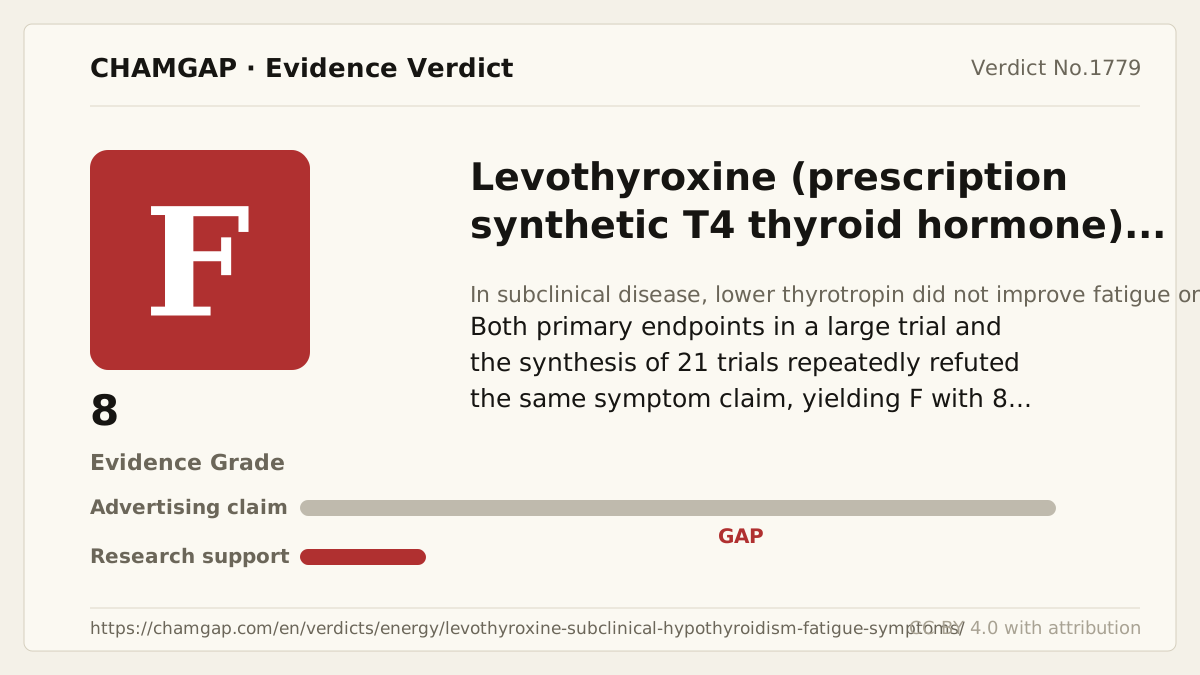
[Chamgap] Levothyroxine x improved fatigue and symptoms in subclinical hypothyroidism — Evidence Grade F·8. 2 cited sources checked. Source: https://chamgap.com/en/verdicts/energy/levothyroxine-subclinical-hypothyroidism-fatigue-symptoms/ · CC BY 4.0CC BY 4.0 — free to use with attribution; do not distort grades, numbers, or verdict meaning.
What this document does and does not do
Chamgap is an information source. It reports what research has and has not confirmed; it does not tell readers what to take or buy. That decision belongs to readers and, when needed, medical or legal professionals. This verdict reflects literature available up to the search date and may change as new research appears. Nothing here is medical advice.