
L-carnitine,
does it really help with Reduction of cancer- and treatment-related fatigue in patients with cancer?
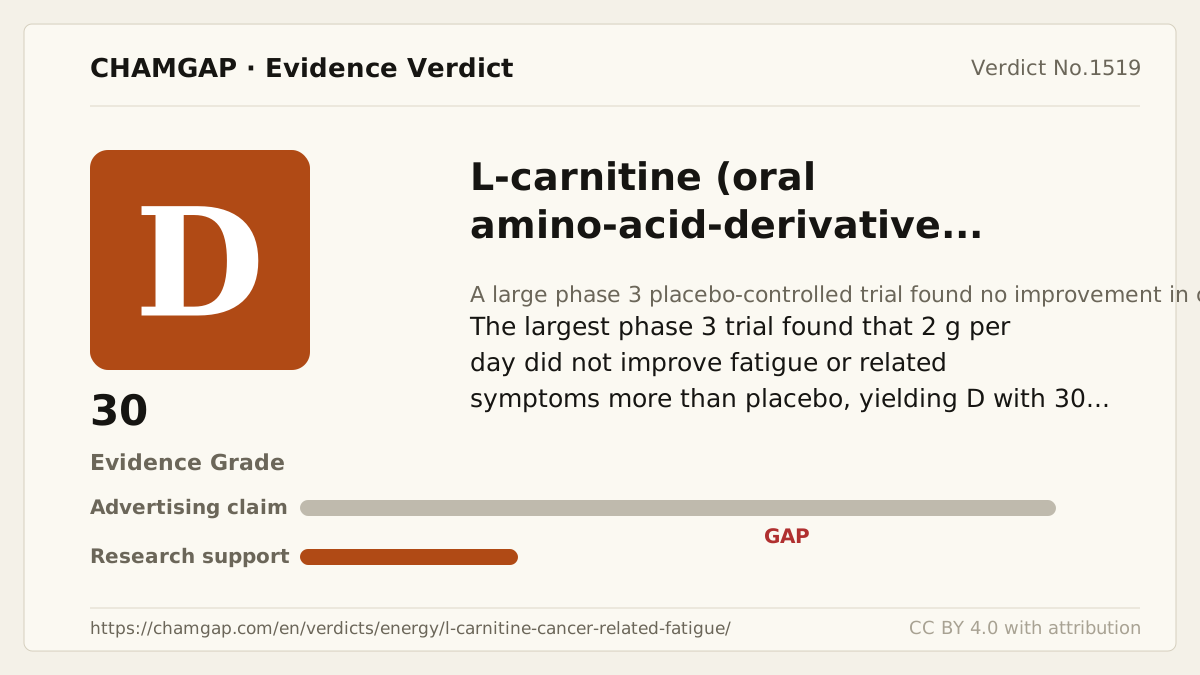
research showsL-carnitine is rated D because it did not reduce cancer- or treatment-related fatigue more than placebo. An ECOG phase 3 double-blind randomized trial gave 2 g per day for four weeks to 376 patients with moderate to severe fatigue and found no significant advantage for fatigue, depression, or pain. The subgroup with carnitine deficiency at baseline also showed no between-group benefit, while both groups improved, indicating a large placebo response. The large placebo-controlled null trial yields D with 30 points.
ads claimMarketing directly connects fatty-acid transport and cellular-energy mechanisms to relief of subjective fatigue in patients with cancer. Raising circulating carnitine and improving fatigue relative to placebo are not the same endpoint.
Useful facts when choosing a product
- L-carnitine is an amino-acid derivative involved in transporting fatty acids into mitochondria and is available as oral supplements and prescription levocarnitine products.
- The ECOG phase 3 trial used 1 g twice daily, totaling 2 g per day for four weeks, and included patients with varied invasive cancers.
- Oral use can cause nausea, abdominal cramps, diarrhea, and a fishy body odor.
- Gut-microbial production of trimethylamine N-oxide and cardiovascular risk has been studied, but the magnitude of long-term clinical harm from supplementation remains uncertain.
Chamgap Semantic Classification Code
Candidate index · review held
S.l-carnitine.oral.cancer-and-treatment-related-fatigue-with-cancer.reduce.placeboSupplements and nutraceuticals > L-carnitine > Oral > cancer- and treatment-related fatigue with cancer > Reduction claim > Placebo
An automated migration candidate, not an issued permanent code; exact claim scope remains under review. This machine-generated migration candidate helps retrieval but is not a permanent assignment. The original verdict ID and URL remain authoritative.
What the research actually shows
Early phase 1 and 2 work by Cruciani and colleagues explored safety, dosing, and symptom changes in patients with cancer, fatigue, and carnitine deficiency and reported an improvement signal. The subsequent multicenter ECOG phase 3 trial randomized 376 participants to L-carnitine at 2 g per day or placebo. Change in fatigue at four weeks was the primary outcome, and L-carnitine was not superior to placebo; depression and pain also did not differ. The NCI PDQ likewise summarizes L-carnitine as a supplement that failed to yield positive effects in a large randomized trial. This claim is distinct from body-fat or weight-loss claims and from acetyl-L-carnitine claims for cognition or neuropathy.
Why this is classified as D (30)
A 376-person multicenter phase 3 double-blind placebo-controlled trial found no between-group benefit for fatigue, depression, or pain, including in participants deficient at baseline. The large high-quality direct null trial yields D with 30 points.
Counterpoint. Correction of a medical carnitine deficiency is a separate indication and is not equivalent to proven efficacy for the symptom of cancer-related fatigue.
Rejudgment record. New verdict — Prioritized the null findings for fatigue, depression, pain, and the deficient subgroup in the 376-person multicenter ECOG phase 3 double-blind placebo-controlled trial over positive signals from an early small open-label study
Sub-claim grades by effect
This ingredient is marketed for several effects. A single overall grade blends strong and weak claims together, so each effect is graded separately here. The overall grade reflects the strongest disconfirming or core claim.
| Effect (sub-claim) | Grade | Basis |
|---|---|---|
| Reduced cancer-related fatigue | D | The 376-person phase 3 trial found no difference from placebo. |
| Reduced treatment-related fatigue | D | Efficacy was not established in the large trial that included patients receiving varied cancer treatments. |
| Improved quality of life | D | Secondary outcomes, including the fatigue-related quality-of-life instrument FACIT-F and performance status, showed no benefit over placebo. |
Cross-check — AI research and Codex final gate
Evidence Table
| Study | Design | Sample | Funding | Endpoint | Result | Weight |
|---|---|---|---|---|---|---|
| Cruciani RA et al. ECOG phase III 2012 | Multicenter phase 3 randomized double-blind placebo-controlled trial | 376 patients with cancer | ECOG cooperative study supported by the United States NCI | Four-week change in fatigue, depression, pain, and analysis of the deficient subgroup | Two grams per day did not improve fatigue, depression, or pain versus placebo, and the baseline-deficient subgroup was also null. | Pivotal large direct null trial |
| Cruciani RA et al. phase I/II 2006 | Open-label phase 1 and 2 safety and dose-finding study | 27 patients with cancer, fatigue, and carnitine deficiency | Academic and public-interest research support | Tolerability, carnitine levels, fatigue, and mood | A symptom-improvement signal appeared, but the small uncontrolled study could not separate a placebo effect. | Early exploratory signal not confirmed in phase 3 |
Receipt — 2 References
All 2 cited sources were verified for existence at the original page (as of 2026-07-23).
Final verification and publication gate: Codex · Evidence date: 2026-07-23 · Corrections: none
Cite this verdict
[Chamgap] L-carnitine x reduced cancer- and treatment-related fatigue — Evidence Grade D·30. 2 cited sources checked. Source: https://chamgap.com/en/verdicts/energy/l-carnitine-cancer-related-fatigue/ · CC BY 4.0CC BY 4.0 — free to use with attribution; do not distort grades, numbers, or verdict meaning.
What this document does and does not do
Chamgap is an information source. It reports what research has and has not confirmed; it does not tell readers what to take or buy. That decision belongs to readers and, when needed, medical or legal professionals. This verdict reflects literature available up to the search date and may change as new research appears. Nothing here is medical advice.