
Ibuprofen,
does it really help with Reduced acute mountain sickness during rapid ascent?
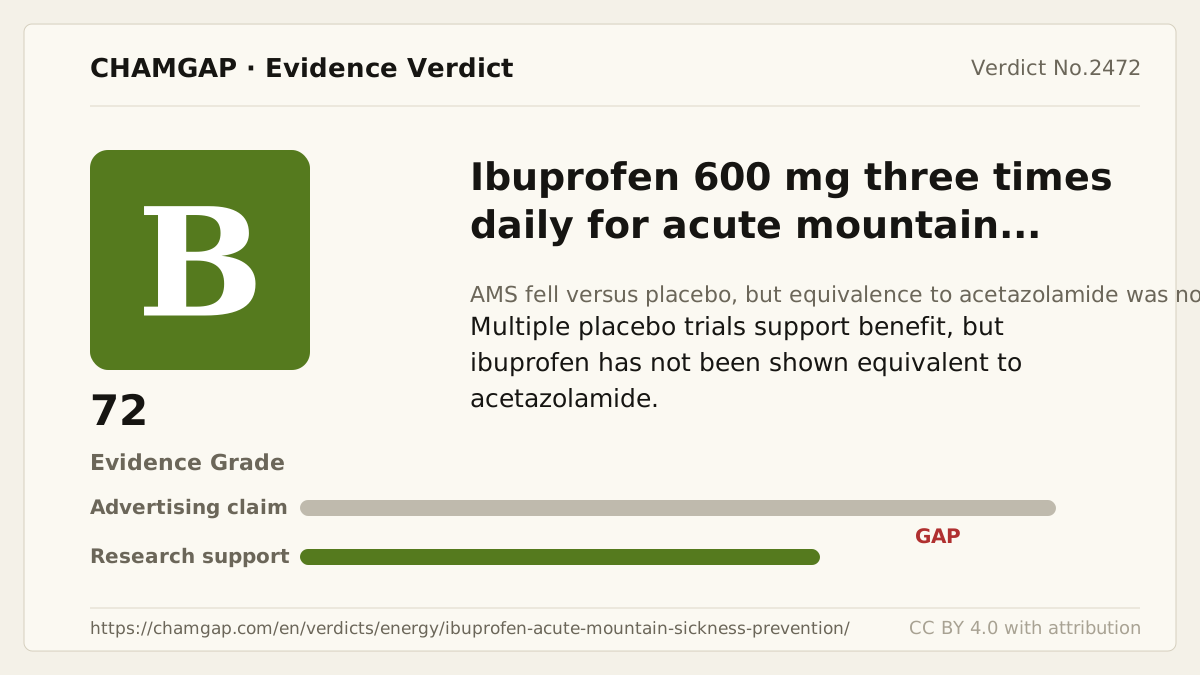
research showsThe grade is B. Placebo-controlled trials pooled 49/167 (29.3%) with ibuprofen versus 73/151 (48.3%) with placebo. ASCENT's randomized analysis was 30/123 (24.4%) versus 44/109 (40.4%), but attrition was substantial and noninferiority to acetazolamide was not shown.
ads claimIbuprofen must not be marketed as a substitute for acclimatization, stopping ascent, descent, or acetazolamide.
Useful facts when choosing a product
- Typical study dosing was 600 mg every eight hours.
- Pooled placebo-controlled incidence was 29.3% versus 48.3%.
- AMS required headache plus a Lake Louise score of at least three.
Chamgap Semantic Classification Code
Candidate index · review held
UNK.ibuprofen-three-times.UNK.acute-mountain-sickness-during-rapid-ascent.reduce.placeboUnknown > Ibuprofen three times > Unknown > acute mountain sickness during rapid ascent > Reduction claim > Placebo
An automated migration candidate, not an issued permanent code; exact claim scope remains under review. This machine-generated migration candidate helps retrieval but is not a permanent assignment. The original verdict ID and URL remain authoritative.
What the research actually shows
ASCENT recruited 294 Western trekkers at Pheriche, 4280 m, or Dingboche, 4358 m, on the Everest approach and followed continued ascent to Lobuche, 4928 m. Ibuprofen 600 mg three times daily began with at least three doses over 18 to 24 hours before ascent and continued during ascent. HEAT was a separate three-arm trial that recruited 343 trekkers at 4280 or 4358 m and compared ibuprofen 600 mg, acetazolamide 85 mg, or placebo three times daily during continued ascent to 4928 m. The White Mountain trial rapidly ascended from 1240 m to 3810 m and gave the first dose six hours before ascent. AMS meant a Lake Louise score of at least three including headache. ISRCTN91790322 registered ASCENT, and the registered AMS incidence and severity outcomes matched the paper.
Why this is classified as B (72)
Lower incident AMS without qualifying independent replication, with important ASCENT attrition, gives B with 72 points. ASCENT support was from Wellcome Trust, UK.
Counterpoint. Prevention of HAPE or HACE was not established.
Rejudgment record. Cross-check applied — Lower AMS incidence without qualifying independent replication, with ASCENT attrition; funding was Wellcome Trust, UK
| Endpoint | H | Hard endpoint - actual events such as death |
| Replication | R1 | Single confirmatory trial |
| Independence | I2 | Decisive evidence is publicly or non-profit funded |
| Effect size | E+ | Meets the clinically important threshold |
Stored derived and displayed grades match; this is not a current recalculation or validity check (B).
Sub-claim grades by effect
This ingredient is marketed for several effects. A single overall grade blends strong and weak claims together, so each effect is graded separately here. The overall grade reflects the strongest disconfirming or core claim.
| Effect (sub-claim) | Grade | Basis |
|---|---|---|
| AMS prevention versus placebo | B | Multiple trials found lower absolute incidence. |
| Equivalent to acetazolamide | D | The direct noninferiority trial did not succeed. |
Cross-check — AI research and Codex final gate
Evidence Table
| Study | Design | Sample | Funding | Endpoint | Result | Weight |
|---|---|---|---|---|---|---|
| Gertsch et al. ASCENT 2012 | Double-blind placebo-controlled randomized trial | 294 randomized; randomized analysis 232 (123/109); 183 completers | Wellcome Trust, UK | AMS defined as Lake Louise score at least 3 including headache | 30/123 (24.4%) vs 44/109 (40.4%), P=.01 | Key placebo-controlled evidence |
| Bhattachar et al. 2024 | Triple-blind ibuprofen, acetazolamide, and placebo trial | 304 analyzed (102/99/103) | Armed Forces Medical Research Committee, India | AMS with Lake Louise score at least 3 | Ibuprofen 5% vs placebo 13%, RR 0.39 (0.14-1.04) | Recent publicly funded supportive evidence |
Receipt — 3 References
All 3 cited sources were verified for existence at the original page (as of 2026-08-08).
Final verification and publication gate: Codex · Evidence date: 2026-08-08 · Corrections: none
Cite this verdict
[Chamgap] Ibuprofen x prevention of acute mountain sickness — Evidence Grade B·72. 3 cited sources checked. Source: https://chamgap.com/en/verdicts/energy/ibuprofen-acute-mountain-sickness-prevention/ · CC BY 4.0CC BY 4.0 — free to use with attribution; do not distort grades, numbers, or verdict meaning.
What this document does and does not do
Chamgap is an information source. It reports what research has and has not confirmed; it does not tell readers what to take or buy. That decision belongs to readers and, when needed, medical or legal professionals. This verdict reflects literature available up to the search date and may change as new research appears. Nothing here is medical advice.