
Home long-term NIV,
does it really help with Delayed readmission or death in patients with persistent hypercapnia after an acute COPD exacerbation?
research showsHome long-term NIV is graded C because one pivotal randomized trial delayed readmission or death in selected patients whose hypercapnia persisted after stabilization from an acute COPD exacerbation, while synthesis and mortality-only results are inconsistent. In the 116-patient HOT-HMV trial, adding NIV to oxygen increased the median time to the composite endpoint from 1.4 to 4.3 months, with an adjusted HR of 0.49, but 12-month deaths were 16 versus 19. The RESCUE trial using an earlier hypercapnia assessment did not reduce readmission or death, and pooled randomized evidence after a recent exacerbation did not significantly reduce mortality. This verdict concerns long-term post-discharge home treatment and does not borrow evidence from acute inpatient NIV or CPAP for sleep apnea.
ads claimDevice promotion can extend carbon-dioxide reduction into a survival claim for all people with COPD. The direct positive evidence applies to a narrow group with severe hypercapnia and an oxygen indication still present two to four weeks after stabilization.
Useful facts when choosing a product
- Home long-term NIV is a prescribed device treatment that supplies different inspiratory and expiratory pressures through a mask and can include a backup respiratory rate.
- Median HOT-HMV settings were inspiratory pressure 24 cm H2O, expiratory pressure 4 cm H2O, and a backup rate of 14 breaths per minute, used with home oxygen.
- HOT-HMV enrolled patients with PaCO2 above 53 mm Hg two to four weeks after resolution of acute acidosis and excluded obesity, obstructive sleep apnea, and other causes of respiratory failure.
- Mask pressure, air leak, nasal or oral dryness, abdominal bloating, sleep disruption, and reduced adherence can occur; equipment fitting and follow-up are components of treatment.
Chamgap Semantic Classification Code
Candidate index · review held
P.home-long-term-noninvasive-ventilation.device.delayed-readmission-or-death-with-persistent-hypercapnia-after-an-acute-copd-exacerbation.reduce.usual-careProcedures, devices and tests > Home long-term noninvasive ventilation > Device delivered > Delayed readmission or death with persistent hypercapnia after an acute COPD exacerbation > Reduction claim > Usual care
An automated migration candidate, not an issued permanent code; exact claim scope remains under review. This machine-generated migration candidate helps retrieval but is not a permanent assignment. The original verdict ID and URL remain authoritative.
What the research actually shows
Murphy and colleagues randomized 116 patients at 13 United Kingdom centers whose PaCO2 remained above 53 mm Hg two to four weeks after resolution of respiratory acidemia to oxygen alone or oxygen plus home NIV. Median time to readmission or death was 1.4 versus 4.3 months, adjusted HR 0.49 (95% CI 0.31 to 0.77; P=.002), and 12-month risks were 80.4% versus 63.4%. Deaths were 19 versus 16, leaving mortality alone unresolved. The 201-patient RESCUE trial found no improvement in readmission or death with nocturnal NIV when hypercapnia was assessed more rapidly after ventilatory support. A 2022 global review pooled nine post-hospital randomized trials and found a nonsignificant mortality RR of 0.78 (95% CI 0.60 to 1.03).
Why this is classified as C (55)
HOT-HMV provided a direct hard composite benefit with adjusted HR 0.49 (95% CI 0.31 to 0.77). Mortality alone was unresolved, RESCUE was null, and pooled mortality after recent hospitalization was nonsignificant, with strong dependence on the timing and threshold of persistent hypercapnia; the conflict and restricted-population rules therefore give C with 55 points.
Counterpoint. This verdict excludes the separate evidence for inpatient NIV during acute hypercapnic COPD exacerbations and CPAP for obstructive sleep apnea.
Rejudgment record. New verdict — Accepted the HOT-HMV hard composite benefit in a selected post-discharge persistent-hypercapnia population while applying the conflict and restricted-population rules because RESCUE was null, pooled post-hospital randomized mortality was null, mortality alone was uncertain, and effects depended on patient selection
Sub-claim grades by effect
This ingredient is marketed for several effects. A single overall grade blends strong and weak claims together, so each effect is graded separately here. The overall grade reflects the strongest disconfirming or core claim.
| Effect (sub-claim) | Grade | Basis |
|---|---|---|
| Delayed readmission or death after a COPD exacerbation in persistent hypercapnia | C | HOT-HMV was positive, but RESCUE and pooled evidence were inconsistent and selection criteria strongly influenced the result. |
| Reduction in mortality alone | C | HOT-HMV recorded 16 versus 19 deaths, and pooled post-hospital randomized mortality was RR 0.78 (95% CI 0.60 to 1.03). |
| Reduction in hospital admissions | C | Some trials and syntheses show a reduction signal, but heterogeneity is substantial and separation from the composite effect is difficult. |
Cross-check — AI research and Codex final gate
Evidence Table
| Study | Design | Sample | Funding | Endpoint | Result | Weight |
|---|---|---|---|---|---|---|
| Murphy PB et al. 2017 HOT-HMV | Multicenter randomized oxygen-therapy-controlled trial | 116 patients with persistent hypercapnia two to four weeks after stabilization from a COPD exacerbation | Unrestricted research funding and equipment support from Philips Respironics; multiple device-company relationships disclosed | Time to first readmission or death within 12 months | Median 4.3 versus 1.4 months, adjusted HR 0.49 (95% CI 0.31 to 0.77; P=.002); 16 versus 19 deaths at 12 months. | Pivotal positive randomized hard-composite evidence |
| Struik FM et al. 2014 RESCUE | Multicenter randomized parallel-group controlled trial | 201 patients with COPD and hypercapnia after ventilatory support for acute respiratory failure | Support reported from the Netherlands Lung Foundation and device companies | Readmission or death at one year | Nocturnal NIV did not significantly reduce readmission or death versus standard care. | Direct conflicting randomized evidence |
| Dretzke J et al. 2022 global systematic review | Systematic review and meta-analysis of randomized and nonrandomized home-NIV studies | Nine randomized trials in the post-hospital mortality analysis | A noncommercial grant from ResMed and Philips; no funder role in design, analysis, or the manuscript was reported | Mortality and hospitalization | Post-hospital randomized mortality was nonsignificant, RR 0.78 (95% CI 0.60 to 1.03). | Key null integrated evidence |
Receipt — 3 References
All 3 cited sources were verified for existence at the original page (as of 2026-07-23).
Final verification and publication gate: Codex · Evidence date: 2026-07-23 · Corrections: none
Cite this verdict
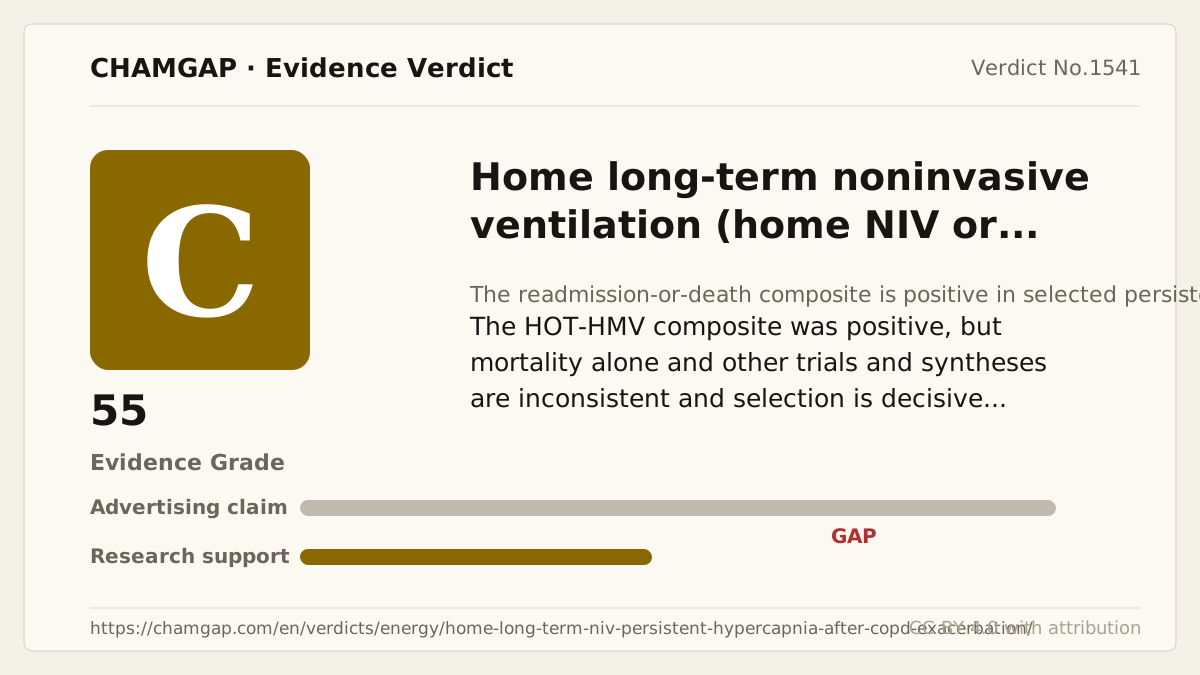
[Chamgap] Home long-term NIV x delayed readmission or death after an acute COPD exacerbation — Evidence Grade C·55. 3 cited sources checked. Source: https://chamgap.com/en/verdicts/energy/home-long-term-niv-persistent-hypercapnia-after-copd-exacerbation/ · CC BY 4.0CC BY 4.0 — free to use with attribution; do not distort grades, numbers, or verdict meaning.
What this document does and does not do
Chamgap is an information source. It reports what research has and has not confirmed; it does not tell readers what to take or buy. That decision belongs to readers and, when needed, medical or legal professionals. This verdict reflects literature available up to the search date and may change as new research appears. Nothing here is medical advice.