
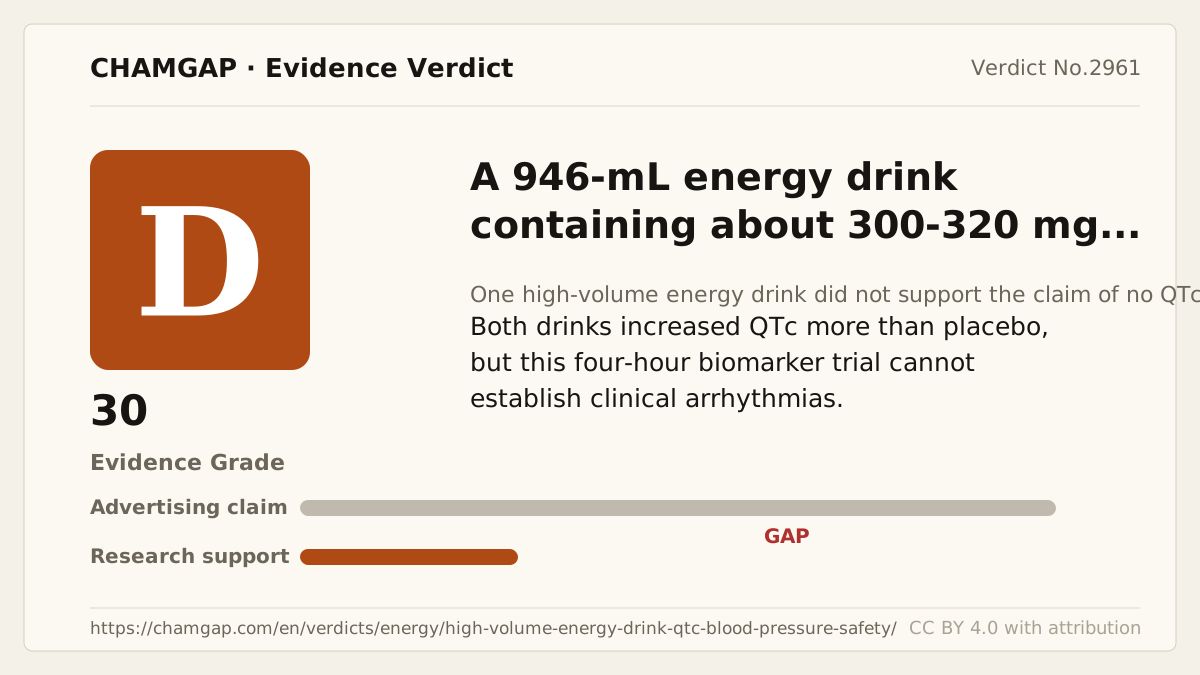
A 946-mL energy drink containing about 300-320 mg caffeine consumed within one hour,
does it really help with No adverse ECG or blood-pressure effect?
research showsGrade D. In a 34-person crossover trial, maximum Bazett-corrected QTc change was +17.9±13.9 ms with drink A, +19.6±15.8 ms with drink B, and +11.9±11.1 ms with placebo; overall P=.005, A versus placebo P=.04, and B versus placebo P<.01. The no-problem claim was not supported.
ads claimThis applies only to one high-volume exposure in healthy young adults. It cannot be extended to chronic use, one can or less, adolescents, patients, or medication users.
Useful facts when choosing a product
- The exposure was 946 mL containing about 300-320 mg caffeine within one hour.
- QTc measures delayed ventricular repolarization.
- Arrhythmia, hospitalization, and death were not tested.
Chamgap Semantic Classification Code
Candidate index · review held
F.caffeinated-energy-drink.food.MULTI.assess.placeboFoods and beverages > Caffeinated energy drink > Food consumption > Multiple: primary unresolved > Association or change assessment > Placebo
An automated migration candidate, not an issued permanent code; exact claim scope remains under review. This machine-generated migration candidate helps retrieval but is not a permanent assignment. The original verdict ID and URL remain authoritative.
What the research actually shows
NCT03196908 enrolled 34 healthy adults aged 18-40 without cardiovascular disease, hypertension, QT prolongation, or regular medication use. Each consumed drinks A and B and placebo on separate days, with measurements every 30 minutes through 240 minutes. QTc-by-time and peripheral and central systolic- and diastolic-pressure-by-time interactions were all P<.001. The paper did not report 95% confidence intervals for between-condition differences. Power assumed a 10-ms QTc mean difference, but without an interval for a between-condition difference exceeding 10 ms this was not used as an exclusion threshold. The University of the Pacific supported the study; no energy-drink-company funding was reported. Sachin A. Shah disclosed prior expert-witness work in caffeine energy-drink litigation. Commercial drinks were prepared by investigators in identical containers.
Why this is classified as D (30)
A publicly supported trial found adverse QTc and pressure signals, but independent QTc replication is limited and the study was small and brief, giving D with 30 points.
Counterpoint. QTc prolongation is not the same as a demonstrated clinical arrhythmia.
Rejudgment record. Cross-check applied — Adverse placebo-controlled primary QTc result, limited independent QTc replication, and a 34-person four-hour design
| Endpoint | S | Surrogate marker - laboratory or imaging measures |
| Replication | R1 | Single confirmatory trial |
| Independence | I2 | Decisive evidence is publicly or non-profit funded |
| Effect size | E- | Harm increased in the trials |
| Precision | C0 | The confidence interval leaves room for benefit |
Stored derived and displayed grades match; this is not a current recalculation or validity check (D).
Sub-claim grades by effect
This ingredient is marketed for several effects. A single overall grade blends strong and weak claims together, so each effect is graded separately here. The overall grade reflects the strongest disconfirming or core claim.
| Effect (sub-claim) | Grade | Basis |
|---|---|---|
| No QTc or blood-pressure effect | D | QTc and blood-pressure trajectories differed from placebo. |
| Increased clinical arrhythmia | ? | The four-hour trial did not test clinical arrhythmia. |
Cross-check — AI research and Codex final gate
Evidence Table
| Study | Design | Sample | Funding | Endpoint | Result | Weight |
|---|---|---|---|---|---|---|
| Shah SA et al. 2019 | Randomized double-masked placebo-controlled crossover trial | 34 healthy adults | Supported by the University of the Pacific; no energy-drink-company funding reported | Bazett- and Fridericia-corrected QTc | Maximum Bazett-QTc change: A +17.9±13.9 ms, B +19.6±15.8 ms, placebo +11.9±11.1 ms; overall P=.005 | Pivotal direct trial |
Receipt — 2 References
All 2 cited sources were verified for existence at the original page (as of 2026-08-26).
Final verification and publication gate: Codex · Evidence date: 2026-08-26 · Corrections: none
Cite this verdict
[Chamgap] Harm of High-Volume Energy Drinks for QTc and Blood Pressure — Evidence Grade D·30. 2 cited sources checked. Source: https://chamgap.com/en/verdicts/energy/high-volume-energy-drink-qtc-blood-pressure-safety/ · CC BY 4.0CC BY 4.0 — free to use with attribution; do not distort grades, numbers, or verdict meaning.
What this document does and does not do
Chamgap is an information source. It reports what research has and has not confirmed; it does not tell readers what to take or buy. That decision belongs to readers and, when needed, medical or legal professionals. This verdict reflects literature available up to the search date and may change as new research appears. Nothing here is medical advice.