
High-dose intravenous vitamin C,
does it really help with Reduced temporary fatigue in healthy office workers?
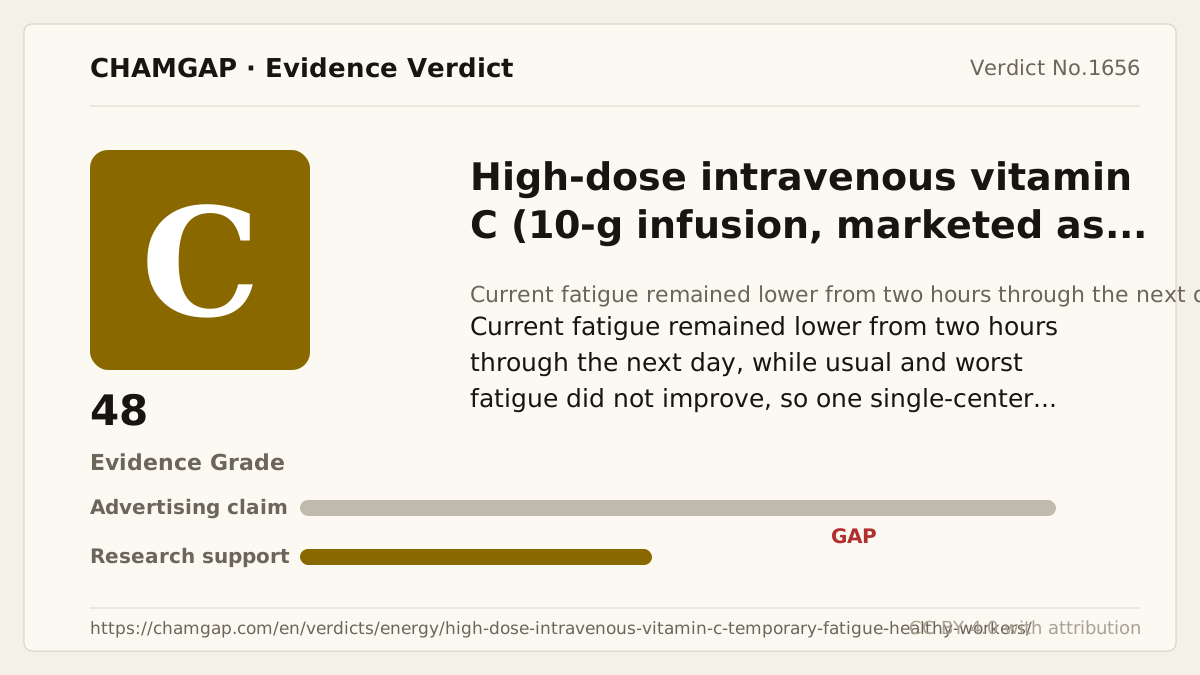
research showsHigh-dose intravenous vitamin C is rated C because one randomized trial found that current fatigue in healthy office workers was lower from two hours after infusion through the next day. Of 147 randomized participants, 141 were included in the main analysis. The time-by-group effect for current-fatigue NRS succeeded at P=.004, whereas usual fatigue and worst fatigue did not differ significantly. This was a single-center, one-day trial without independent replication, supporting C with 48 points.
ads claimIn Korea it is widely sold as a fatigue-recovery, vitamin-recharge, or instant-energy infusion. Direct evidence is limited to one single-dose 10-g study in which current fatigue remained lower from two hours through the next day; usual fatigue, worst fatigue, and long-term benefit from repeated infusions remain unproven.
Useful facts when choosing a product
- The pivotal trial infused 10 g of vitamin C in 100 mL of saline as a single intervention; this exposure is not equivalent to ordinary oral vitamin C.
- The directly studied population was apparently healthy full-time workers aged 20 to 49 years, not people with myalgic encephalomyelitis, cancer-related fatigue, or post-infectious fatigue.
- Intravenous administration is a medical procedure, and kidney disease, stone or hyperoxaluria risk, and glucose-6-phosphate dehydrogenase deficiency require assessment beforehand.
- High-dose intravenous vitamin C can cause oxalate nephropathy or stones, and severe hemolysis has been reported in glucose-6-phosphate dehydrogenase deficiency.
Chamgap Semantic Classification Code
Candidate index · review held
M.vitamin-c.intravenous.temporary-fatigue.reduce.placeboMedicinal interventions > Vitamin C > Intravenous > Temporary fatigue > Reduction claim > Placebo
An automated migration candidate, not an issued permanent code; exact claim scope remains under review. This machine-generated migration candidate helps retrieval but is not a permanent assignment. The original verdict ID and URL remain authoritative.
What the research actually shows
A Korean double-blind randomized trial assigned 147 healthy full-time office workers to intravenous vitamin C 10 g or saline and analyzed 141 participants, 70 and 71 respectively. Fatigue NRS was assessed before infusion, two hours later, and the next day. Current fatigue remained lower from two hours through the next day and the time-by-group effect succeeded at P=.004, while usual-fatigue and worst-fatigue items on the same instrument were nonsignificant. A 2021 systematic review assembled intravenous-vitamin-C fatigue studies but found heterogeneous diseases, doses, and cointerventions and supplied no independent confirmatory trial of a single 10-g dose in healthy workers.
Why this is classified as C (48)
Current-fatigue NRS remained lower from two hours through the next day and succeeded at P=.004 in 141 analyzed participants, but usual and worst fatigue on the same instrument were nonsignificant. This was one single-center, one-day trial without independent confirmation, so rule ①-ⓒ supports C with 48 points.
Counterpoint. A tired healthy adult may experience subjective relief through the next day, but the infusion does not replace evaluation of sleep loss, anemia, thyroid disease, depression, infection, or other causes.
Rejudgment record. Cross-check applied — Accepted that current fatigue remained lower from two hours through the next day but applied rule ①-ⓒ because usual and worst fatigue on the same instrument were null, only 141 were analyzed in a single-center trial, follow-up lasted one day, and no independent confirmation exists
Sub-claim grades by effect
This ingredient is marketed for several effects. A single overall grade blends strong and weak claims together, so each effect is graded separately here. The overall grade reflects the strongest disconfirming or core claim.
| Effect (sub-claim) | Grade | Basis |
|---|---|---|
| Reduced current fatigue from two hours after infusion through the next day | C | In 141 analyzed participants, current fatigue remained lower from two hours through the next day and the time-by-group effect succeeded at P=.004, but this was a single-center trial with one-day follow-up. |
| Reduced usual fatigue | D | The usual-fatigue item was nonsignificant in the same randomized trial, so efficacy was not demonstrated. |
| Reduced worst fatigue | D | The worst-fatigue item was nonsignificant in the same randomized trial, so efficacy was not demonstrated. |
Cross-check — AI research and Codex final gate
Evidence Table
| Study | Design | Sample | Funding | Endpoint | Result | Weight |
|---|---|---|---|---|---|---|
| Suh SY et al. 2012 | Korean single-center randomized double-blind saline-controlled trial | 147 randomized (74/73); actual main analysis 141 (70/71) | Dongguk University research funding; no manufacturer funding reported | Changes in current, usual, and worst fatigue NRS at two hours and the next day | Current fatigue remained lower from two hours through the next day and the time-by-group effect succeeded at P=.004, while usual and worst fatigue on the same instrument were nonsignificant. | Key direct randomized evidence, but single, one-day, and only partially positive |
| Vollbracht C and Kraft K. 2021 | Systematic review and feasibility analysis of intravenous vitamin C for fatigue | Nine clinical studies across conditions; the Suh trial was the sole direct randomized study in healthy workers | The first author was affiliated with Pascoe Pharmazeutische Präparate GmbH | Fatigue and quality of life across multiple conditions | Described positive signals, but diseases, doses, and cointerventions were heterogeneous and no independent replication in healthy workers existed. | Evidence-scope and nonreplication assessment |
Receipt — 3 References
All 3 cited sources were verified for existence at the original page (as of 2026-07-24).
Final verification and publication gate: Codex · Evidence date: 2026-07-24 · Corrections: none
Cite this verdict
[Chamgap] High-dose intravenous vitamin C x reduced temporary fatigue in healthy office workers — Evidence Grade C·48. 3 cited sources checked. Source: https://chamgap.com/en/verdicts/energy/high-dose-intravenous-vitamin-c-temporary-fatigue-healthy-workers/ · CC BY 4.0CC BY 4.0 — free to use with attribution; do not distort grades, numbers, or verdict meaning.
What this document does and does not do
Chamgap is an information source. It reports what research has and has not confirmed; it does not tell readers what to take or buy. That decision belongs to readers and, when needed, medical or legal professionals. This verdict reflects literature available up to the search date and may change as new research appears. Nothing here is medical advice.