
Handheld fan to the face,
does it really help with Immediate reduction in patient-perceived breathlessness?
research showsThe grade is B. A 50-participant U.K. crossover trial found less breathlessness with airflow to the face than to the leg, P=0.003. In a 40-participant Japanese terminal-cancer trial, five-minute NRS change was -1.35 versus -0.10, and improvement of at least one point occurred in 16/20 (80%) versus 5/20 (25%). Participants cannot be kept unaware of whether airflow reaches the face or leg while preserving the same intervention, so this unavoidable lack of masking was not counted as an avoidable flaw. The single avoidable flaw is that both pivotal trials enrolled fewer than 200 participants, giving B with 68 points.
ads claimFan airflow does not deliver oxygen or treat the underlying disease. It should be described as brief symptom support, not as an alternative to oxygen or emergency treatment.
Useful facts when choosing a product
- Both trials directed fan airflow around the nose and mouth for five minutes.
- Controls received airflow to the legs, partially matching sound and air movement.
- The outcome was immediate patient-reported breathlessness, not oxygenation or survival.
Chamgap Semantic Classification Code
Candidate index · review held
UNK.of-handheld-fan-airflow-directed-across-the-nose-and-mouth-during-refractory-breathlessness.UNK.immediate-reduction-perceived-breathlessness.reduce.UNKUnknown > of handheld-fan airflow directed across the nose and mouth during refractory breathlessness > Unknown > Immediate reduction -perceived breathlessness > Reduction claim > Unknown
An automated migration candidate, not an issued permanent code; exact claim scope remains under review. This machine-generated migration candidate helps retrieval but is not a permanent assignment. The original verdict ID and URL remain authoritative.
What the research actually shows
Galbraith randomized 50 people with advanced disease to face-first or leg-first order in a crossover trial; no registration number or complete funding text was confirmed. Its primary outcome was a greater-than-1-cm fall on a 10-cm VAS. Kako randomized 40 terminal-cancer inpatients, 20 per arm, to five minutes of airflow to the face or legs. A registration number and complete funding statement were not recovered from accessible reporting.
Why this is classified as B (68)
Immediate symptom reduction and a large response-rate difference are promising. Because airflow location cannot be concealed, the unavoidable lack of masking was not counted as a flaw, and unconfirmed funding was counted only under replication and independence. Axis 6 therefore has one avoidable flaw—the two pivotal trials enrolled 50 and 40 participants, both under 200—giving B1 and the E+ strength-axis band anchor of B with 68 points.
Counterpoint. B does not establish durability or substitution for emergency treatment. It marks a large immediate symptom signal from a low-burden supportive measure.
Rejudgment record. Cross-check applied — We cross-checked randomization, the five-minute comparison, patient-reported primary outcomes, denominators, change scores, and response rates against both original records. Masking of airflow location was impossible by design and was not counted as a flaw; unconfirmed funding was confined to the replication and independence axes rather than counted twice.
| Endpoint | P | Symptom or function itself is the target - including patient reports and performance tests |
| Replication | R1 | Single confirmatory trial |
| Independence | I1 | Mixed funding sources |
| Effect size | E+ | Meets the clinically important threshold |
Stored derived and displayed grades match; this is not a current recalculation or validity check (B).
Sub-claim grades by effect
This ingredient is marketed for several effects. A single overall grade blends strong and weak claims together, so each effect is graded separately here. The overall grade reflects the strongest disconfirming or core claim.
| Effect (sub-claim) | Grade | Basis |
|---|---|---|
| Five minutes of handheld-fan airflow to the face immediately reduces refractory breathlessness. | B | Two small randomized trials were positive, and the unavoidable lack of masking was not counted as a flaw. |
| A fan replaces oxygen or treatment of the underlying cause. | ? | The selected trials assessed five-minute symptoms, not treatment substitution. |
Cross-check — AI research and Codex final gate
Evidence Table
| Study | Design | Sample | Funding | Endpoint | Result | Weight |
|---|---|---|---|---|---|---|
| Galbraith S et al., handheld-fan crossover trial 2010 | Randomized five-minute face-versus-leg crossover trial | 50 participants with advanced disease | Funding or acknowledgment text was not confirmed | Primary: greater-than-1-cm reduction on a 10-cm breathlessness VAS | Significantly greater reduction with facial than leg airflow, P=0.003; between-treatment effect and CI not confirmed in accessible reporting | Direct positive crossover signal, but small |
| Kako J et al., terminal-cancer parallel trial 2018 | Single-unit randomized five-minute face-versus-leg parallel trial | 40 randomized and analyzed, 20 per arm | Funding or acknowledgment text was not confirmed | Five-minute breathlessness NRS change and response of at least one point | -1.35 (95% CI -1.86 to -0.84) versus -0.10 (-0.53 to 0.33), P<0.001; response in 16/20 versus 5/20 | Direct terminal-cancer evidence with a large response-rate difference |
Receipt — 2 References
All 2 cited sources were verified for existence at the original page (as of 2026-08-14).
Final verification and publication gate: Codex · Evidence date: 2026-08-14 · Corrections: none
Cite this verdict
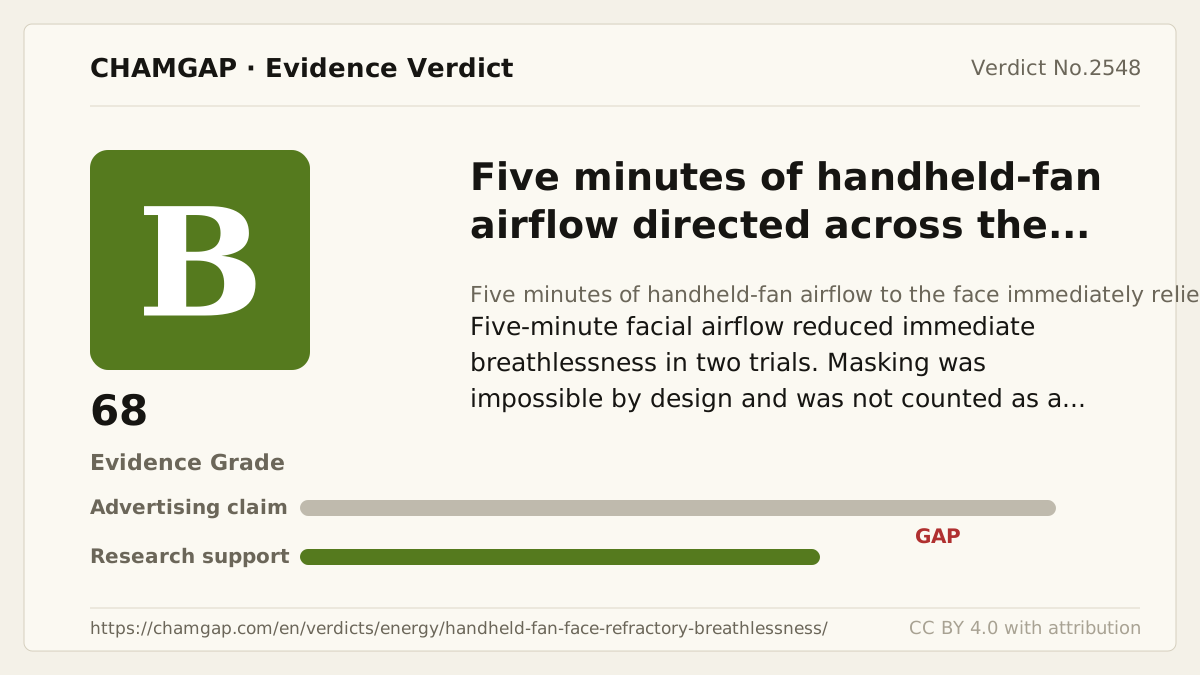
[Chamgap] Handheld fan to the face x refractory breathlessness — Evidence Grade B·68. 2 cited sources checked. Source: https://chamgap.com/en/verdicts/energy/handheld-fan-face-refractory-breathlessness/ · CC BY 4.0CC BY 4.0 — free to use with attribution; do not distort grades, numbers, or verdict meaning.
What this document does and does not do
Chamgap is an information source. It reports what research has and has not confirmed; it does not tell readers what to take or buy. That decision belongs to readers and, when needed, medical or legal professionals. This verdict reflects literature available up to the search date and may change as new research appears. Nothing here is medical advice.