
Graduated compression stockings,
does it really help with Relief of leg fatigue, discomfort, and edema in healthy people who stand for prolonged periods at work?
research showsGraduated compression stockings are rated D for relieving leg fatigue, discomfort, and edema in healthy people who stand for long periods at work. A field trial in 40 male security guards working a 12-hour shift found favorable prevention of worsening fatigue, edema, and discomfort with 15–20 or 20–30 mmHg stockings. Each group contained only about 13 participants, however, and the key evidence in a Cochrane review was a single high-risk-of-bias crossover trial in 19 female flight attendants. The evidence is too small and fragile for broad generalization to healthy workers or long-term use.
ads claimMarketing converts improved circulation into promises of no all-day fatigue, prevention of swelling in every healthy worker, or prevention of venous disease. The actual evidence measured leg volume and subjective discomfort over a work shift or in a small crossover study.
Useful facts when choosing a product
- Graduated compression is strongest at the ankle and decreases up the leg. The 15–20 and 20–30 mmHg ranges are not interchangeable, so labeling and intended pressure matter.
- Poor fit or rolling can cause skin irritation, pain, pressure marks, numbness, or a localized tourniquet effect.
- People with peripheral arterial disease or severe impaired circulation should not self-select compression without clinical assessment.
- Sudden one-sided swelling, pain, redness, or shortness of breath requires evaluation for urgent causes such as thrombosis rather than treatment as ordinary occupational fatigue.
Chamgap Semantic Classification Code
Candidate index · review held
P.graduated-compression-stockings.device.leg-fatigue-discomfort-and-edema-who-stand-for-prolonged-periods-at-work.relieve.baselineProcedures, devices and tests > Graduated compression stockings > Device delivered > leg fatigue, discomfort, and edema who stand for prolonged periods at work > Symptom-relief claim > Within-group baseline comparison
An automated migration candidate, not an issued permanent code; exact claim scope remains under review. This machine-generated migration candidate helps retrieval but is not a permanent assignment. The original verdict ID and URL remain authoritative.
What the research actually shows
Garcia and colleagues randomized 40 healthy male security guards to regular socks, 15–20 mmHg stockings, or 20–30 mmHg stockings and measured twitch force, leg volume, and discomfort before and after a 12-hour shift. Outcomes worsened with regular socks but did not significantly deteriorate within either compression group. The Robertson Cochrane review found only one eligible prospective crossover study in 19 asymptomatic female flight attendants; it suggested less fatigue but was very small and at high risk of bias, precluding a firm conclusion. Existing items 1177 on compression sportswear and 1197 on pneumatic compression boots concern exercise recovery, a different efficacy axis and use from occupational prolonged-standing fatigue and edema.
Why this is classified as D (34)
A 40-guard trial and a 19-flight-attendant crossover study provide favorable short-term signals, but tiny samples, risk of bias, narrow occupations and sex representation, and no long-term evidence give D with 34 points.
Counterpoint. A properly sized lower-pressure product can be tested for individual symptom relief, but it does not replace movement, breaks, footwear adjustment, or evaluation of an underlying cause.
Rejudgment record. New verdict — Recorded the favorable direction of a 40-worker field randomized trial, but applied D for small and low-quality evidence because the key Cochrane base was one high-risk-of-bias 19-person crossover study with poor replication, precision, generalizability, and long-term coverage
Sub-claim grades by effect
This ingredient is marketed for several effects. A single overall grade blends strong and weak claims together, so each effect is graded separately here. The overall grade reflects the strongest disconfirming or core claim.
| Effect (sub-claim) | Grade | Basis |
|---|---|---|
| Relief of leg fatigue and discomfort in healthy prolonged-standing workers | D | Small occupational signals are favorable, but replication and generalizability are poor. |
| Relief of leg edema in healthy prolonged-standing workers | D | There is a signal for preventing increased leg volume, but each group was very small. |
| Long-term prevention of occupational leg symptoms with compression stockings | D | Long-term prevention, quality of life, absence, and productivity outcomes are not established. |
Cross-check — AI research and Codex final gate
Evidence Table
| Study | Design | Sample | Funding | Endpoint | Result | Weight |
|---|---|---|---|---|---|---|
| Garcia MG et al. 2023 | Randomized three-group occupational field trial | 40 healthy male security guards over a 12-hour shift | Non-United States government research support | Muscle fatigue, leg-volume edema, and discomfort | Outcomes worsened with regular socks but did not significantly deteriorate within the 15–20 or 20–30 mmHg groups. | Direct but very small |
| Robertson L et al. 2013 Cochrane review | Systematic review | One eligible study with 19 female flight attendants | Cochrane academic review | Occupational venous symptoms and fatigue | Stockings possibly improved fatigue, but evidence was extremely small, high-risk-of-bias, and insufficient for conclusions. | Key evidence limitation |
Receipt — 2 References
All 2 cited sources were verified for existence at the original page (as of 2026-07-23).
Final verification and publication gate: Codex · Evidence date: 2026-07-23 · Corrections: none
Cite this verdict
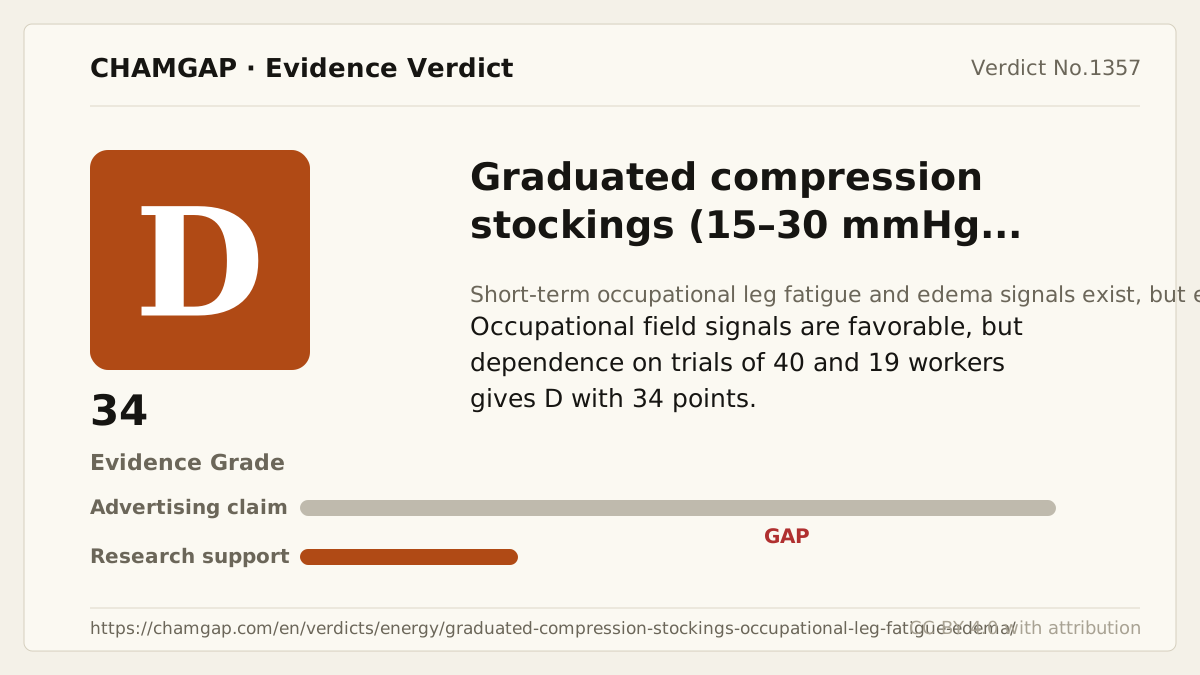
[Chamgap] Graduated compression stockings x Relief of leg fatigue, discomfort, and edema in healthy people who stand for prolonged periods at work — Evidence Grade D·34. 2 cited sources checked. Source: https://chamgap.com/en/verdicts/energy/graduated-compression-stockings-occupational-leg-fatigue-edema/ · CC BY 4.0CC BY 4.0 — free to use with attribution; do not distort grades, numbers, or verdict meaning.
What this document does and does not do
Chamgap is an information source. It reports what research has and has not confirmed; it does not tell readers what to take or buy. That decision belongs to readers and, when needed, medical or legal professionals. This verdict reflects literature available up to the search date and may change as new research appears. Nothing here is medical advice.