
Erythropoiesis-stimulating agents to correct anemia during radiotherapy,
does it really help with Improved locoregional tumor control in head and neck squamous-cell carcinoma?
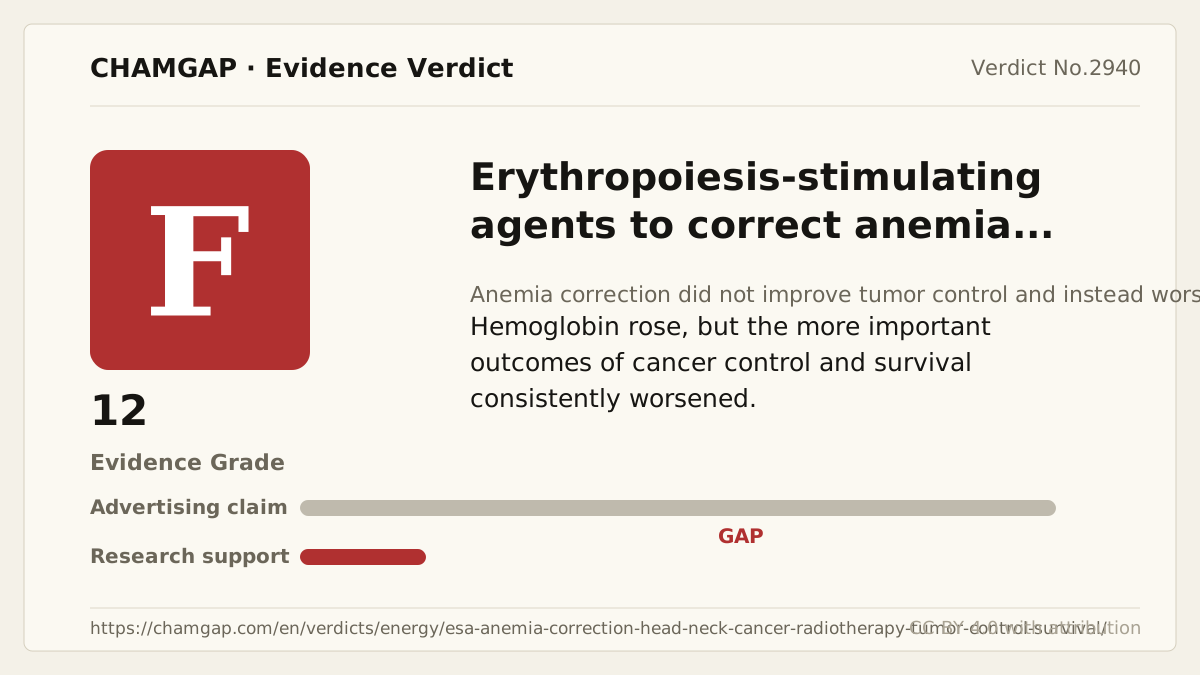
research showsGrade F. In DAHANCA 10, the lower-is-better five-year cumulative locoregional failure rate was 47% with darbepoetin versus 34% in controls, HR 1.53 (95% CI 1.16 to 2.02), significantly worse with darbepoetin. Event-free survival, disease-specific death, and overall death all moved in the same harmful direction, while earlier independent trials and a five-trial review repeatedly refuted benefit.
ads claimConverting hemoglobin correction into improved tumor oxygenation and treatment efficacy contradicts randomized evidence. The FDA boxed warning also states that ESAs may shorten survival or increase tumor progression or recurrence in cancer, including head and neck cancer. Context matters: verdict 2925 is B with 72 points for darbepoetin reducing transfusions in very-low-birth-weight preterm infants.
Useful facts when choosing a product
- DAHANCA 10 included patients with hemoglobin below 14.0 g/dL and used weekly darbepoetin during radiotherapy.
- The trial stopped at 522 rather than the planned 600 after a planned interim analysis showed inferiority of the experimental arm.
- It was open label and did not uniformly use central blinded imaging review for locoregional failure.
Chamgap Semantic Classification Code
Candidate index · review held
P.erythropoiesis-stimulating-agents-to-correct-anemia-during-radiotherapy.UNK.locoregional-tumor-control-in-head-and-neck-squamous-cell-carcinoma.improve.placeboProcedures, devices and tests > Erythropoiesis-stimulating agents to correct anemia during radiotherapy > Unknown > locoregional tumor control in head and neck squamous-cell carcinoma > Improvement claim > Placebo
An automated migration candidate, not an issued permanent code; exact claim scope remains under review. This machine-generated migration candidate helps retrieval but is not a permanent assignment. The original verdict ID and URL remain authoritative.
What the research actually shows
Four lines of evidence in the same indication converge. ① ENHANCE randomized 351 patients and worsened its primary locoregional progression-free survival endpoint with epoetin beta: adjusted RR 1.62 (95% CI 1.22 to 2.14; P=.0008), with survival RR 1.39 (1.05 to 1.84). ② RTOG 99-03 randomized 148 patients and found no epoetin alfa benefit: three-year locoregional failure 44% versus 36% (P=.56), long-term five-year failure 46.2% versus 39.4% (P=.42), and overall survival 36.9% versus 38.2% (P=.54). ③ Independent Danish and Norwegian investigators again found significant harm in DAHANCA 10. ④ A review of five RCTs and 1,397 patients found radiotherapy plus EPO worse than radiotherapy alone for overall survival, Peto OR 0.73 (95% CI 0.58 to 0.91), and locoregional progression-free survival, OR 0.63 (0.49 to 0.80). DAHANCA 10 stopped at 522 of a planned 600 after a planned interim analysis showed inferiority of the experimental arm, was open label, and did not uniformly use central blinded imaging review for locoregional failure. The Danish Cancer Society and Amgen funded it; Amgen supplied free drug and mainly paid GCP and quality-control costs. The investigator-driven trial reports no Amgen involvement in design, conduct, collection, or analysis, and says the company offered no manuscript comments.
Why this is classified as F (12)
Independent randomized trials of three different erythropoiesis-stimulating agents repeatedly failed to show benefit in the same head-and-neck radiotherapy setting, and DAHANCA 10 found significant harm on primary tumor control and several survival endpoints, giving F with 12 points. Early stopping at a planned interim analysis and open-label assessment were also counted as design flaws.
Counterpoint. This verdict is limited to the claim of improved tumor control during cancer radiotherapy. Results for erythropoiesis-stimulating agents in other populations and for other goals, such as anemia of kidney disease or reducing transfusions in preterm infants, are not merged into it.
Rejudgment record. Cross-check applied — Repeated refutation across ENHANCE, RTOG 99-03, DAHANCA 10, and a five-RCT review, with significant harm in DAHANCA 10
| Endpoint | H | Hard endpoint - actual events such as death |
| Replication | RX | Repeatedly refuted in the same indication |
| Independence | I1 | Mixed funding sources |
| Effect size | E- | Harm increased in the trials |
| Precision | C0 | The confidence interval leaves room for benefit |
Stored derived and displayed grades match; this is not a current recalculation or validity check (F).
Sub-claim grades by effect
This ingredient is marketed for several effects. A single overall grade blends strong and weak claims together, so each effect is graded separately here. The overall grade reflects the strongest disconfirming or core claim.
| Effect (sub-claim) | Grade | Basis |
|---|---|---|
| Improved locoregional tumor control | F | Five-year failure worsened to 47% versus 34%. |
| Improved survival | F | Disease-specific and overall death both significantly favored harm. |
Cross-check — AI research and Codex final gate
Evidence Table
| Study | Design | Sample | Funding | Endpoint | Result | Weight |
|---|---|---|---|---|---|---|
| Overgaard J et al. 2018 DAHANCA 10 | Multicenter open-label randomized phase 3 trial | 522 randomized and 513 evaluable, 254 versus 259 | Danish Cancer Society grant; Amgen grant and free Aranesp | Primary time to locoregional failure and five-year cumulative locoregional failure | Five-year 47% vs 34%, HR 1.53 (95% CI 1.16-2.02); event-free survival HR 1.36, disease-specific death HR 1.43, overall death HR 1.30 | Pivotal independent repeated harm evidence |
| Henke M et al. 2003 ENHANCE | Multicenter randomized double-blind placebo-controlled trial | 351 patients, 180 epoetin beta and 171 placebo, intention to treat | Supported by F. Hoffmann-La Roche | Primary locoregional progression-free survival | Adjusted RR 1.62 (95% CI 1.22-2.14), P=.0008; survival RR 1.39 (1.05-1.84) | Earlier significant harm evidence |
| Machtay M et al. RTOG 99-03 and long-term follow-up | Reports from the same multicenter randomized phase 3 trial | 148 randomized | National Cancer Institute and Ortho Biotech support | Locoregional failure and overall survival | Three-year failure 44% vs 36%, P=.56; five-year 46.2% vs 39.4%, P=.42; OS 36.9% vs 38.2%, P=.54 | Independent repeated null evidence |
| Bohlius J et al. 2009 systematic review | Systematic review and meta-analysis of five randomized trials | Five RCTs and 1,397 patients | Cochrane review; included trials had mixed public and company funding | Overall survival and locoregional progression-free survival | OS Peto OR 0.73 (95% CI 0.58-0.91) and locoregional PFS OR 0.63 (0.49-0.80), favoring radiotherapy alone | Synthesis of repeated refutation |
Receipt — 5 References
All 5 cited sources were verified for existence at the original page (as of 2026-08-26).
Final verification and publication gate: Codex · Evidence date: 2026-08-26 · Corrections: none
Cite this verdict
[Chamgap] Harm of Erythropoiesis-Stimulating-Agent Anemia Correction for Tumor Control and Survival in Head-and-Neck Radiotherapy — Evidence Grade F·12. 5 cited sources checked. Source: https://chamgap.com/en/verdicts/energy/esa-anemia-correction-head-neck-cancer-radiotherapy-tumor-control-survival/ · CC BY 4.0CC BY 4.0 — free to use with attribution; do not distort grades, numbers, or verdict meaning.
What this document does and does not do
Chamgap is an information source. It reports what research has and has not confirmed; it does not tell readers what to take or buy. That decision belongs to readers and, when needed, medical or legal professionals. This verdict reflects literature available up to the search date and may change as new research appears. Nothing here is medical advice.