
CPAP,
does it really help with Improvement in daytime sleepiness, daily functioning, and quality of life in obstructive sleep apnea?
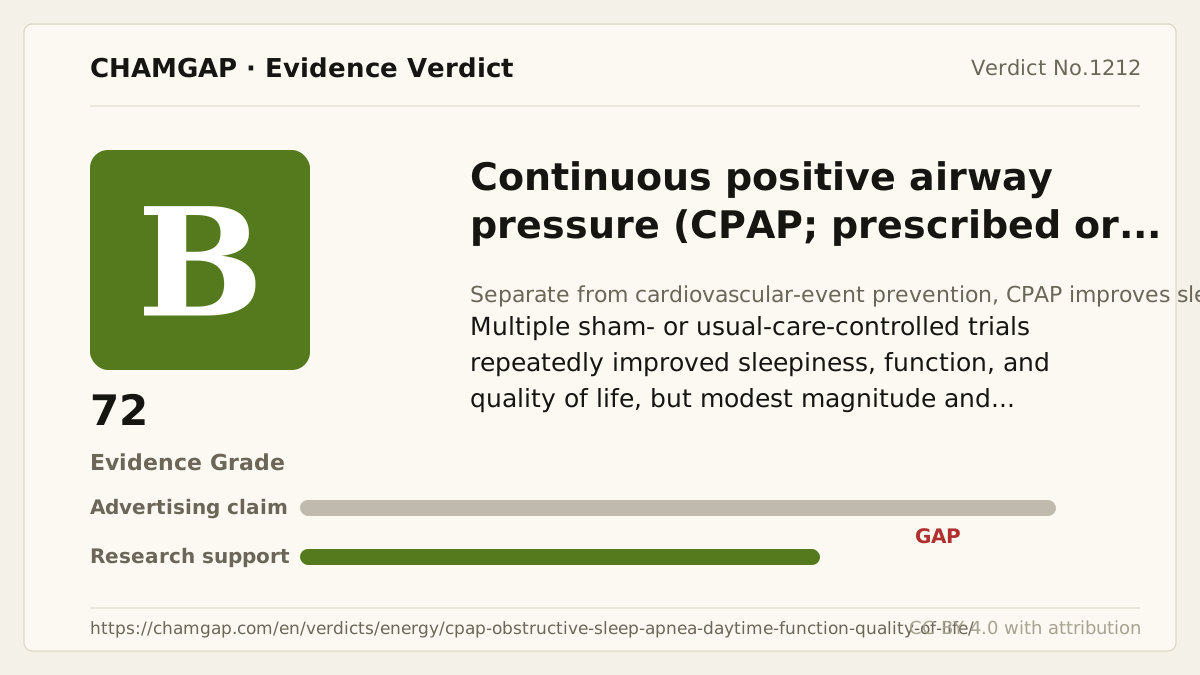
research showsCPAP is rated B because it produces small but consistent improvements in daytime sleepiness, daily functioning, and quality of life in obstructive sleep apnea. Although the cardiovascular primary endpoint was null in 2,717 SAVE participants, CPAP improved Epworth daytime-sleepiness scores by about 2.5 points and improved health-related quality of life and mood. In 239 sleepy participants with mild-to-moderate OSA in CATNAP, the eight-week Functional Outcomes of Sleep Questionnaire total score improved versus sham CPAP, with an effect size of 0.41. Another sham-controlled trial found improvement not only in subjective sleepiness but also in objective wakefulness and several quality-of-life domains. Average effects are not large and depend on actual nightly use, yielding B with 72 points. This is a symptom-treatment axis and does not conflict with verdict 1179, which rates CPAP cardiovascular secondary prevention an F grade.
ads claimMarketing can imply that better oxygen overnight eliminates all daytime fatigue and every health risk. The most certain benefit is an average improvement in OSA-related sleepiness, daily function, and quality of life; cardiovascular-event prevention and fatigue from every cause are separate claims.
Useful facts when choosing a product
- CPAP delivers continuous positive pressure through a mask during sleep to prevent upper-airway collapse. It requires sleep testing, a prescription and pressure setting, mask fitting, and follow-up.
- Fixed-pressure CPAP, auto-adjusting PAP, humidifiers, and mask designs differ. Product-specific comfort and leak control affect actual nightly use.
- Dry nose or mouth, congestion, skin irritation, pressure marks, air leaks, bloating, and claustrophobic sensation are common problems. Humidification, another mask, pressure adjustment, and gradual adaptation can help.
- Efficacy depends heavily on actual hours of use. Persistent sleepiness calls for checking leaks, residual apnea, insufficient sleep, insomnia, medicines, narcolepsy, and other causes; prescribed therapy should not be stopped without clinical advice.
Chamgap Semantic Classification Code
Candidate index · review held
P.continuous-positive-airway-pressure.device.daytime-sleepiness-daily-functioning-and-quality-of-life-in-obstructive-sleep-apnea.improve.shamProcedures, devices and tests > Continuous positive airway pressure > Device delivered > daytime sleepiness, daily functioning, and quality of life in obstructive sleep apnea > Improvement claim > Sham procedure or device
An automated migration candidate, not an issued permanent code; exact claim scope remains under review. This machine-generated migration candidate helps retrieval but is not a permanent assignment. The original verdict ID and URL remain authoritative.
What the research actually shows
CATNAP randomized 281 adults with Epworth scores above 10 and an apnea-hypopnea index of 5 to 30 events per hour to active or sham CPAP. Forty-two withdrew before treatment, leaving 239 exposed participants and 223 in the primary efficacy analysis. At eight weeks, adjusted FOSQ total-score change was 0.89 with active therapy and -0.06 with sham, p=0.006, corresponding to an effect size of 0.41. A one-month sham-controlled trial in 102 men with moderate-to-severe OSA found active CPAP superior for subjective sleepiness, objective Osler wakefulness, and several quality-of-life measures. SAVE followed 2,717 participants for a mean of 3.7 years and did not reduce cardiovascular events, but significantly improved snoring, daytime sleepiness, health-related quality of life, and mood. Cardiovascular prevention and symptom treatment therefore separated even within the same trial.
Why this is classified as B (72)
SAVE's 2,717 participants had about a 2.5-point greater improvement in Epworth sleepiness plus better health-related quality of life and mood, while CATNAP's 239 participants had a sham-adjusted FOSQ effect size of 0.41. A separate sham-controlled trial in moderate-to-severe OSA supported the same direction for subjective sleepiness, objective wakefulness, and quality of life. Repeated randomized evidence and direct patient-important symptom outcomes support B, while modest average magnitude and dependence on adherence set the score at 72. Verdict 1179's F for cardiovascular secondary prevention is a separate hard-outcome axis.
Counterpoint. Patients with marked sleepiness who can use CPAP consistently are most likely to feel a substantial benefit. When mask discomfort undermines efficacy, humidification, interface type, pressure, and leak should be adjusted before abandoning therapy.
Rejudgment record. Cross-check applied — Applied B because SAVE, CATNAP, and sham-controlled trials repeatedly improved daytime sleepiness, functional daily outcomes, and health-related quality of life across different populations, with support from some objective wakefulness measures; reflected modest average magnitude and dependence on actual nightly use, while separating the null cardiovascular secondary-prevention axis in verdict 1179
Sub-claim grades by effect
This ingredient is marketed for several effects. A single overall grade blends strong and weak claims together, so each effect is graded separately here. The overall grade reflects the strongest disconfirming or core claim.
| Effect (sub-claim) | Grade | Basis |
|---|---|---|
| Reduction of daytime sleepiness in obstructive sleep apnea | B | Epworth sleepiness repeatedly improved in SAVE and sham-controlled trials, with some objective wakefulness measures moving in the same direction. |
| Improvement in sleepiness-related daily functioning | B | CATNAP found a sham-adjusted FOSQ total-score effect size of 0.41, although the average effect was modest. |
| Improvement in health-related quality of life | B | SAVE and a separate sham-controlled trial improved several quality-of-life domains, but real benefit depends on hours of use. |
Cross-check — AI research and Codex final gate
Evidence Table
| Study | Design | Sample | Funding | Endpoint | Result | Weight |
|---|---|---|---|---|---|---|
| Weaver TE et al. 2012 CATNAP | Multicenter randomized double-blind sham-CPAP-controlled trial | 281 randomized, 42 withdrew before treatment, 239 exposed, and 223 in the primary efficacy analysis | Public support including the United States NHLBI plus Respironics Foundation and Cephalon support; equipment supplied by Philips Respironics and others | Eight-week Functional Outcomes of Sleep Questionnaire total score | Adjusted FOSQ change was 0.89 with active CPAP versus -0.06 with sham, p=0.006, with a between-group effect size of 0.41 (95% CI 0.14 to 0.67). | Direct sham-controlled functional efficacy evidence |
| McEvoy RD et al. 2016 SAVE | Multinational multicenter randomized open-label blinded-endpoint trial | 2,717 adults with cardiovascular disease and moderate-to-severe OSA | Main support from the Australian NHMRC and Philips Respironics, with device support from Respironics and ResMed, among others | Cardiovascular composite plus daytime sleepiness, quality of life, and mood | The cardiovascular primary endpoint was null, but snoring and daytime sleepiness decreased and health-related quality of life and mood improved. | Largest long-term replication of symptom benefit |
| Siccoli MM et al. 2008 | Randomized active-CPAP versus sham-CPAP controlled trial | 102 men with moderate-to-severe OSA | Detailed funding not reported in the abstract | Epworth sleepiness, objective Osler wakefulness, and disease-specific and general quality of life | Active CPAP outperformed sham for subjective sleepiness, objective wakefulness, and most quality-of-life measures. | Short-term evidence with convergent subjective and objective support |
Receipt — 3 References
All 3 cited sources were verified for existence at the original page (as of 2026-07-23).
Final verification and publication gate: Codex · Evidence date: 2026-07-23 · Corrections: none
Cite this verdict
[Chamgap] CPAP x improved daytime sleepiness, daily functioning, and quality of life in obstructive sleep apnea — Evidence Grade B·72. 3 cited sources checked. Source: https://chamgap.com/en/verdicts/energy/cpap-obstructive-sleep-apnea-daytime-function-quality-of-life/ · CC BY 4.0CC BY 4.0 — free to use with attribution; do not distort grades, numbers, or verdict meaning.
What this document does and does not do
Chamgap is an information source. It reports what research has and has not confirmed; it does not tell readers what to take or buy. That decision belongs to readers and, when needed, medical or legal professionals. This verdict reflects literature available up to the search date and may change as new research appears. Nothing here is medical advice.