
Celtic sea salt,
does it really help with Recovery from alleged adrenal fatigue and improved daily energy by drinking salt water in the morning?
research showsThe claim that morning water with Celtic sea salt recovers alleged adrenal fatigue or raises daily energy is rated ?. No human clinical literature was found directly testing this specific salt, regimen, and outcome. More fundamentally, a 2016 systematic review found no consistent hypothalamic-pituitary-adrenal-axis or cortisol evidence supporting adrenal fatigue as a diagnosis, and papers using the exact term were descriptive rather than direct tests. Because there is no product-specific efficacy trial to refute repeatedly, ? takes priority over F. Sodium, trace minerals, iodine status, and blood-pressure or kidney risks from excess sodium remain separate from efficacy.
ads claimMarketing combines trace minerals in sea salt, a subjective refreshed feeling after drinking water, and legitimate electrolyte therapy into adrenal reset, cortisol recovery, or instant energy. The presence of ingredients does not establish a diagnosis or a clinical effect.
Useful facts when choosing a product
- Celtic sea salt can contain moisture and trace minerals, but sodium and chloride are its main nutritional constituents. Composition varies with origin, processing, grain size, and moisture, so one product analysis cannot be assigned to every sea salt.
- The presence of small amounts of magnesium, potassium, or calcium does not make it a balanced oral rehydration solution. Clinical rehydration solutions use specified proportions of water, sodium, glucose, and other ingredients for defined situations.
- Some sea salts are not iodized. Anyone relying on salt as an iodine source should check the label, because trace-mineral marketing does not substitute for iodine fortification.
- Daily salt water can increase total sodium intake. People with hypertension, heart failure, edema, kidney disease, or prescribed sodium restriction should be especially cautious, while persistent fatigue deserves evaluation for anemia, thyroid disease, sleep disorders, depression, and true adrenal insufficiency.
Chamgap Semantic Classification Code
Candidate index · review held
F.celtic-sea-salt.food.recovery-from-alleged-adrenal-fatigue-and-improved-daily-energy-by-drinking-salt-water-in-the-morning.improve.UNKFoods and beverages > Celtic sea salt > Food consumption > Recovery from alleged adrenal fatigue and improved daily energy by drinking salt water in the morning > Improvement claim > Unknown
An automated migration candidate, not an issued permanent code; exact claim scope remains under review. This machine-generated migration candidate helps retrieval but is not a permanent assignment. The original verdict ID and URL remain authoritative.
What the research actually shows
The systematic review by Cadegiani and Kater evaluated literature connecting fatigue or burnout with the hypothalamic-pituitary-adrenal axis and found no consistent diagnostic basis for adrenal fatigue. Searches did not identify a human randomized or credible prospective study that jointly tested Celtic sea salt itself, morning timing, fatigue recovery, and daily vitality. In contrast, a meta-analysis of 133 randomized sodium trials found a dose-response relation in which sodium reduction lowered blood pressure, providing safety context against treating salt water as a universally healthy drink.
Why this is classified as ?
There is no human efficacy literature testing a Celtic sea salt product and morning salt-water regimen for recovery from alleged adrenal fatigue or increased energy. Although a systematic review also found the adrenal-fatigue construct unsubstantiated, the salt intervention itself has not been repeatedly refuted, so ? takes priority over F. The score is null. Sodium-related blood-pressure and kidney risk and lack of iodine fortification remain separate safety and product facts.
Counterpoint. Persistent fatigue is safer to evaluate for sleep, nutrition, medicines, anemia, thyroid disease, infection, mental health, and true adrenal insufficiency than to mask with salt-based self-diagnosis. Rehydration for exercise, heat, or diarrhea has a different purpose and a defined formulation.
Rejudgment record. New verdict — Confirmed from a systematic review that the adrenal-fatigue construct is unsubstantiated and found no direct human efficacy trial of morning Celtic sea salt water for that condition or everyday energy; therefore applied ? for absent human efficacy literature rather than F for repeated refutation of the salt intervention
Sub-claim grades by effect
This ingredient is marketed for several effects. A single overall grade blends strong and weak claims together, so each effect is graded separately here. The overall grade reflects the strongest disconfirming or core claim.
| Effect (sub-claim) | Grade | Basis |
|---|---|---|
| Recovery from alleged adrenal fatigue with morning Celtic salt water | ? | There is no direct human efficacy trial, and adrenal fatigue itself is not a validated medical construct. |
| Increased daily energy from morning Celtic salt water | ? | No credible human trial was found directly measuring subjective or objective energy or vitality in generally healthy adults. |
| Reduction of persistent fatigue with morning Celtic salt water | ? | Trace minerals in sea salt and electrolyte treatment for specific disorders are not efficacy literature for this product and regimen against fatigue. |
Cross-check — AI research and Codex final gate
Evidence Table
| Study | Design | Sample | Funding | Endpoint | Result | Weight |
|---|---|---|---|---|---|---|
| Cadegiani FA and Kater CE. 2016 | Systematic review of the adrenal-fatigue construct | 3,470 records identified and 58 studies included; ten papers used the exact term | No external funding | Consistency between fatigue or burnout and cortisol or hypothalamic-pituitary-adrenal-axis measures | Results were almost systematically conflicting, with no substantiation of adrenal fatigue as an actual medical condition. | Key evidence that the claim's construct is unsubstantiated; not a Celtic salt trial |
| Huang L et al. 2020 | Systematic review and dose-response meta-analysis of randomized dietary-sodium trials | 133 studies and 12,197 participants | Academic and public research support with author disclosures reported | Changes in sodium intake and systolic and diastolic blood pressure | Greater sodium reduction produced greater blood-pressure lowering in a dose-response pattern across diverse subgroups. | High-sodium safety context rather than efficacy evidence |
Receipt — 2 References
All 2 cited sources were verified for existence at the original page (as of 2026-07-22).
Final verification and publication gate: Codex · Evidence date: 2026-07-22 · Corrections: none
Cite this verdict
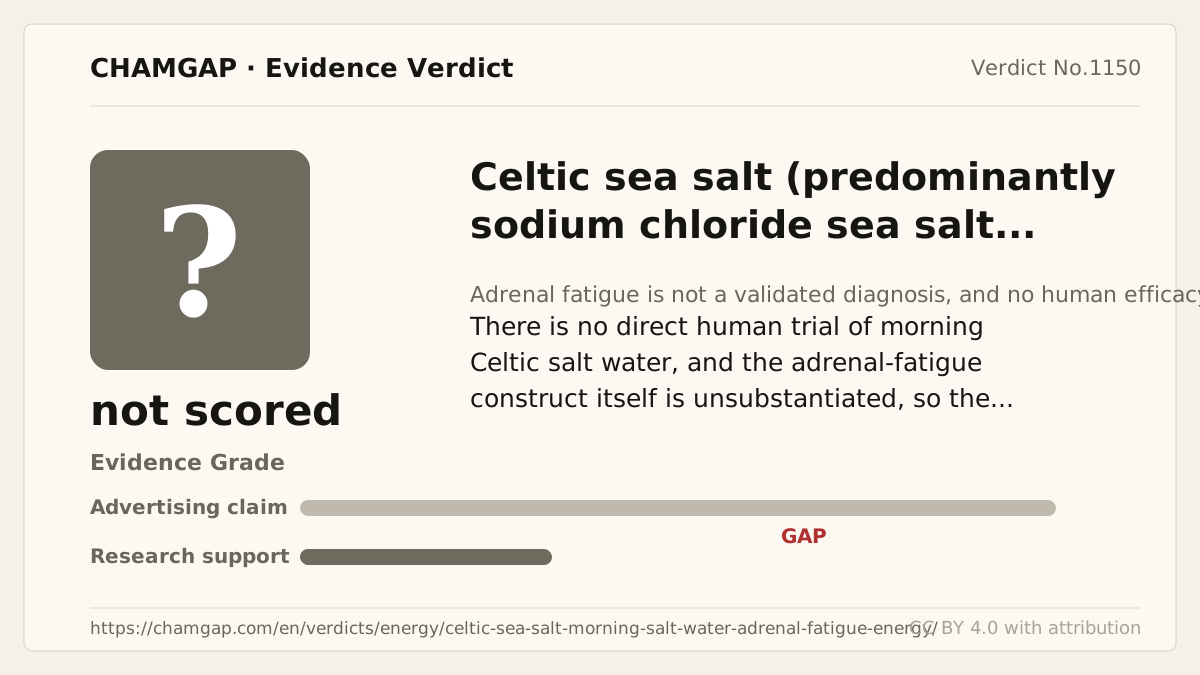
[Chamgap] Celtic sea salt x recovery from alleged adrenal fatigue and improved daily energy — Evidence Grade ?. 2 cited sources checked. Source: https://chamgap.com/en/verdicts/energy/celtic-sea-salt-morning-salt-water-adrenal-fatigue-energy/ · CC BY 4.0CC BY 4.0 — free to use with attribution; do not distort grades, numbers, or verdict meaning.
What this document does and does not do
Chamgap is an information source. It reports what research has and has not confirmed; it does not tell readers what to take or buy. That decision belongs to readers and, when needed, medical or legal professionals. This verdict reflects literature available up to the search date and may change as new research appears. Nothing here is medical advice.