
Caffeine citrate,
does it really help with Reduction in death or neurodevelopmental disability at 18 to 21 months when treating apnea of prematurity?
research showsCaffeine citrate is rated B because it reduced the composite of death or neurodevelopmental disability at 18 to 21 months when used for apnea of prematurity. The publicly led CAP trial randomized 2,006 infants with birth weights of 500 to 1,250 g and found this outcome in 40.2% versus 46.2%, with an adjusted odds ratio of 0.77. This is a direct, important clinical endpoint, reinforced by shorter respiratory support and reductions in cerebral palsy and cognitive delay. It remains essentially one large trial, however, and the composite outcomes at age 5 years and age 11 years were not significant. A high B with 79 points is therefore more appropriate than A.
ads claimNeonatal intensive-care evidence should not be transferred to ordinary caffeinated drinks or claims of universal brain-development enhancement. CAP tested measured caffeine-citrate treatment in very-low-birth-weight preterm infants under specialist neonatal care, which differs from stimulant use in healthy infants or adults.
Useful facts when choosing a product
- Caffeine citrate is a specialist neonatal prescription medicine for apnea of prematurity, supplied as an injection or oral solution, and cannot be replaced with an ordinary caffeinated drink.
- CAP used a caffeine-citrate loading dose of 20 mg/kg followed by 5 mg/kg maintenance adjusted to clinical response; actual administration follows neonatal specialist prescribing and the product label.
- Tachycardia, feeding intolerance, gastrointestinal symptoms, glucose instability, and transiently slower weight gain can occur, so heart rate, intake, growth, and serum concentrations when indicated are monitored.
- CAP most directly applies to infants with birth weights of 500 to 1,250 g considered candidates for methylxanthine therapy during the first 10 days of life and should not be automatically generalized to every prophylactic early-use strategy.
Chamgap Semantic Classification Code
Candidate index · review held
M.caffeine-citrate.oral.death-or-neurodevelopmental-disability-at-when-treating-apnea-of-prematurity.reduce.placeboMedicinal interventions > Caffeine citrate > Oral > death or neurodevelopmental disability at when treating apnea of prematurity > Reduction claim > Placebo
An automated migration candidate, not an issued permanent code; exact claim scope remains under review. This machine-generated migration candidate helps retrieval but is not a permanent assignment. The original verdict ID and URL remain authoritative.
What the research actually shows
The 2006 short-term CAP report by Schmidt and colleagues found that caffeine allowed earlier discontinuation of positive-pressure support and oxygen and reduced bronchopulmonary dysplasia. In the 2007 report at 18 to 21 months, death or neurodevelopmental disability occurred in 40.2% versus 46.2%, cerebral palsy in 4.4% versus 7.3%, and cognitive delay in 33.8% versus 38.3%. At age 5 in 2012, death or disability was 21.1% versus 24.8% and was not statistically significant. At age 11 in 2017, the composite of academic, motor, and behavioral impairment was 31.7% versus 37.6%, with a nonsignificant adjusted odds ratio of 0.78, while motor impairment was reduced from 27.5% to 19.7%, with an adjusted odds ratio of 0.66. Initial direct benefit is strong, but consistency across all long-term domains is limited.
Why this is classified as B (79)
The 2,006-participant, double-blind, publicly led CAP trial reduced death or neurodevelopmental disability at 18 to 21 months from 46.2% to 40.2%, with an adjusted odds ratio of 0.77, providing strong direct clinical evidence. No independent large trial has replicated it, and nonsignificant overall composites at ages 5 and 11 weaken long-term consistency. Persistent motor benefit prevents a downgrade to C or D, but B with 79 points is more honest than A.
Counterpoint. Benefit on the composite does not mean that death alone was reduced; differences in cerebral palsy and cognitive delay contributed most. Questions about when to start, when to stop, and purely prophylactic use are separate from this verdict.
Rejudgment record. New verdict — Applied a high B because the 2,006-participant publicly led double-blind CAP trial reduced the important direct composite of death or neurodevelopmental disability at 18 to 21 months, while the absence of independent large replication and nonsignificant overall composites at ages 5 and 11 prevent an A rating
Sub-claim grades by effect
This ingredient is marketed for several effects. A single overall grade blends strong and weak claims together, so each effect is graded separately here. The overall grade reflects the strongest disconfirming or core claim.
| Effect (sub-claim) | Grade | Basis |
|---|---|---|
| Reduced death or neurodevelopmental disability at 18 to 21 months after treatment of apnea of prematurity | B | CAP found 40.2% versus 46.2% and an adjusted odds ratio of 0.77, but there is no independent large replication. |
| Reduced cerebral palsy and cognitive delay at 18 to 21 months | B | CAP found cerebral palsy in 4.4% versus 7.3% and cognitive delay in 33.8% versus 38.3%, while the overall long-term composite attenuated. |
| Shorter positive-pressure and oxygen treatment and reduced bronchopulmonary dysplasia | B | Randomized secondary outcomes in the short-term CAP report consistently favored caffeine. |
Cross-check — AI research and Codex final gate
Evidence Table
| Study | Design | Sample | Funding | Endpoint | Result | Weight |
|---|---|---|---|---|---|---|
| Schmidt B et al. 2007 CAP 18-to-21-month follow-up | International multicenter randomized double-blind placebo-controlled trial | 2,006 preterm infants with birth weights of 500 to 1,250 g | Public CIHR and Australian NHMRC funding; study drug supplied by Sabex | Death or neurodevelopmental disability at 18 to 21 months | The composite occurred in 40.2% versus 46.2%, with an adjusted odds ratio of 0.77 (95% CI 0.64 to 0.93). | Pivotal large randomized direct-clinical-endpoint evidence |
| Schmidt B et al. 2006 CAP short-term outcomes | International multicenter randomized double-blind placebo-controlled trial | 2,006 preterm infants | Public CIHR and Australian NHMRC funding | Bronchopulmonary dysplasia and duration of positive-pressure support and oxygen | Caffeine reduced bronchopulmonary dysplasia and allowed earlier discontinuation of positive-pressure support and oxygen. | Respiratory-mechanism and short-term efficacy support |
| Schmidt B et al. 2012 CAP 5-year follow-up | Masked long-term follow-up of a randomized cohort | Vital status for 1,704 children and composite data for 1,640 at age 5 | Public research funding | Death or disability at age 5 | The outcome was 21.1% versus 24.8%, with a center-adjusted odds ratio of 0.82 (95% CI 0.65 to 1.03), which was not significant. | Long-term composite limitation |
| Schmidt B et al. 2017 CAP 11-year follow-up | Age-11 follow-up of a randomized cohort | 920 children with primary composite data | Public CIHR and Australian NHMRC funding | Composite academic, motor, and behavioral impairment and motor impairment | The composite was nonsignificant at 31.7% versus 37.6%, but motor impairment was 19.7% versus 27.5%, with an adjusted odds ratio of 0.66. | Partial long-term persistence with limited overall consistency |
Receipt — 4 References
All 4 cited sources were verified for existence at the original page (as of 2026-07-24).
Final verification and publication gate: Codex · Evidence date: 2026-07-24 · Corrections: none
Cite this verdict
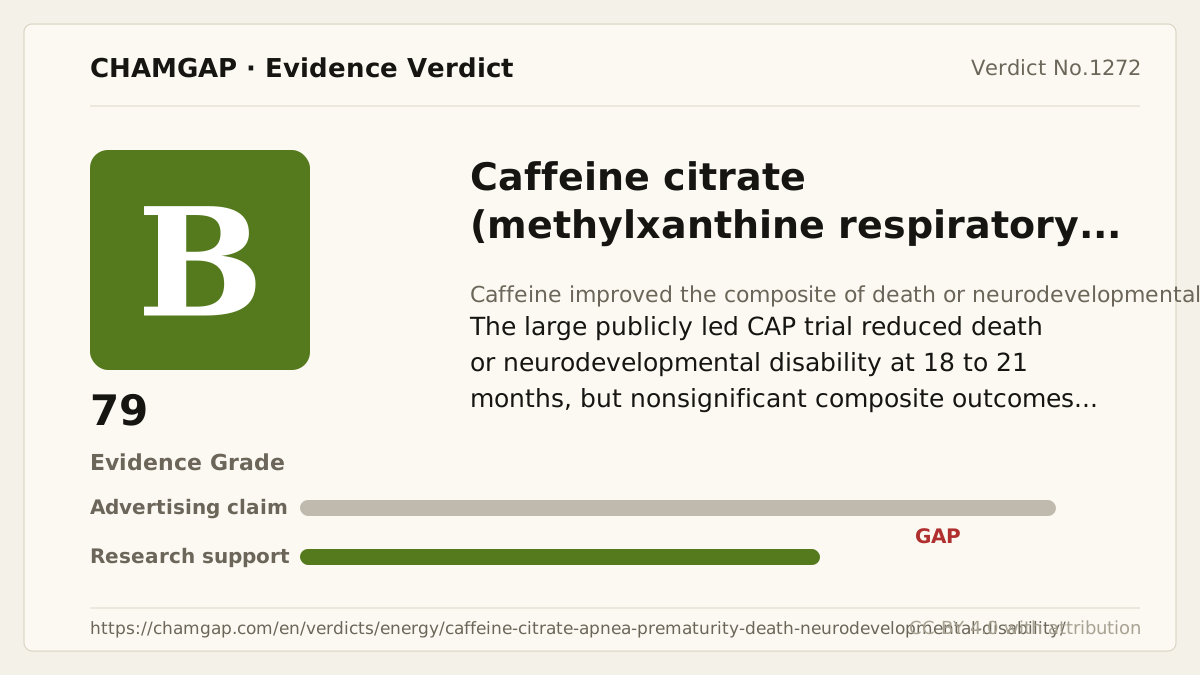
[Chamgap] Caffeine citrate x reduced death or neurodevelopmental disability in apnea of prematurity — Evidence Grade B·79. 4 cited sources checked. Source: https://chamgap.com/en/verdicts/energy/caffeine-citrate-apnea-prematurity-death-neurodevelopmental-disability/ · CC BY 4.0CC BY 4.0 — free to use with attribution; do not distort grades, numbers, or verdict meaning.
What this document does and does not do
Chamgap is an information source. It reports what research has and has not confirmed; it does not tell readers what to take or buy. That decision belongs to readers and, when needed, medical or legal professionals. This verdict reflects literature available up to the search date and may change as new research appears. Nothing here is medical advice.