
Amantadine sulfate,
does it really help with Improvement of chronic fatigue and daily function in people with multiple sclerosis?
research showsRoutine use of amantadine to improve chronic fatigue and daily function in multiple sclerosis is rated F. In the publicly funded TRIUMPHANT-MS randomized double-blind four-period crossover trial, the 136-person primary analysis produced an MFIS score of 40.6 with placebo and 41.3 with amantadine, showing no superiority, while adverse events occurred in 39% with amantadine versus 31% with placebo. A 2025 meta-analysis of nine randomized trials and 601 participants also found no reduction in fatigue severity, SMD -0.22 (95% CI -0.72 to 0.27), and higher insomnia odds, OR 2.33. A 2026 network meta-analysis reported a positive MFIS fatigue-impact estimate, but no drug improved fatigue severity and the estimate retained indirectness from older small trials and mixed scales. Repeated null results and harm in the largest modern direct trial and latest direct meta-analysis take priority, supporting F with 16 points.
ads claimOff-label custom and a dopaminergic wakefulness mechanism can be expanded into claims of eliminating fatigue and restoring daily function. Trials show that feeling more awake is not equivalent to clinically meaningful improvement of MS fatigue, and amantadine does not replace assessment of sleep disorders, depression, pain, infection, anemia, or medication effects.
Useful facts when choosing a product
- Amantadine sulfate is a prescription medicine used for parkinsonian symptoms, and use of products such as PK-Merz for multiple-sclerosis fatigue is off label.
- TRIUMPHANT-MS tested oral amantadine up to 100 mg twice daily for no more than six weeks per period, so the result cannot automatically be transferred to other salts, infusions, extended-release products, or longer treatment.
- Amantadine is eliminated by the kidneys, and reduced kidney function and older age increase accumulation, confusion, and hallucination risk, requiring dose adjustment.
- Insomnia, dizziness, nausea, dry mouth, peripheral edema, livedo reticularis, agitation, and hallucinations can occur. Abrupt discontinuation after long-term use can cause delirium or worsen parkinsonian symptoms, so tapering requires prescriber supervision.
Chamgap Semantic Classification Code
Candidate index · review held
M.amantadine-sulfate.UNK.chronic-fatigue-and-daily-function-with-multiple-sclerosis.improve.placeboMedicinal interventions > Amantadine sulfate > Unknown > chronic fatigue and daily function with multiple sclerosis > Improvement claim > Placebo
An automated migration candidate, not an issued permanent code; exact claim scope remains under review. This machine-generated migration candidate helps retrieval but is not a permanent assignment. The original verdict ID and URL remain authoritative.
What the research actually shows
TRIUMPHANT-MS randomized people with MS and MFIS scores above 33 to four sequences and four periods of amantadine, modafinil, methylphenidate, and placebo under double masking. Each treatment lasted up to six weeks. Among 136 participants in the primary analysis, amantadine did not improve MFIS clinically or statistically versus placebo, and all three active drugs produced more adverse events. Cruccioli in 2025 pooled nine amantadine-versus-placebo randomized trials with 601 participants and found fatigue-severity SMD -0.22 with p=0.37 and insomnia OR 2.33 with p=0.006. The 2026 Rastkar network meta-analysis of 15 studies found no medication superior for fatigue severity but reported a positive amantadine result for fatigue impact on the MFIS, demonstrating endpoint discordance. Overall, the combined claim of sustained improvement in chronic fatigue and daily function has not been reproduced.
Why this is classified as F (16)
Although older small positive studies exist, a large publicly funded modern crossover trial found no superiority for fatigue or quality of life and more adverse events. A 2025 meta-analysis of nine randomized trials then confirmed no fatigue-severity benefit and more insomnia. The positive MFIS signal in a 2026 network meta-analysis was incorporated as endpoint discordance, but fatigue severity remained null and the estimate did not overcome the large direct trial. Repeated refutation and harm support F with 16 points, while safety remains separately recorded.
Counterpoint. Severe fatigue calls for assessment of sleep, depression or anxiety, pain, infection, anemia, thyroid disease, medicines, and activity patterns, followed by a multidisciplinary plan that can include exercise, energy conservation, and cognitive behavioral approaches. Any individualized amantadine trial needs explicit targets and stopping rules.
Rejudgment record. New verdict — Included the contrary positive MFIS signal from the 2026 network meta-analysis, but prioritized the null result and excess adverse events in the largest modern direct TRIUMPHANT-MS trial and the null fatigue-severity result with more insomnia in the 2025 nine-trial direct meta-analysis, meeting the repeated-refutation and harm standard for F
Sub-claim grades by effect
This ingredient is marketed for several effects. A single overall grade blends strong and weak claims together, so each effect is graded separately here. The overall grade reflects the strongest disconfirming or core claim.
| Effect (sub-claim) | Grade | Basis |
|---|---|---|
| Reduction of chronic fatigue severity in multiple sclerosis | F | The largest modern trial and a nine-trial meta-analysis found no improvement versus placebo. |
| Improvement in the impact of multiple-sclerosis fatigue on daily life | F | TRIUMPHANT-MS was null on the MFIS, while the positive 2026 network estimate conflicts with it and relies on mixed endpoints and older small studies. |
| Sustained improvement in daily activity and quality of life | F | The modern direct trial did not improve quality of life versus placebo and found more adverse events, while pooled evidence found more insomnia. |
Cross-check — AI research and Codex final gate
Evidence Table
| Study | Design | Sample | Funding | Endpoint | Result | Weight |
|---|---|---|---|---|---|---|
| Nourbakhsh B et al. 2021 TRIUMPHANT-MS | Randomized placebo-controlled four-sequence four-period double-blind crossover trial | Approximately 140 enrolled; 136 in the primary intention-to-treat analysis | Public funding from the Patient-Centered Outcomes Research Institute | MFIS fatigue impact, sleepiness, quality of life, and adverse events | MFIS was 40.6 with placebo and 41.3 with amantadine, showing no superiority, while adverse events occurred in 31% and 39%, respectively. | Largest modern direct refutation |
| Cruccioli MM et al. 2025 | Systematic review and meta-analysis of amantadine-versus-placebo randomized trials | Nine randomized trials and 601 participants | Funding varied across included trials; assessed under the meta-analysis authors' disclosures | Fatigue severity and adverse effects including insomnia | Fatigue-severity SMD was -0.22 (95% CI -0.72 to 0.27), p=0.37, while insomnia OR was 2.33 (1.27 to 4.29), p=0.006. | Confirms repeated null efficacy and increased insomnia |
| Rastkar M et al. 2026 | Network meta-analysis of treatments for multiple-sclerosis fatigue | Fifteen studies | Academic meta-analysis with heterogeneous funding across included studies | Fatigue severity and MFIS fatigue impact | No medication was superior to placebo for fatigue severity, but amantadine had a positive estimated MFIS fatigue-impact mean difference of -12.11. | Contrary signal showing endpoint discordance |
Receipt — 3 References
All 3 cited sources were verified for existence at the original page (as of 2026-07-22).
Final verification and publication gate: Codex · Evidence date: 2026-07-22 · Corrections: none
Cite this verdict
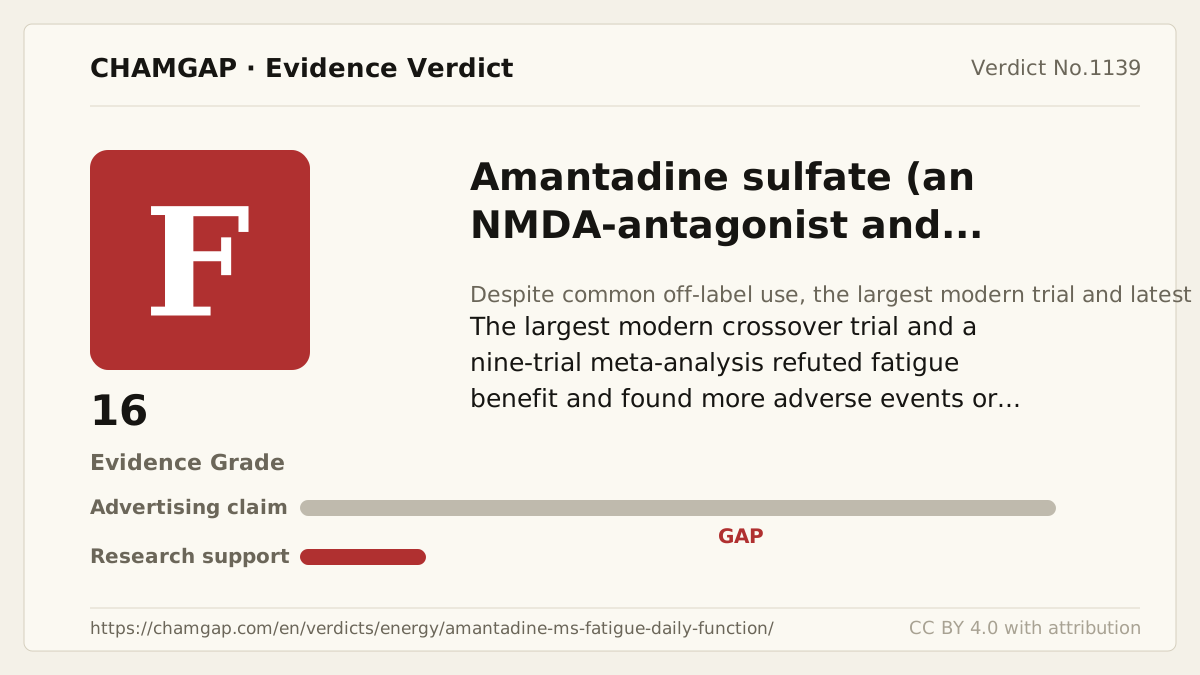
[Chamgap] Amantadine sulfate x improvement of chronic fatigue and daily function in multiple sclerosis — Evidence Grade F·16. 3 cited sources checked. Source: https://chamgap.com/en/verdicts/energy/amantadine-ms-fatigue-daily-function/ · CC BY 4.0CC BY 4.0 — free to use with attribution; do not distort grades, numbers, or verdict meaning.
What this document does and does not do
Chamgap is an information source. It reports what research has and has not confirmed; it does not tell readers what to take or buy. That decision belongs to readers and, when needed, medical or legal professionals. This verdict reflects literature available up to the search date and may change as new research appears. Nothing here is medical advice.