
Acetyl-L-carnitine,
does it really help with Improved multiple-sclerosis-related fatigue and daily function?
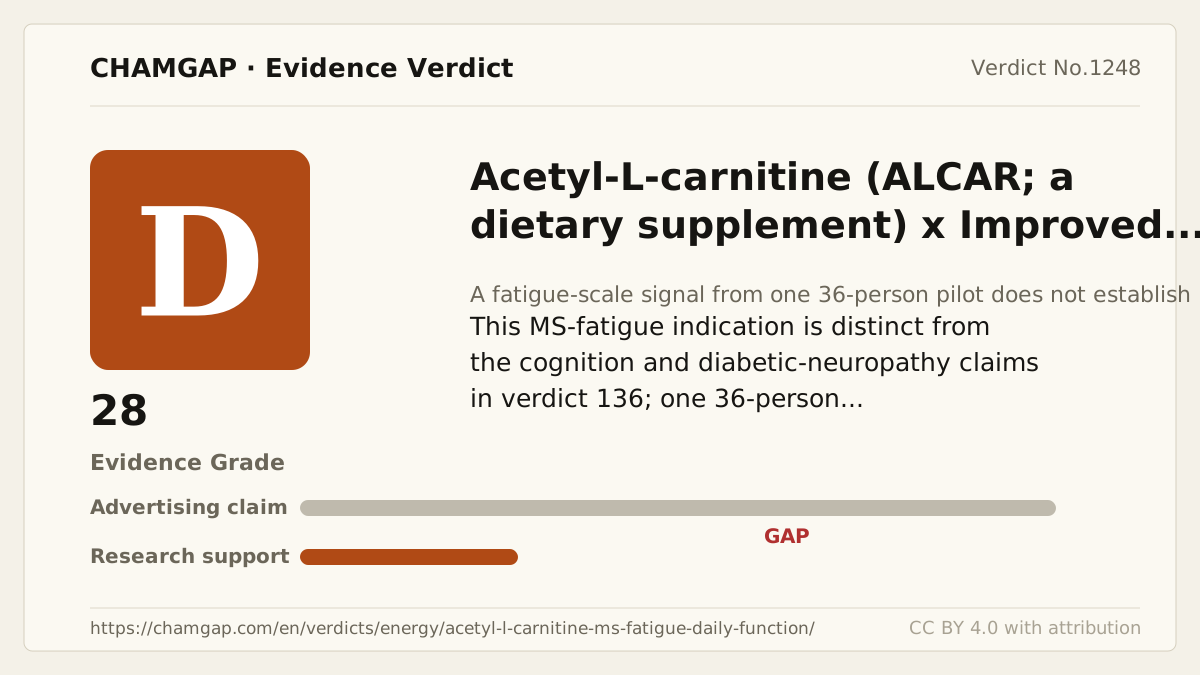
research showsAcetyl-L-carnitine for multiple-sclerosis-related fatigue and daily function is rated D. The only completed eligible trial enrolled 36 fatigued patients in a small crossover comparison of ALCAR 2 g/day with amantadine 200 mg/day. Thirty completed the study, and the primary Fatigue Severity Scale favored ALCAR, but the Fatigue Impact Scale, depression, and social-experience secondary outcomes were not significant and there was no placebo group. Cochrane found only this completed trial and one trial that was still ongoing at the time, concluding that effects on fatigue, fatigue-related disability, quality of life, and safety were unclear. Without credible independent replication or direct daily-function improvement, the grade is D.
ads claimMarketing can turn mitochondrial energy, relief of MS fatigue, and restored daily vitality into a disease-specific treatment claim. MS fatigue can reflect sleep disorders, depression, anemia, infection, medicines, pain, or disease activity, so a supplement response should not be used to infer the cause.
Useful facts when choosing a product
- The only completed pilot used ALCAR 1 g twice daily, totaling 2 g/day for three months; results cannot automatically be substituted with ordinary L-carnitine or another salt form.
- ALCAR is sold as a supplement but does not replace multiple-sclerosis disease-modifying treatment, rehabilitation, or a clinical fatigue evaluation, and use should be discussed with the treating neurology team.
- Short-term use is generally tolerated, but nausea, abdominal discomfort, diarrhea, a fishy body odor, headache, agitation, or insomnia can occur.
- People with a seizure history, kidney or thyroid disease, or use of warfarin or multiple medicines should consult a clinician before taking it.
Chamgap Semantic Classification Code
Candidate index · review held
S.acetyl-l-carnitine.UNK.multiple-sclerosis-related-fatigue-and-daily-function.improve.MULTISupplements and nutraceuticals > Acetyl-L-carnitine > Unknown > multiple-sclerosis-related fatigue and daily function > Improvement claim > Multiple: primary unresolved
An automated migration candidate, not an issued permanent code; exact claim scope remains under review. This machine-generated migration candidate helps retrieval but is not a permanent assignment. The original verdict ID and URL remain authoritative.
What the research actually shows
Tomassini and colleagues assigned 36 patients with relapsing-remitting or secondary progressive MS to three months of treatment, a three-month washout, and three months of crossover treatment. ALCAR 2 g/day outperformed amantadine 200 mg/day on the Fatigue Severity Scale but not on the Fatigue Impact Scale, Beck Depression Inventory, or Social Experience Checklist, and six participants withdrew because of adverse reactions. The Tejani Cochrane review searched through September 2011 and found this completed trial plus one then-ongoing placebo-controlled crossover trial without results. Mortality and quality of life were not reported, and fatigue-related disability could not be judged; the reviewers concluded that evidence of therapeutic advantage over placebo or active comparators was insufficient.
Why this is classified as D (28)
The only completed direct human trial was a 36-person active-comparator crossover pilot with 30 completers. Its primary Fatigue Severity Scale was positive, but the functional-impact, depression, and social-experience secondary outcomes were null, with no placebo, independent replication, or quality-of-life data. Cochrane judged effects on fatigue, fatigue-related disability, and quality of life unclear, placing the evidence in D with 28 points.
Counterpoint. A clinician may still consider it individually when amantadine adverse effects are problematic. Efficacy cannot be considered established until a larger placebo-controlled parallel trial reproduces benefits in both fatigue and daily function.
Rejudgment record. Cross-check applied — Applied D because the only completed direct study was a 36-person randomized double-blind active-comparator crossover pilot with a positive primary Fatigue Severity Scale but null Fatigue Impact Scale, depression, and social-experience secondary outcomes, no placebo, independent replication, or quality-of-life data, and Cochrane judged fatigue and disability effects unclear
Sub-claim grades by effect
This ingredient is marketed for several effects. A single overall grade blends strong and weak claims together, so each effect is graded separately here. The overall grade reflects the strongest disconfirming or core claim.
| Effect (sub-claim) | Grade | Basis |
|---|---|---|
| Improved multiple-sclerosis-related fatigue | D | Only the FSS in a 36-person active-comparator crossover trial was positive; there was no placebo or independent replication, and Cochrane judged the effect unclear. |
| Reduced impact of fatigue on daily life | D | The Fatigue Impact Scale and social-experience outcomes were nonsignificant, so direct improvement in daily function was not demonstrated. |
| Improved quality of life | D | Quality of life was not reported in the completed trial, leaving extremely limited evidence. |
Cross-check — AI research and Codex final gate
Evidence Table
| Study | Design | Sample | Funding | Endpoint | Result | Weight |
|---|---|---|---|---|---|---|
| Tomassini V et al. 2004 | Randomized double-blind active-comparator crossover pilot trial | 36 patients with MS-related fatigue enrolled and 30 completed | Funding was not reported in the PubMed abstract | Primary FSS; secondary FIS, BDI, SEC, and adverse-event withdrawals | FSS favored ALCAR over amantadine, but all secondary outcomes were nonsignificant and there was no placebo group. | Only completed direct trial; small and internally inconsistent |
| Tejani AM et al. 2012 | Cochrane intervention systematic review | One completed trial with 36 participants and one trial then ongoing | Academic Cochrane review | Fatigue, fatigue-related disability, quality of life, mortality, and adverse events | Concluded that fatigue, disability, quality-of-life, and safety effects were unclear and evidence of therapeutic advantage was insufficient. | Key independent synthesis finding insufficient evidence |
Receipt — 2 References
All 2 cited sources were verified for existence at the original page (as of 2026-07-24).
Final verification and publication gate: Codex · Evidence date: 2026-07-24 · Corrections: none
Cite this verdict
[Chamgap] Acetyl-L-carnitine x improved multiple-sclerosis-related fatigue and daily function — Evidence Grade D·28. 2 cited sources checked. Source: https://chamgap.com/en/verdicts/energy/acetyl-l-carnitine-ms-fatigue-daily-function/ · CC BY 4.0CC BY 4.0 — free to use with attribution; do not distort grades, numbers, or verdict meaning.
What this document does and does not do
Chamgap is an information source. It reports what research has and has not confirmed; it does not tell readers what to take or buy. That decision belongs to readers and, when needed, medical or legal professionals. This verdict reflects literature available up to the search date and may change as new research appears. Nothing here is medical advice.