
Dangjo pepper dried powder,
does it really help with Suppression of the postprandial rise in blood glucose?
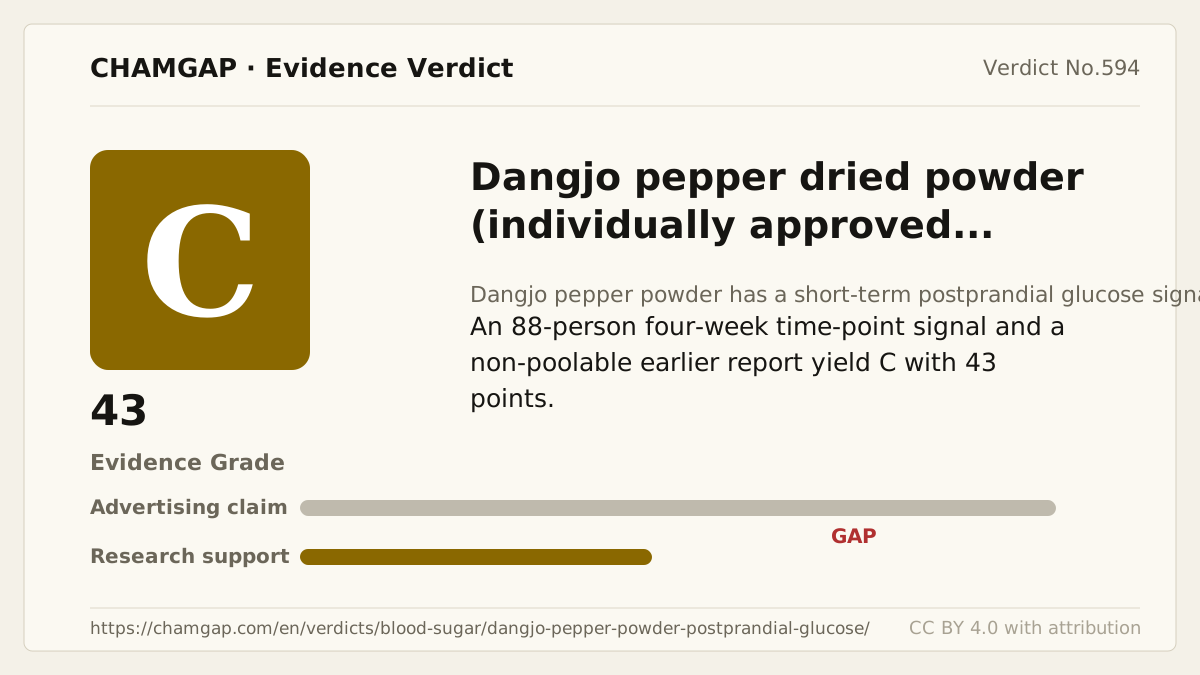
research showsDangjo pepper dried powder is rated C because an 88-person randomized double-blind study reported lower 60-minute postprandial glucose after 7 g per day for four weeks. The participants were healthy, follow-up was short, and the public abstract does not permit verification of prespecified endpoints, funding, or HbA1c. A 2017 Japanese-language report also studied postprandial glucose with the same Dangjo cultivar, but product and dose equivalence and independence are unconfirmed, so it cannot be pooled as replication. Evidence remains concentrated in the recognized ingredient.
ads claimMarketing can expand control of post-meal glucose into normalization of HbA1c or treatment and prevention of diabetes. Current public evidence concerns a specific standardized powder at 7 g per day and a four-week 60-minute glucose result; it cannot be transferred to ordinary fresh peppers, other extracts, or long-term glycemic control.
Useful facts when choosing a product
- Dangjo pepper dried powder No. 2023-32 is a specific individually recognized functional ingredient standardized using quercitrin. Its evidence does not automatically apply to ordinary Dangjo peppers or leaf extracts.
- The publicly summarized human study used 7 g daily with meals for four weeks. Consumers should check the recognized-ingredient amount and daily serving on the actual product label.
- Individual recognition is not drug approval and does not justify stopping diabetes medicine or replacing diet and exercise. People with elevated glucose or diabetes treatment should consult a clinician.
- Safety evidence beyond short trials is limited. Pepper allergy or gastrointestinal irritation can occur, and hypoglycemia risk in combination with glucose-lowering medicines has not been adequately established.
Chamgap Semantic Classification Code
Candidate index · review held
S.dangjo-pepper-dried-powder.UNK.suppression-of-the-postprandial-rise-in-blood-glucose.assess.placeboSupplements and nutraceuticals > Dangjo pepper dried powder > Unknown > Suppression of the postprandial rise in blood glucose > Association or change assessment > Placebo
An automated migration candidate, not an issued permanent code; exact claim scope remains under review. This machine-generated migration candidate helps retrieval but is not a permanent assignment. The original verdict ID and URL remain authoritative.
What the research actually shows
The Nutrition 2023 abstract and Korean recognition summaries describe 88 healthy adults, 7 g per day for four weeks, and a lower between-group 60-minute postprandial glucose value. No full paper permits verification of complete outcome tables, prespecified endpoints, attrition, funding, or HbA1c. A 2017 Japanese-language human report also assessed postprandial glucose with the same Dangjo cultivar, but product and dose equivalence and independence from the development line could not be confirmed, so it was not pooled with the 2023 trial. Recognition No. 2023-32 was treated only as administrative confirmation.
Why this is classified as C (43)
The 88-person randomized double-blind 60-minute postprandial signal is accepted, but it comes from healthy adults, four weeks, and a public abstract without verifiable prespecified endpoints, funding, or HbA1c. A 2017 report in the same cultivar cannot be pooled because product and dose equivalence and independence are unconfirmed. Ingredient concentration and rules ①, ②-b, and ④ yield C with 43 points.
Counterpoint. Within the product label, it may be a supplementary option for nondiabetic adults concerned about post-meal glucose spikes. It should not be used as treatment in diabetes, where glucose and HbA1c monitoring and standard care are required.
Rejudgment record. New verdict — Accepted the 60-minute signal from an 88-person randomized double-blind trial but applied C under rules ①, ②-b, and ④ because participants were healthy, follow-up was four weeks, prespecified endpoints, funding, and HbA1c were unavailable, and a 2017 same-cultivar report could not be pooled because product and dose equivalence and independence were unconfirmed
Sub-claim grades by effect
This ingredient is marketed for several effects. A single overall grade blends strong and weak claims together, so each effect is graded separately here. The overall grade reflects the strongest disconfirming or core claim.
| Effect (sub-claim) | Grade | Basis |
|---|---|---|
| Acute and short-term suppression of postprandial glucose rise | C | An 88-person four-week product-specific study provides a 60-minute signal, but publication and independent replication are limited. |
| HbA1c and long-term glycemic control | ? | No long-term human HbA1c evidence was found. |
| Diabetes treatment because the ingredient is individually recognized | F | Individual recognition is neither drug approval nor recognition of efficacy as diabetes treatment. |
Cross-check — AI research and Codex final gate
Evidence Table
| Study | Design | Sample | Funding | Endpoint | Result | Weight |
|---|---|---|---|---|---|---|
| Kim KJ et al. Nutrition 2023 conference abstract | Conference abstract of a randomized double-blind placebo-controlled parallel human trial | 88 adults | Functional-ingredient development program context; limited funding detail in the abstract | Postprandial glucose over time after 7 g daily for four weeks, with public summaries reporting the 60-minute value | The 60-minute postprandial glucose value was reported as significantly lower than control. | Only direct human efficacy evidence |
| Kim KJ et al. 2023 Food Bioscience | Preclinical enzyme and cell-uptake assays plus mouse carbohydrate-challenge experiments | Cells and mice; no humans | 2020 functional-crop discovery program of the Korea Food Industry Cluster Promotion Agency | Alpha-glucosidase activity, Caco-2 glucose uptake, and mouse carbohydrate-challenge glucose | The study identified quercitrin and found enzyme-inhibition and animal glucose signals. | Mechanistic support only; cannot raise the human grade |
| Korean individual recognition No. 2023-32 | Korean regulatory individual-recognition record and public summary | Recognition No. 2023-32 | Ingredient developer and recognition-applicant dossier | Functional claim for suppressing postprandial glucose rise | A specific Dangjo pepper dried powder was recognized as a functional ingredient. | Confirms study existence; not evidence-grade support |
Receipt — 4 References
All 4 cited sources were verified for existence at the original page (as of 2026-07-19).
Final verification and publication gate: Codex · Evidence date: 2026-07-19 · Corrections: none
Cite this verdict
[Chamgap] Dangjo pepper dried powder x suppression of postprandial glucose rise — Evidence Grade C·43. 4 cited sources checked. Source: https://chamgap.com/en/verdicts/blood-sugar/dangjo-pepper-powder-postprandial-glucose/ · CC BY 4.0CC BY 4.0 — free to use with attribution; do not distort grades, numbers, or verdict meaning.
What this document does and does not do
Chamgap is an information source. It reports what research has and has not confirmed; it does not tell readers what to take or buy. That decision belongs to readers and, when needed, medical or legal professionals. This verdict reflects literature available up to the search date and may change as new research appears. Nothing here is medical advice.