
Young-donor plasma infusion,
does it really help with Reversal of aging, restored memory, and extended healthspan and lifespan?
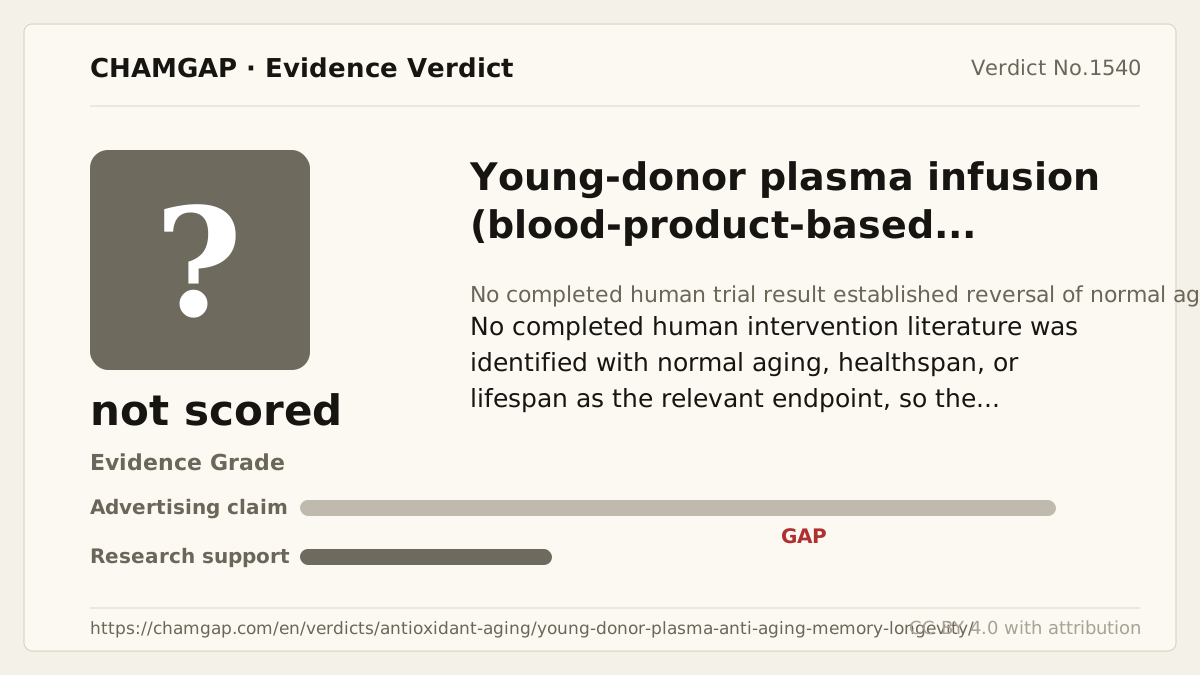
research showsYoung-donor plasma infusion is rated ? because no completed human intervention result was identified that tested reversal of normal aging, restored memory, healthspan, or lifespan as the relevant endpoint. The PLASMA study in 18 patients with Alzheimer disease primarily assessed safety and feasibility, and its nine-person randomized crossover cohort showed no significant cognitive-test improvement. It was not a trial of normal aging or longevity. The FDA warns that young plasma has no proven clinical benefit for aging or memory loss, is not approved for these uses, and carries transfusion risks.
ads claimRejuvenation in mice, an Alzheimer safety study, or inflammatory-biomarker changes can be expanded into reversal of normal human aging and longer life. These sources use different products, populations, and endpoints.
Useful facts when choosing a product
- Plasma is a blood component containing clotting factors, antibodies, and many proteins; a young donor does not create an approved anti-aging indication.
- The FDA states that young-donor plasma is not approved for normal aging or memory loss and lacks demonstrated clinical benefit from adequate controlled trials.
- Plasma infusion can cause allergic reactions or anaphylaxis, residual transmission of infection, transfusion-related acute lung injury, and circulatory overload.
Chamgap Semantic Classification Code
Candidate index · review held
P.young-donor-plasma-infusion.procedural.reversal-of-aging-restored-memory-and-extended-healthspan-and-lifespan.assess.UNKProcedures, devices and tests > Young-donor plasma infusion > Procedural > Reversal of aging, restored memory, and extended healthspan and lifespan > Association or change assessment > Unknown
An automated migration candidate, not an issued permanent code; exact claim scope remains under review. This machine-generated migration candidate helps retrieval but is not a permanent assignment. The original verdict ID and URL remain authoritative.
What the research actually shows
Sha and colleagues enrolled 18 patients with Alzheimer disease: nine entered a double-blind crossover of young fresh-frozen plasma and saline, and nine received open-label plasma. The primary focus was safety, tolerability, and feasibility, and randomized cognitive tests did not significantly improve. One participant stopped because of urticaria. NCT04241159, planned in older adults without the specified disease context, was withdrawn because the protocol required revisions and posted no results. The FDA states that no proven clinical benefit exists for normal aging or memory loss.
Why this is classified as ?
No completed human intervention result was identified with reversal of normal aging, restored memory, healthspan, or lifespan as the relevant endpoint, so the grade is ?.
Counterpoint. The Alzheimer PLASMA study and a perioperative inflammatory-surrogate study are not direct evidence for normal aging, healthspan, or lifespan.
Rejudgment record. New verdict — Separated animal studies, Alzheimer safety studies, and perioperative immune surrogates from the claim and applied the ? rule because completed human intervention results for reversal of normal aging, restored memory, healthspan, or lifespan were not identified
Sub-claim grades by effect
This ingredient is marketed for several effects. A single overall grade blends strong and weak claims together, so each effect is graded separately here. The overall grade reflects the strongest disconfirming or core claim.
| Effect (sub-claim) | Grade | Basis |
|---|---|---|
| Reversal of biological aging | ? | No completed human intervention result with this endpoint was identified. |
| Restoration of memory and cognition | ? | No completed trial in normal aging was identified, and PLASMA in Alzheimer disease was not a confirmatory cognition trial. |
| Extension of healthspan and lifespan | ? | No completed human intervention result evaluating healthspan or lifespan was identified. |
Cross-check — AI research and Codex final gate
Evidence Table
| Study | Design | Sample | Funding | Endpoint | Result | Weight |
|---|---|---|---|---|---|---|
| Sha SJ, Deutsch GK, Tian L, et al. 2019 | Randomized crossover and open-label safety and feasibility study in Alzheimer disease | 18 participants; nine in the double-blind crossover and nine in the open-label cohort | NIH and Alkahest-related support and interests were reported | Safety, tolerability, feasibility, and exploratory cognition and function | Randomized cognitive tests did not significantly improve, and one open-label participant discontinued because of urticaria. | Indirect evidence with a different disease and primary purpose |
| U.S. Food and Drug Administration. 2019, updated 2024 | Regulatory safety and efficacy communication | Not applicable | United States federal regulator | Absence of benefit for aging or memory loss and plasma-transfusion risks | The agency warned of no proven clinical benefit or approved indication and of infectious, allergic, respiratory, and cardiovascular risks. | Key regulatory and safety evidence |
Receipt — 3 References
All 3 cited sources were verified for existence at the original page (as of 2026-07-23).
Final verification and publication gate: Codex · Evidence date: 2026-07-23 · Corrections: none
Cite this verdict
[Chamgap] Young-donor plasma infusion x reversal of aging, restored memory, and extended healthspan and lifespan — Evidence Grade ?. 3 cited sources checked. Source: https://chamgap.com/en/verdicts/antioxidant-aging/young-donor-plasma-anti-aging-memory-longevity/ · CC BY 4.0CC BY 4.0 — free to use with attribution; do not distort grades, numbers, or verdict meaning.
What this document does and does not do
Chamgap is an information source. It reports what research has and has not confirmed; it does not tell readers what to take or buy. That decision belongs to readers and, when needed, medical or legal professionals. This verdict reflects literature available up to the search date and may change as new research appears. Nothing here is medical advice.