
10,000 steps per day,
does it really help with Lower all-cause mortality through a special 10,000-step threshold?
research showsThe grade is B with 72 points. In CARDIA, the hazard ratio versus fewer than 7,000 steps was 0.28 (95% CI 0.15 to 0.54) for 7,000 to 9,999 and 0.45 (0.25 to 0.81) for at least 10,000. The estimate above 10,000 was higher, the intervals overlapped from 0.25 to 0.54, and only 72 deaths occurred. The association is credible, but there is no evidence that 10,000 is better.
ads claimA device can count daily activity, but it cannot turn 9,999 into clinical failure and 10,000 into clinical success. Goals should reflect age, function, and baseline activity.
Useful facts when choosing a product
- ActiGraph 7164 hip accelerometry over a mean seven days yielded group medians of 5,837, 8,502, and 11,815 steps per day.
- The intervals for 7,000 to 9,999 steps and at least 10,000 steps overlapped from 0.25 to 0.54.
- Peer-reviewed histories say the goal likely traces to Yamasa's 1965 manpo-kei, meaning 10,000-step meter, while noting that the precise origin of the target remains uncertain.
- Verdict 1436 is C with 54 points and concerns post-meal walking and glucose, whereas this verdict concerns total daily steps and death.
Chamgap Semantic Classification Code
Candidate index · review held
X.walking-about-7.behavioral.all-cause-mortality-through-a-special-10-000-step-threshold.reduce.UNKBehaviors, exposures and policies > Walking about 7 > Behavioral delivery > all-cause mortality through a special 10,000-step threshold > Reduction claim > Unknown
An automated migration candidate, not an issued permanent code; exact claim scope remains under review. This machine-generated migration candidate helps retrieval but is not a permanent assignment. The original verdict ID and URL remain authoritative.
What the research actually shows
In 2005 to 2006, CARDIA participants aged 38 to 50 wore an ActiGraph 7164 on the hip for seven consecutive days; inclusion required at least three days with ten or more wear hours. Median counts across groups were 5,837, 8,502, and 11,815 steps per day. Deaths were adjudicated using semiannual contacts, records, certificates, and the National Death Index. Multivariable adjustment and a sensitivity analysis excluding deaths in the first two years were reported, but its exact hazard ratio and interval were not verified. A 15-cohort synthesis of 47,471 people and 3,013 deaths found plateaus near 6,000 to 8,000 steps for adults aged at least 60 and 8,000 to 10,000 for younger adults. Although cohorts came from multiple countries and institutions, one collaborative group applied the common analysis plan and pooled the data, and each cohort's funding could not be individually verified; it therefore did not raise replication independence. CARDIA used NHLBI contracts and NIA and NIH grants, and the article states that funders had no role in study design or conduct.
Why this is classified as B (72)
Accelerometer exposure, objective mortality, multivariable adjustment, lag analysis, and funder noninvolvement support B with 72 points. Multiple categories, analytic multiplicity, 72 deaths, and overlapping intervals still do not support superiority at 10,000.
Counterpoint. B does not validate 10,000 steps. It grades the association with lower mortality, not an exact universal optimum.
Rejudgment record. Cross-check applied — Accelerometer exposure, objective death, multivariable adjustment, and a lag analysis were weighed against multiple categories, analytic multiplicity, 72 events, and no superiority at 10,000
| Endpoint | H | Hard endpoint - actual events such as death |
| Replication | R1 | Single confirmatory trial |
| Independence | I2 | Decisive evidence is publicly or non-profit funded |
| Effect size | E+ | Meets the clinically important threshold |
Stored derived and displayed grades match; this is not a current recalculation or validity check (B).
Sub-claim grades by effect
This ingredient is marketed for several effects. A single overall grade blends strong and weak claims together, so each effect is graded separately here. The overall grade reflects the strongest disconfirming or core claim.
| Effect (sub-claim) | Grade | Basis |
|---|---|---|
| Association of at least 7,000 steps with lower all-cause mortality | C | Device-measured cohorts and international synthesis agree in direction, but this is not a randomized prescription effect. |
| Exactly 10,000 steps is a uniquely optimal threshold | D | In CARDIA, the estimate above 10,000 was not lower than at 7,000 to 9,999 and the intervals overlapped. |
Cross-check — AI research and Codex final gate
Evidence Table
| Study | Design | Sample | Funding | Endpoint | Result | Weight |
|---|---|---|---|---|---|---|
| Paluch AE et al. 2021 CARDIA | Prospective cohort with accelerometer-measured exposure | 2,110 analyzed, mean 10.8 years, 72 deaths | NHLBI contracts and NIA and NIH grants; funders had no role in study design or conduct | All-cause mortality | Versus fewer than 7,000 steps, HR was 0.28 (95% CI 0.15 to 0.54) for 7,000 to 9,999 and 0.45 (0.25 to 0.81) for at least 10,000. | Principal device-measured hard-outcome cohort |
| Paluch AE et al. 2022 Steps for Health Collaborative | Meta-analysis of 15 prospective cohorts | 47,471 participants and 3,013 deaths | Funding for each individual cohort was not verified | All-cause mortality and age-specific step dose-response | The curve plateaued near 6,000 to 8,000 steps at age 60 or older and 8,000 to 10,000 below age 60. | External context for age-specific plateaus |
Receipt — 4 References
All 4 cited sources were verified for existence at the original page (as of 2026-08-04).
Final verification and publication gate: Codex · Evidence date: 2026-08-04 · Corrections: none
Cite this verdict
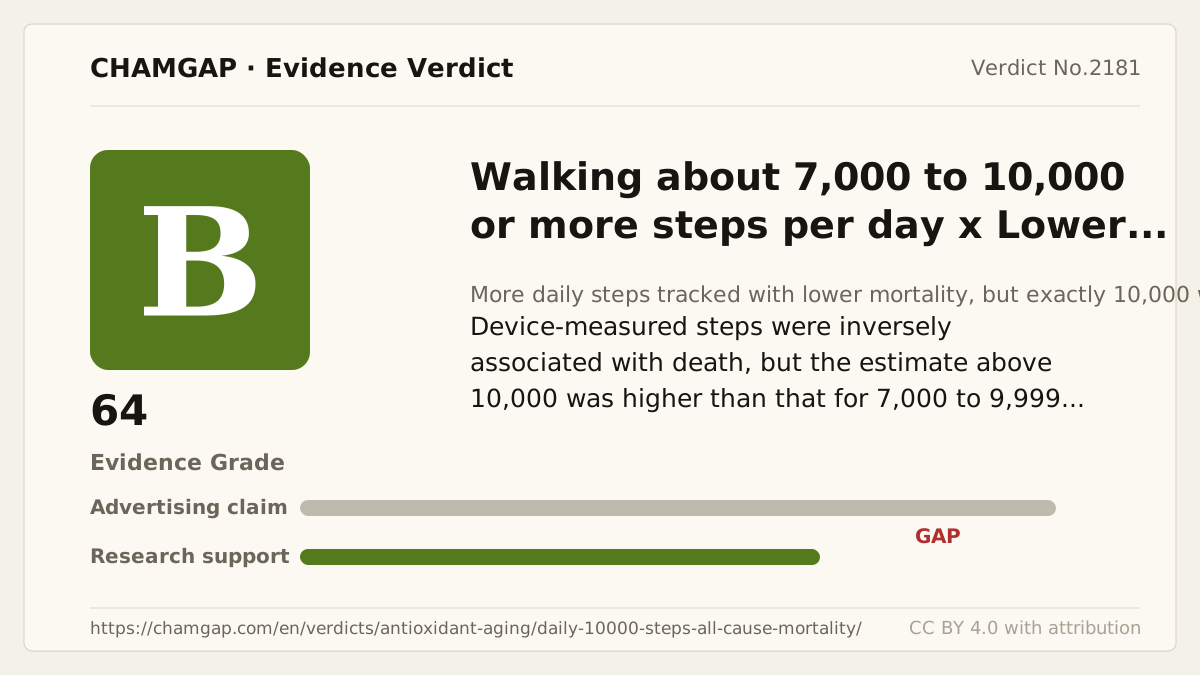
[Chamgap] 10,000 steps per day x lower all-cause mortality — Evidence Grade B·72. 4 cited sources checked. Source: https://chamgap.com/en/verdicts/antioxidant-aging/daily-10000-steps-all-cause-mortality/ · CC BY 4.0CC BY 4.0 — free to use with attribution; do not distort grades, numbers, or verdict meaning.
What this document does and does not do
Chamgap is an information source. It reports what research has and has not confirmed; it does not tell readers what to take or buy. That decision belongs to readers and, when needed, medical or legal professionals. This verdict reflects literature available up to the search date and may change as new research appears. Nothing here is medical advice.