
Raw whole watercress,
does it really help with Reduced lymphocyte DNA damage?
research showsThe grade is C. In a crossover trial, 60 healthy adults, 30 men and 30 women, were assigned the intervention order and ate 85 g/day of raw watercress for eight weeks. Lymphocyte oxidative-purine DNA damage fell, but the study used no control food and was a small, short trial funded by three watercress companies. The paper described using blood as a surrogate tissue to investigate intermediate biomarkers of cancer risk; this does not establish cancer prevention. The score is 44.
ads claimA lower lymphocyte assay result is not the same as fewer cancers. This verdict concerns the whole raw food, not an extract, juice, or capsule.
Useful facts when choosing a product
- The intervention was 85 g of raw watercress added daily for eight weeks, not a juice, extract, or capsule.
- The abstract reports 23.9% while the Results reports 22.9% (-4.53+/-1.14, p=0.002); no correction was identified.
- Gerard's 1633 Herball, Book 2 chapter 17, described watercress as very good for scurvy. That aligns with vitamin C but is a different outcome from modern lymphocyte DNA damage.
- This is a separate whole-food question, not an extract verdict.
Chamgap Semantic Classification Code
Candidate index · review held
UNK.raw-whole-watercress.UNK.lymphocyte-dna-damage.reduce.UNKUnknown > Raw whole watercress > Unknown > lymphocyte DNA damage > Reduction claim > Unknown
An automated migration candidate, not an issued permanent code; exact claim scope remains under review. This machine-generated migration candidate helps retrieval but is not a permanent assignment. The original verdict ID and URL remain authoritative.
What the research actually shows
Gill and colleagues did not assign parallel groups; they randomized the intervention order in a crossover trial of 60 healthy adults, 30 men and 30 women. Participants added 85 g/day of raw watercress to their usual diet for eight weeks and maintained their usual diet without a control food for another eight weeks; all 60 were analyzed. Basal DNA damage fell 17% (difference -2.65+/-1.17, p=0.03). Basal plus oxidative purine damage fell 23.9% in the abstract but 22.9% in the Results (-4.53+/-1.14, p=0.002). DNA damage after a hydrogen-peroxide challenge fell 9.4%, but the mean difference was -3.10+/-1.66 with p=0.07 and was not significant. No validated clinical-importance threshold exists for this assay, so the paired standardized difference of about 0.51 calculated from the reported standard error and n=60 was compared with Cohen's conventional moderate threshold of 0.5. The paper describes investigating intermediate biomarkers of cancer risk by using blood as a surrogate tissue. Vitacress Ltd, Geest Plc, and The Watercress Company funded the study, and Vitacress supplied the watercress. Fogarty 2013 involved 10 men from the same university, used Vitacress-supplied food, and measured a different exercise-induced endpoint, so it is not independent replication.
Why this is classified as C (50)
A positive surrogate in one small, short, industry-funded trial without independent replication gives C with 50 points.
Counterpoint. The measured reduction in DNA damage is real within this trial; it does not demonstrate fewer cancers.
Rejudgment record. Cross-check applied — A single randomized whole-watercress crossover trial improved a lymphocyte surrogate, but the decisive evidence is industry funded, small, short, and not independently replicated
| Endpoint | S | Surrogate marker - laboratory or imaging measures |
| Replication | R1 | Single confirmatory trial |
| Independence | I0 | Evidence comes only from manufacturer studies |
| Effect size | E+ | Meets the clinically important threshold |
Stored derived and displayed grades match; this is not a current recalculation or validity check (C).
Sub-claim grades by effect
This ingredient is marketed for several effects. A single overall grade blends strong and weak claims together, so each effect is graded separately here. The overall grade reflects the strongest disconfirming or core claim.
| Effect (sub-claim) | Grade | Basis |
|---|---|---|
| Reduced oxidative purine DNA damage in lymphocytes | C | Positive in one 60-person crossover trial, but it is a surrogate without independent replication. |
| Reduced cancer incidence | ? | The trial did not measure cancer incidence. |
| Higher plasma lutein and beta-carotene | C | They rose 100% and 33%, respectively, but are separate laboratory markers. |
Cross-check — AI research and Codex final gate
Evidence Table
| Study | Design | Sample | Funding | Endpoint | Result | Weight |
|---|---|---|---|---|---|---|
| Gill CIR et al. 2007 | Single-blind randomized crossover dietary trial | 60 randomized and 60 analyzed | Funded by Vitacress Ltd, Geest Plc, and The Watercress Company; food supplied by Vitacress | Basal and oxidative-purine lymphocyte DNA damage by comet assay | Basal damage -17% (p=0.03); oxidative purine damage -23.9% in the abstract and -22.9% in Results (-4.53+/-1.14, p=0.002) | Only direct trial of whole watercress |
| Fogarty MC et al. 2013 | Open crossover exercise study | 10 men | University of Ulster investigators; food supplied by Vitacress | Exercise-induced mononuclear-cell DNA damage and lipid peroxidation | Different endpoint with overlapping institution and supplier; not independent replication | Supporting evidence only |
Receipt — 3 References
All 3 cited sources were verified for existence at the original page (as of 2026-08-02).
Final verification and publication gate: Codex · Evidence date: 2026-08-02 · Corrections: none
Cite this verdict
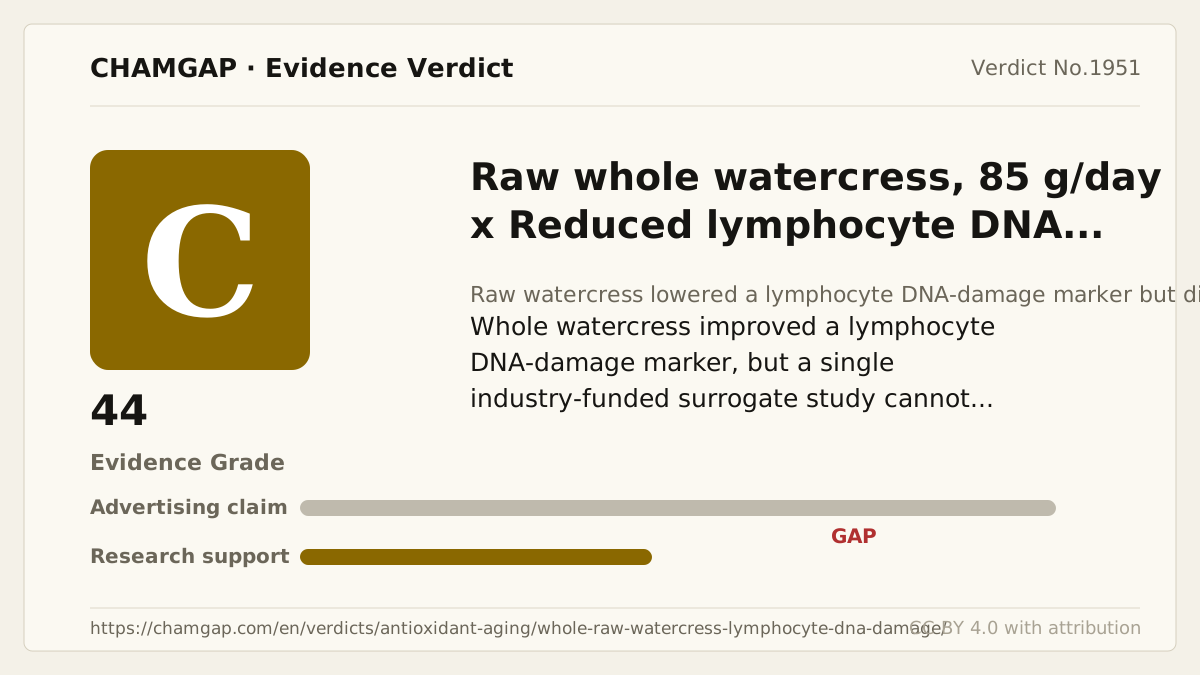
[Chamgap] Raw whole watercress x reduced lymphocyte DNA damage — Evidence Grade C·50. 3 cited sources checked. Source: https://chamgap.com/en/verdicts/antioxidant-aging/whole-raw-watercress-lymphocyte-dna-damage/ · CC BY 4.0CC BY 4.0 — free to use with attribution; do not distort grades, numbers, or verdict meaning.
What this document does and does not do
Chamgap is an information source. It reports what research has and has not confirmed; it does not tell readers what to take or buy. That decision belongs to readers and, when needed, medical or legal professionals. This verdict reflects literature available up to the search date and may change as new research appears. Nothing here is medical advice.