
Volunteering,
does it really help with Reduced all-cause mortality risk during prospective follow-up?
research showsThe grade is C with 54 points. Okun et al. pooled eleven prospective cohorts with about 49,400 participants. The unadjusted pooled estimate was 0.53 (95% CI 0.45-0.62), while the adjusted estimate was 0.76 (0.69-0.84). People healthy enough to volunteer may already live longer, and there was no reported sensitivity analysis excluding early deaths. The original paper did not provide a total death count, so it could not be verified.
ads claimVerdict 2213 is C with 54 points and concerns decline in physical functioning, whereas this verdict concerns death, a hard event. A harder endpoint does not turn a self-selected observational association into proof that volunteering extends life.
Useful facts when choosing a product
- The synthesis covered eleven prospective cohorts with about 49,400 participants; a total death count could not be verified because the paper did not report a sum.
- The unadjusted pooled HR of 0.53 attenuated to the adjusted pooled HR of 0.76.
- Every study adjusted for age, sex, and physical health, but there was no reported early-death exclusion sensitivity analysis.
Chamgap Semantic Classification Code
Candidate index · review held
UNK.unpaid-participation-in-community-or-nonprofit-volunteering.UNK.all-cause-mortality-risk-during-prospective-follow-up.reduce.UNKUnknown > Unpaid participation in community or nonprofit volunteering > Unknown > all-cause mortality risk during prospective follow-up > Reduction claim > Unknown
An automated migration candidate, not an issued permanent code; exact claim scope remains under review. This machine-generated migration candidate helps retrieval but is not a permanent assignment. The original verdict ID and URL remain authoritative.
What the research actually shows
Okun, Yeung, and Brown synthesized mortality estimates from eleven prospective studies involving about 49,400 participants. The original paper did not report a summed death count, so the total number of deaths could not be verified. The unadjusted pooled HR was 0.53 (95% CI 0.45-0.62), while the adjusted pooled HR was 0.76 (0.69-0.84), P<.001, with I-squared 59%. Covariate adjustment shifted HRs an average of 0.20 toward one. Adjustment covered age, sex, physical health, socioeconomic status, health behaviors, marital status, religiosity, emotional health, social connection, ethnicity, employment, cognition, and leisure. There was no reported sensitivity analysis excluding deaths in the first one or two years.
Why this is classified as C (54)
A significant mortality association remained, but healthy-volunteer selection, uneven residual adjustment, and absence of an early-death exclusion analysis produced at least two major limitations, giving C with 54 points.
Counterpoint. Repeated pre-volunteering health trajectories, natural experiments, or instrumental-variable designs could better reduce self-selection and reverse causation.
Rejudgment record. Cross-check applied — Cross-checked the first author, prospective-cohort count and sample, adjusted and unadjusted HRs, covariate categories, heterogeneity, and absence of early-death exclusion analysis
| Endpoint | H | Hard endpoint - actual events such as death |
| Replication | R1 | Single confirmatory trial |
| Independence | I1 | Mixed funding sources |
| Effect size | E+ | Meets the clinically important threshold |
Stored derived and displayed grades match; this is not a current recalculation or validity check (C).
Sub-claim grades by effect
This ingredient is marketed for several effects. A single overall grade blends strong and weak claims together, so each effect is graded separately here. The overall grade reflects the strongest disconfirming or core claim.
| Effect (sub-claim) | Grade | Basis |
|---|---|---|
| Association of volunteering with lower mortality hazard | C | The adjusted pooled HR was 0.76, but all evidence was observational. |
| Causal life extension from volunteering | ? | Healthy-person selection and reverse causation were not excluded. |
Cross-check — AI research and Codex final gate
Evidence Table
| Study | Design | Sample | Funding | Endpoint | Result | Weight |
|---|---|---|---|---|---|---|
| Okun et al. prospective-cohort meta-analysis of volunteering and mortality 2013 | Random-effects meta-analysis of eleven prospective cohorts | Approximately 49,400 participants; total deaths could not be verified because the paper reported no sum | Meta-analysis funded by the US National Institute on Aging; funding across individual cohorts was not consistently established | All-cause mortality during prospective follow-up | Adjusted HR 0.76 (95% CI 0.69 to 0.84), P<.001, I-squared 59%; unadjusted HR 0.53 (0.45 to 0.62). | Large observational synthesis directly addressing mortality, but vulnerable to health selection and reverse causation |
Receipt — 1 References
All 1 cited sources were verified for existence at the original page (as of 2026-08-05).
Final verification and publication gate: Codex · Evidence date: 2026-08-05 · Corrections: none
Cite this verdict
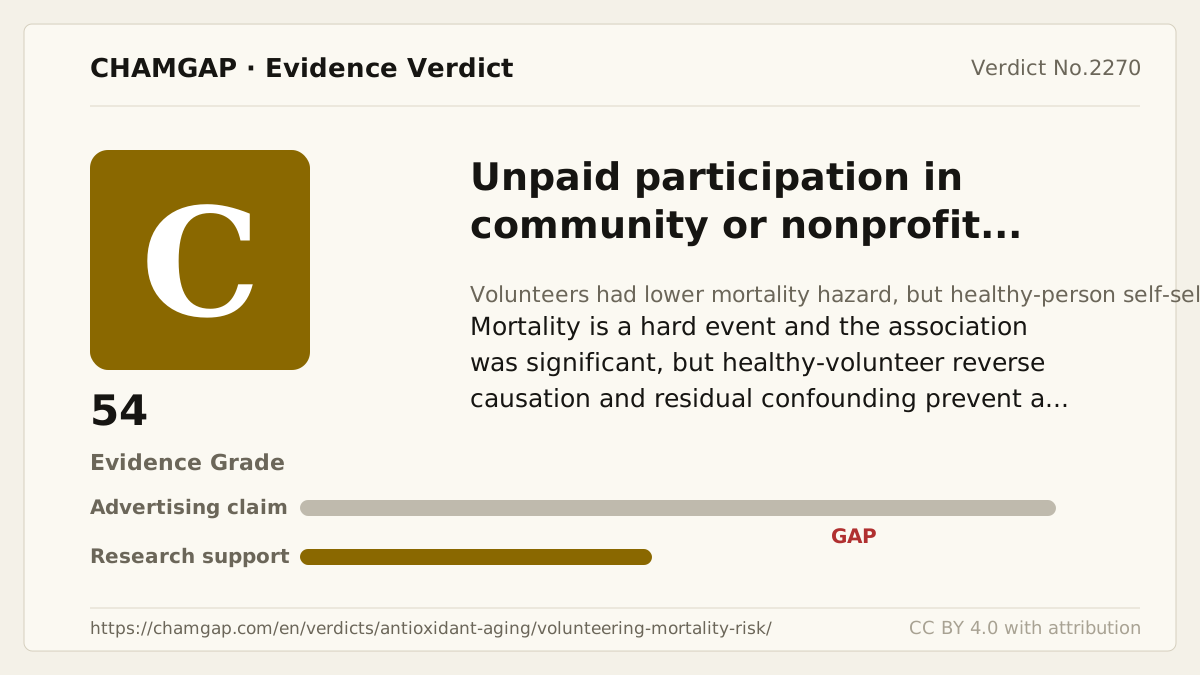
[Chamgap] Volunteering x mortality risk — Evidence Grade C·54. 1 cited sources checked. Source: https://chamgap.com/en/verdicts/antioxidant-aging/volunteering-mortality-risk/ · CC BY 4.0CC BY 4.0 — free to use with attribution; do not distort grades, numbers, or verdict meaning.
What this document does and does not do
Chamgap is an information source. It reports what research has and has not confirmed; it does not tell readers what to take or buy. That decision belongs to readers and, when needed, medical or legal professionals. This verdict reflects literature available up to the search date and may change as new research appears. Nothing here is medical advice.