
Vitamin D3,
does it really help with Slowed biological aging by reducing telomere attrition in middle-aged and older adults?
research showsVitamin D3 2,000 IU/day is rated C because one randomized trial found slightly less leukocyte telomere attrition over four years in middle-aged and older adults. The VITAL-Telomere ancillary study included 1,054 participants and analyzed 2,571 specimens from 1,031 participants. The four-year difference versus placebo was only 0.14 kb less attrition (95% CI 0.007 to 0.27), P=0.039. Leukocyte telomere length is a narrow laboratory surrogate for actual aging rate, healthspan, or lifespan, and the lower confidence bound was close to zero. The parent VITAL trial did not reduce total invasive cancer or major cardiovascular events. The positive result is not a D-level null finding, but actual lifespan and disease reduction remain unproven, supporting the bottom of grade C, C with 42 points.
ads claimPromotion can convert the finding into three years younger telomeres, reversal of cellular aging, or life extension. The study measured average leukocyte telomere attrition; appearance, strength, cognition, frailty, disease incidence, mortality, and lifespan were not established as aging-benefit endpoints. This verdict is specifically about a telomere surrogate and is separate from existing vitamin D verdicts on deficiency, bone outcomes, infections, and other disease-prevention claims.
Useful facts when choosing a product
- VITAL-Telomere used vitamin D3 2,000 IU by mouth each day in an ancillary sample of United States men aged at least 50 and women aged at least 55.
- This dose is not approved as a telomere or anti-aging treatment. The need and dose for deficiency treatment should be assessed separately using vitamin D status, diet and sunlight, bone health, and comorbidities.
- The general adult tolerable upper intake level is 4,000 IU/day from all sources, although clinician-supervised treatment can differ. Total intake should account for overlapping supplements.
- Excess intake can cause hypercalcemia and hypercalciuria, nausea, weakness, confusion, polyuria, thirst, and kidney stones, with severe toxicity causing kidney failure, arrhythmia, and soft-tissue calcification. Thiazide diuretics and high-dose calcium also warrant caution.
Chamgap Semantic Classification Code
Candidate index · review held
S.vitamin-d3.oral.slowed-biological-aging-by-reducing-telomere-attrition-in-middle-aged-and-older-adults.reduce.MULTISupplements and nutraceuticals > Vitamin D3 (cholecalciferol) > Oral > Slowed biological aging by reducing telomere attrition in middle-aged and older adults > Reduction claim > Multiple: primary unresolved
An automated migration candidate, not an issued permanent code; exact claim scope remains under review. This machine-generated migration candidate helps retrieval but is not a permanent assignment. The original verdict ID and URL remain authoritative.
What the research actually shows
VITAL-Telomere by Zhu and colleagues used the two-by-two factorial randomization of vitamin D3 2,000 IU/day and marine omega-3 fatty acids 1 g/day in 1,054 participants from the VITAL Clinical and Translational Science Center ancillary cohort. Leukocyte telomere length was measured by quantitative polymerase chain reaction at baseline, year two, and year four, with 2,571 specimens from 1,031 participants analyzed. Vitamin D3 produced 0.14 kb less attrition over four years and an annual trend difference of 0.035 kb; omega-3 fatty acids had no significant effect. The parent VITAL trial followed 25,871 United States men aged at least 50 and women aged at least 55 for a median 5.3 years. Vitamin D3 did not significantly reduce total invasive cancer, hazard ratio 0.96 (95% CI 0.88 to 1.06), or major cardiovascular events, hazard ratio 0.97 (95% CI 0.85 to 1.12). Those negative endpoints do not refute every aspect of aging, but they show that the telomere difference cannot be translated directly into disease prevention.
Why this is classified as C (42)
VITAL-Telomere was a randomized double-blind ancillary study of 1,054 participants and found only 0.14 kb less leukocyte telomere attrition over four years, with a wide 95% confidence interval of 0.007 to 0.27 and P=0.039. Telomere length is a narrow laboratory surrogate for healthspan, function, disease, and mortality, while the parent VITAL cancer and cardiovascular primary endpoints were negative. The positive signal prevents D, but rule ①-ⓐ and the minimal magnitude give C with 42 points.
Counterpoint. For someone taking vitamin D within recommended limits for deficiency correction or bone health, the telomere result may be an interesting ancillary signal. It is not a reason to increase the dose or push blood concentrations higher for anti-aging purposes.
Rejudgment record. Cross-check applied — Rule ①-ⓐ states that when only a surrogate that substitutes for clinical benefit, such as a biomarker, laboratory measure, or imaging measure, improves, the maximum grade is C. Leukocyte telomere length is a biomarker substituting for actual healthspan, function, disease, and mortality, so the rule applies directly. The 0.14-kb four-year difference is accepted without treating it as confirmed slowing of biological aging or extension of life.
Sub-claim grades by effect
This ingredient is marketed for several effects. A single overall grade blends strong and weak claims together, so each effect is graded separately here. The overall grade reflects the strongest disconfirming or core claim.
| Effect (sub-claim) | Grade | Basis |
|---|---|---|
| Reduced four-year leukocyte telomere attrition with vitamin D3 2,000 IU/day | C | The 1,054-participant ancillary study found 0.14 kb less attrition, but telomere length is a surrogate and the confidence interval was wide. |
| Slower actual biological aging through reduced telomere attrition | C | Telomere preservation is a positive signal, but slower aging was not validated through function, frailty, cognition, or multiple biological-age measures. |
| Extended healthspan or lifespan or reduced age-related disease and death with vitamin D3 | ? | The telomere ancillary study did not test these clinical outcomes, and the parent VITAL cancer and cardiovascular primary endpoints were negative. |
Cross-check — AI research and Codex final gate
Evidence Table
| Study | Design | Sample | Funding | Endpoint | Result | Weight |
|---|---|---|---|---|---|---|
| Zhu H et al. 2025 VITAL-Telomere | Prespecified randomized double-blind two-by-two factorial ancillary study within VITAL | 1,054 included; 2,571 specimens from 1,031 participants analyzed | United States NIH funding from NCCIH, NCI, and NHLBI | Change in leukocyte telomere length from baseline to years two and four | Vitamin D3 2,000 IU/day produced 0.14 kb less four-year telomere attrition than placebo (95% CI 0.007 to 0.27; P=0.039). | Key long-term randomized surrogate signal |
| Manson JE et al.; VITAL Research Group. 2019 | Nationwide randomized double-blind placebo-controlled two-by-two factorial trial | 25,871 middle-aged and older United States adults; median follow-up 5.3 years | Multicomponent United States NIH public funding with some in-kind study-agent support | Total invasive cancer and major cardiovascular events | Vitamin D3 was negative for both primary endpoints: invasive cancer HR 0.96 (95% CI 0.88 to 1.06) and major cardiovascular events HR 0.97 (95% CI 0.85 to 1.12). | Parent trial preventing translation of the telomere result into clinical disease benefit |
| United States NIH Office of Dietary Supplements Vitamin D Fact Sheet. 2025 | Public-agency review of nutrition and safety evidence | Synthesis of dietary reference values, clinical trials, and toxicity evidence | United States NIH public information | Upper intake level, hypercalcemia, renal effects, and drug interactions | Lists an adult upper limit of 4,000 IU/day and warns about hypercalcemia, hypercalciuria, kidney stones, kidney failure, and thiazide interactions from excess intake. | Dose and safety evidence |
Receipt — 3 References
All 3 cited sources were verified for existence at the original page (as of 2026-07-24).
Final verification and publication gate: Codex · Evidence date: 2026-07-24 · Corrections: none
Cite this verdict
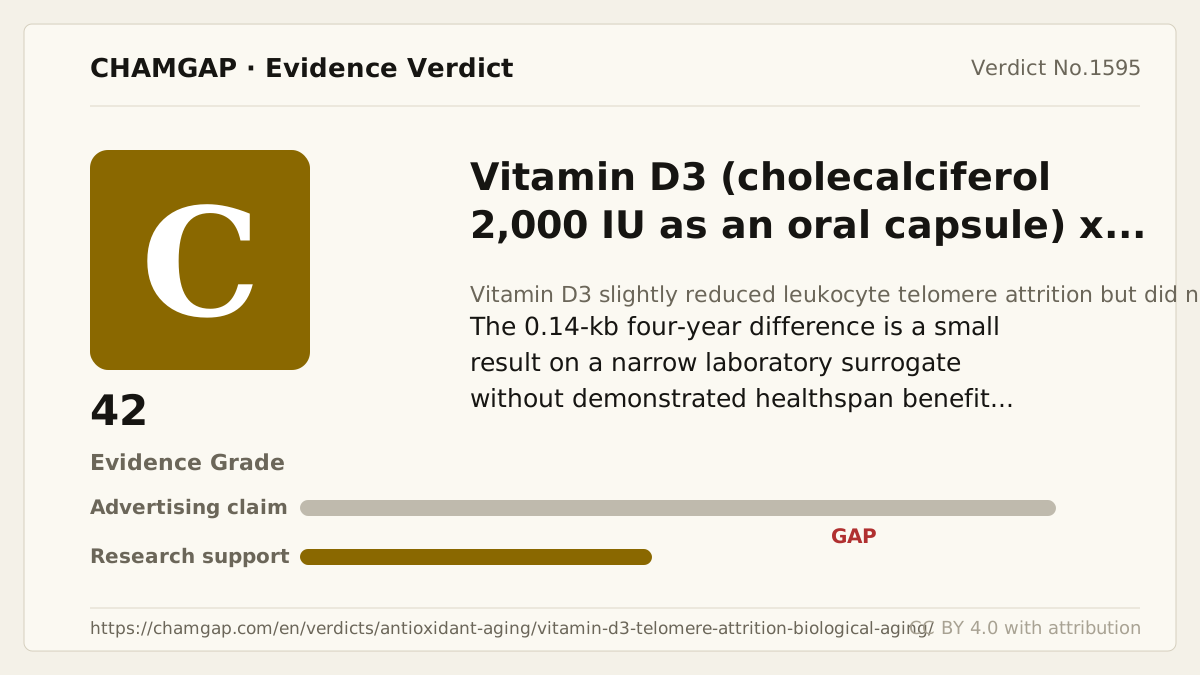
[Chamgap] Vitamin D3 x slowed biological aging through reduced telomere attrition — Evidence Grade C·42. 3 cited sources checked. Source: https://chamgap.com/en/verdicts/antioxidant-aging/vitamin-d3-telomere-attrition-biological-aging/ · CC BY 4.0CC BY 4.0 — free to use with attribution; do not distort grades, numbers, or verdict meaning.
What this document does and does not do
Chamgap is an information source. It reports what research has and has not confirmed; it does not tell readers what to take or buy. That decision belongs to readers and, when needed, medical or legal professionals. This verdict reflects literature available up to the search date and may change as new research appears. Nothing here is medical advice.