
5-Deazaflavin TND1128,
does it really help with Delayed aging and extended healthspan through NAD and mitochondrial activation?
research showsTND1128 is rated ? because no published efficacy result shows that it slows aging or extends healthspan or lifespan in humans. The identified papers examined calcium homeostasis, mitochondrial membrane potential, and ATP-related responses in brain slices from TND1128-treated mice. A ten-person single-arm observational study was registered in Japan in 2026 but is recruiting without results and is not a controlled test of delayed aging or lifespan. NAD-like redox activity and mitochondrial signals are not human clinical efficacy.
ads claimMarketing converts a preclinical mechanism into claims such as stronger than NMN, NAD regeneration, mitochondrial reset, and lifespan extension. Dose, absorption, long-term toxicity, actual content, and clinical effects remain unestablished.
Useful facts when choosing a product
- TND1128 is a 5-deazaflavin derivative sold as a research compound and supplement ingredient, but it is not an approved drug for treating human aging.
- The identified animal papers used subcutaneous pretreatment followed by brain-slice measurements, so they do not establish absorption or effects of marketed oral capsules.
- Independent verification of identity, purity, content, and contamination control is often not publicly available across products.
- Human dose, drug interactions, reproductive toxicity, hepatic and renal effects, and long-term safety have not been established.
Chamgap Semantic Classification Code
Candidate index · review held
S.5-deazaflavin-tnd1128.UNK.delayed-aging-and-extended-healthspan-through-nad-and-mitochondrial-activation.reduce.UNKSupplements and nutraceuticals > 5-Deazaflavin TND1128 > Unknown > Delayed aging and extended healthspan through NAD and mitochondrial activation > Reduction claim > Unknown
An automated migration candidate, not an issued permanent code; exact claim scope remains under review. This machine-generated migration candidate helps retrieval but is not a permanent assignment. The original verdict ID and URL remain authoritative.
What the research actually shows
Takahashi and colleagues in 2023 reported mitigation of cytoplasmic and mitochondrial calcium overload during repeated high-potassium stimulation in brain slices from mice pretreated subcutaneously with TND1128. Their 2024 paper examined mitochondrial membrane potential and on-demand ATP-synthesis signals in mouse brain slices. Neither was an oral human study, and neither measured aging rate, function, disease, or survival. jRCT1030260019, registered in April 2026, is a recruiting open single-arm observational study with a target of ten participants and has no current efficacy result.
Why this is classified as ?
Published TND1128 evidence consists of mechanistic endpoints in mouse brain slices, with no human efficacy result for delayed aging, healthspan, or lifespan. A registered ten-person single-arm study without results is not efficacy evidence, so the grade is ? and the score is null. Unapproved status, quality, and unknown human safety are separate safety issues.
Counterpoint. A standardized oral product could eventually be tested through pharmacokinetics, dose-escalation safety, placebo-controlled functional outcomes, and long-term clinical endpoints. Until then, efficacy language exceeds the evidence.
Rejudgment record. New verdict — Applied the absence-of-human-efficacy-literature rule because identified TND1128 evidence is limited to mechanistic mouse-brain-slice endpoints, with no human result for delayed aging, healthspan, or lifespan
Sub-claim grades by effect
This ingredient is marketed for several effects. A single overall grade blends strong and weak claims together, so each effect is graded separately here. The overall grade reflects the strongest disconfirming or core claim.
| Effect (sub-claim) | Grade | Basis |
|---|---|---|
| Delayed aging and extended healthspan or lifespan in humans | ? | No human efficacy trial with published results was identified. |
| Increased NAD and improved mitochondrial function in humans | ? | Identified signals are limited to mouse brain slices. |
| Clinical efficacy of marketed oral products | ? | No standardized-product pharmacokinetic, dose, or controlled efficacy result exists. |
Cross-check — AI research and Codex final gate
Evidence Table
| Study | Design | Sample | Funding | Endpoint | Result | Weight |
|---|---|---|---|---|---|---|
| Takahashi N et al. 2023 | Ex vivo brain-slice study after TND1128 pretreatment of mice | Mice and brain slices; zero humans | Partly funded by Chemiteras | Cytoplasmic and mitochondrial calcium-overload dynamics | Reported dose-related mitigation, but did not assess aging or healthspan. | Preclinical mechanistic evidence |
| Takahashi N et al. 2024 | Mouse-brain-slice mitochondrial physiology study | Mice and brain slices; zero humans | Academic and product-related support reported | Mitochondrial membrane potential and on-demand ATP synthesis | Reported activation signals without measuring human function, disease, or survival. | Preclinical mechanistic evidence |
Receipt — 2 References
All 2 cited sources were verified for existence at the original page (as of 2026-07-20).
Final verification and publication gate: Codex · Evidence date: 2026-07-20 · Corrections: none
Cite this verdict
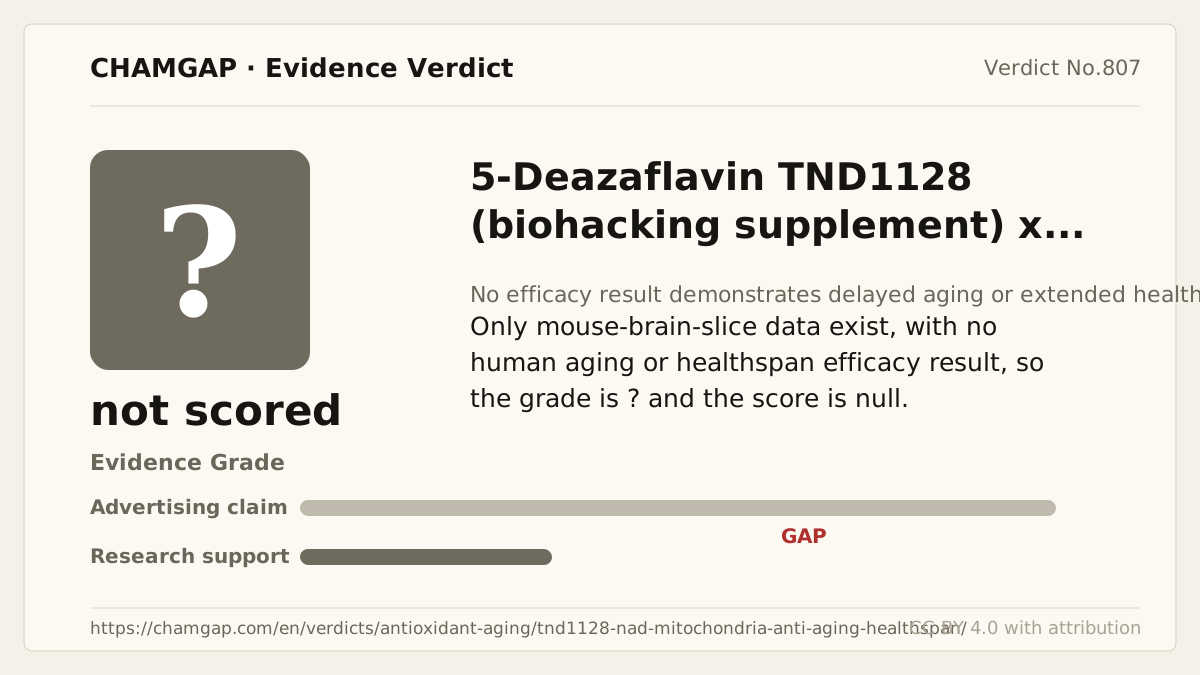
[Chamgap] 5-Deazaflavin TND1128 x delayed aging and extended healthspan — Evidence Grade ?. 2 cited sources checked. Source: https://chamgap.com/en/verdicts/antioxidant-aging/tnd1128-nad-mitochondria-anti-aging-healthspan/ · CC BY 4.0CC BY 4.0 — free to use with attribution; do not distort grades, numbers, or verdict meaning.
What this document does and does not do
Chamgap is an information source. It reports what research has and has not confirmed; it does not tell readers what to take or buy. That decision belongs to readers and, when needed, medical or legal professionals. This verdict reflects literature available up to the search date and may change as new research appears. Nothing here is medical advice.