
Social isolation,
does it really help with Higher all-cause mortality hazard?
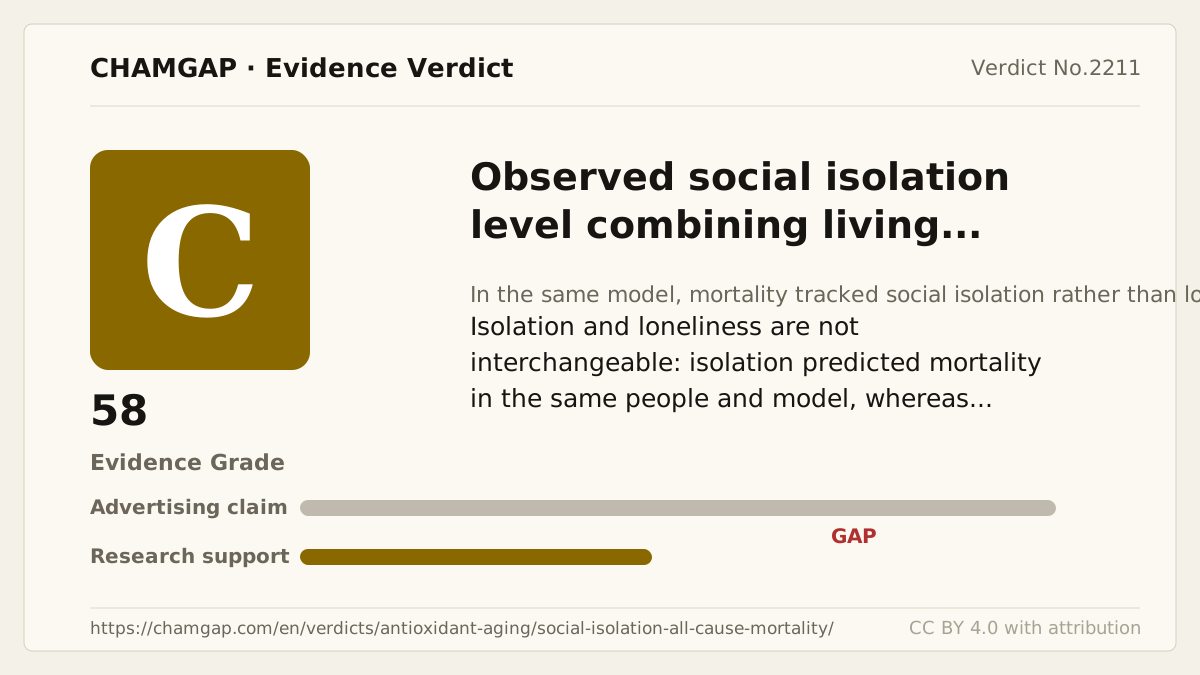
research showsThe grade is C with 56 points. Among 6,500 ELSA participants, 918 died over a mean 7.25 years. In the same model adjusted for health and mobility, high social isolation was associated with mortality, HR 1.26 (95% CI 1.08-1.48), while high loneliness was not, HR 0.92 (0.78-1.09). Contrary to the popular 'loneliness equals 15 cigarettes' wording, the surviving signal in this study concerned objective isolation, not subjective loneliness.
ads claimThe '15 cigarettes a day' phrase was not a direct conversion produced by this cohort. The source and calculation for the 15-cigarette conversion could not be verified within this review, so it was not used as evidence for the grade.
Useful facts when choosing a product
- ELSA measured social isolation from living arrangements, family and friend contact, and organizational participation, while loneliness used a separate UCLA scale.
- In the same fully adjusted model, isolation had HR 1.26 (1.08-1.48) and loneliness had HR 0.92 (0.78-1.09).
- The source and calculation for the 15-cigarette conversion could not be verified and were not used as grading evidence.
Chamgap Semantic Classification Code
Candidate index · review held
UNK.observed-social-isolation-level-combining-living-arrangements.UNK.higher-all-cause-mortality-hazard.increase.MULTIUnknown > Observed social isolation level combining living arrangements > Unknown > Higher all-cause mortality hazard > Increase claim > Multiple: primary unresolved
An automated migration candidate, not an issued permanent code; exact claim scope remains under review. This machine-generated migration candidate helps retrieval but is not a permanent assignment. The original verdict ID and URL remain authoritative.
What the research actually shows
Steptoe followed 6,500 ELSA participants from 2004-2005 to March 2012, a mean 7.25 years. There were 918 deaths (14.1%). Observed mortality proportions were 21.9% versus 12.3% for high versus lower isolation and 19.2% versus 13.0% for high versus lower loneliness. The comparator was observational, contrasting each high-exposure group with the remainder, not no treatment, a waitlist, or an active control. Fully adjusted HRs were 1.26 (1.08-1.48) and 0.92 (0.78-1.09), respectively. A first-two-year death exclusion analysis was performed and retained the conclusion, but randomization was absent. Funding included the US National Institute on Aging and a consortium of UK government departments.
Why this is classified as C (56)
An objective mortality association appeared in a large publicly supported cohort, but observational exposure cannot establish an intervention effect and the social-relationship meta-analysis had 81% heterogeneity, giving C with 56 points.
Counterpoint. This is not evidence that a social-connection program reduces mortality, and loneliness itself was null after full adjustment in the pivotal cohort.
Rejudgment record. Cross-check applied — Credited the adjusted objective mortality association and early-death exclusion analysis while accounting for observational reverse causation, residual confounding, and high meta-analytic heterogeneity
| Endpoint | H | Hard endpoint - actual events such as death |
| Replication | R1 | Single confirmatory trial |
| Independence | I2 | Decisive evidence is publicly or non-profit funded |
| Effect size | E+ | Meets the clinically important threshold |
Stored derived and displayed grades match; this is not a current recalculation or validity check (C).
Sub-claim grades by effect
This ingredient is marketed for several effects. A single overall grade blends strong and weak claims together, so each effect is graded separately here. The overall grade reflects the strongest disconfirming or core claim.
| Effect (sub-claim) | Grade | Basis |
|---|---|---|
| Association of social isolation with higher all-cause mortality | C | The fully adjusted HR was 1.26, but exposure was observational. |
| Independent association of loneliness itself with higher all-cause mortality | D | The same fully adjusted model was null at HR 0.92. |
Cross-check — AI research and Codex final gate
Evidence Table
| Study | Design | Sample | Funding | Endpoint | Result | Weight |
|---|---|---|---|---|---|---|
| Steptoe et al. ELSA cohort 2013 | Prospective observational cohort | 6,500 participants and 918 deaths | US National Institute on Aging, a UK government-department consortium, and nonprofit support | All-cause mortality over a mean 7.25 years | Fully adjusted HR 1.26 (1.08-1.48) for isolation and 0.92 (0.78-1.09) for loneliness; excluding first-two-year deaths retained the conclusion. | Pivotal evidence contrasting isolation and loneliness in the same model |
| Holt-Lunstad et al. meta-analysis 2010 | Meta-analysis of prospective observational studies | 148 studies and 308,849 participants | Brigham Young University and TP Industrial support | All-cause mortality and survival | Survival OR 1.50 (1.42-1.59) with stronger relationships; I-squared 81% (78%-84%). | Broad supporting evidence on social relationships and survival, not grading evidence for the 15-cigarette conversion |
Receipt — 3 References
All 3 cited sources were verified for existence at the original page (as of 2026-08-04).
Final verification and publication gate: Codex · Evidence date: 2026-08-04 · Corrections: none
Cite this verdict
[Chamgap] Social isolation x higher all-cause mortality — Evidence Grade C·56. 3 cited sources checked. Source: https://chamgap.com/en/verdicts/antioxidant-aging/social-isolation-all-cause-mortality/ · CC BY 4.0CC BY 4.0 — free to use with attribution; do not distort grades, numbers, or verdict meaning.
What this document does and does not do
Chamgap is an information source. It reports what research has and has not confirmed; it does not tell readers what to take or buy. That decision belongs to readers and, when needed, medical or legal professionals. This verdict reflects literature available up to the search date and may change as new research appears. Nothing here is medical advice.