
Sleep regularity,
does it really help with Reduced all-cause mortality?
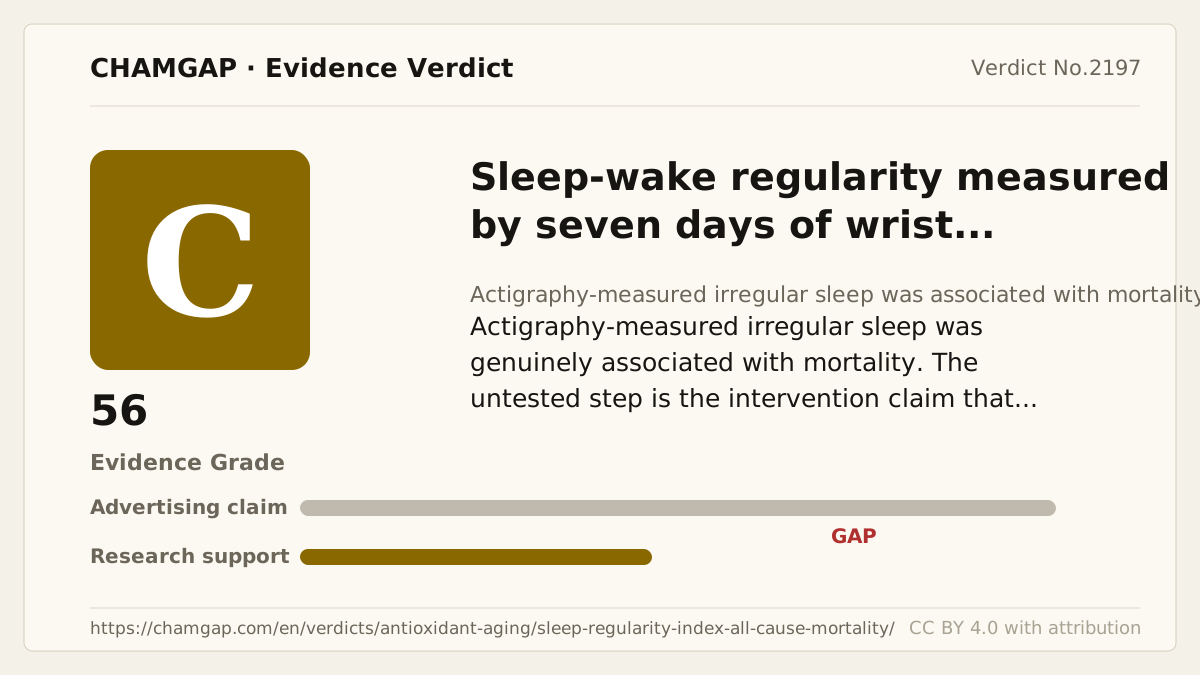
research showsThe grade is C with 56 points. In 88,975 UK Biobank participants wearing wrist accelerometers for seven days, 3,010 deaths occurred over a mean 7.1 years. Relative to median SRI 60, SRI 41 at the 5th percentile had mortality HR 1.53 (95% CI 1.41-1.66), while SRI 75 had HR 0.90 (0.81-1.00). Objective exposure and actual deaths are strengths, but one seven-day observational measurement does not prove that making sleep times regular extends life.
ads claimThe 0-to-100 device metric summarizes association; it is not a validated instruction to keep bedtime and wake time within a particular number of minutes.
Useful facts when choosing a product
- SRI is the seven-day average probability of matching sleep or wake state at time points 24 hours apart, scaled from 0 to 100.
- Median SRI was 60; the 5th and 95th percentiles were 41 and 75.
- Verdict 2199 is C with 54 points for sleep duration and mortality. This verdict asks about timing regularity, not duration.
Chamgap Semantic Classification Code
Candidate index · review held
UNK.sleep-wake-regularity-measured-by-of-wrist-accelerometry.UNK.all-cause-mortality.reduce.UNKUnknown > Sleep-wake regularity measured by of wrist accelerometry > Unknown > all-cause mortality > Reduction claim > Unknown
An automated migration candidate, not an issued permanent code; exact claim scope remains under review. This machine-generated migration candidate helps retrieval but is not a permanent assignment. The original verdict ID and URL remain authoritative.
What the research actually shows
Exposure was seven days of continuous 24-hour wrist accelerometry, not self-report. However, only the accelerometry subset with valid data, 88,975 of the larger UK Biobank, entered analysis after substantial selection. The study did not report a blanket exclusion of early deaths; it modeled time-varying hazards instead. Persistence after sleep-duration adjustment came from sensitivity model 2, not the primary analysis. Verdict 2199 is C with 54 points, but it did not adjust for a regularity index, creating an asymmetry; the two verdicts were not double-counted as independent replication. Funding came from NHMRC, NIA, the Alzheimer's Association, and the Banting Fellowship Program, and no competing interests were declared.
Why this is classified as C (56)
Objective seven-day exposure and 3,010 actual deaths are strengths, while persistence after sleep-duration adjustment appeared in sensitivity model 2. One observational analysis, substantial selection, and early hazard attenuation leave reverse causation, giving C with 56 points.
Counterpoint. A long-term intervention that changes sleep timing should prespecify cardiovascular events if mortality is impractical.
Rejudgment record. Cross-check applied — The eLife article and appendix were checked for SRI computation, seven-day accelerometry, denominator and deaths, sleep-duration-adjusted hazard ratios, time-varying hazards, and funding
| Endpoint | H | Hard endpoint - actual events such as death |
| Replication | R1 | Single confirmatory trial |
| Independence | I2 | Decisive evidence is publicly or non-profit funded |
| Effect size | E+ | Meets the clinically important threshold |
Stored derived and displayed grades match; this is not a current recalculation or validity check (C).
Sub-claim grades by effect
This ingredient is marketed for several effects. A single overall grade blends strong and weak claims together, so each effect is graded separately here. The overall grade reflects the strongest disconfirming or core claim.
| Effect (sub-claim) | Grade | Basis |
|---|---|---|
| Association of irregular sleep with all-cause mortality | C | A sizable association remained in the accelerometry cohort. |
| Making bed and wake times regular reduces mortality | ? | No human intervention trial has changed regularity and measured mortality. |
Cross-check — AI research and Codex final gate
Evidence Table
| Study | Design | Sample | Funding | Endpoint | Result | Weight |
|---|---|---|---|---|---|---|
| Cribb L et al., eLife, 2023 | Prospective UK Biobank accelerometry cohort | 88,975 participants; mean 7.1 years; 3,010 deaths | NHMRC, NIA, Alzheimer's Association, and Banting Fellowship | All-cause, cardiovascular, and cancer mortality | SRI 41 versus 60: HR 1.53 (1.41-1.66); with sleep-duration adjustment, HR 1.42 (1.31-1.55) | Core observational evidence with objective exposure and actual deaths |
Receipt — 1 References
All 1 cited sources were verified for existence at the original page (as of 2026-08-04).
Final verification and publication gate: Codex · Evidence date: 2026-08-04 · Corrections: none
Cite this verdict
[Chamgap] Sleep regularity x reduced all-cause mortality — Evidence Grade C·56. 1 cited sources checked. Source: https://chamgap.com/en/verdicts/antioxidant-aging/sleep-regularity-index-all-cause-mortality/ · CC BY 4.0CC BY 4.0 — free to use with attribution; do not distort grades, numbers, or verdict meaning.
What this document does and does not do
Chamgap is an information source. It reports what research has and has not confirmed; it does not tell readers what to take or buy. That decision belongs to readers and, when needed, medical or legal professionals. This verdict reflects literature available up to the search date and may change as new research appears. Nothing here is medical advice.