
About seven hours of sleep,
does it really help with Lower all-cause mortality than shorter or longer sleep?
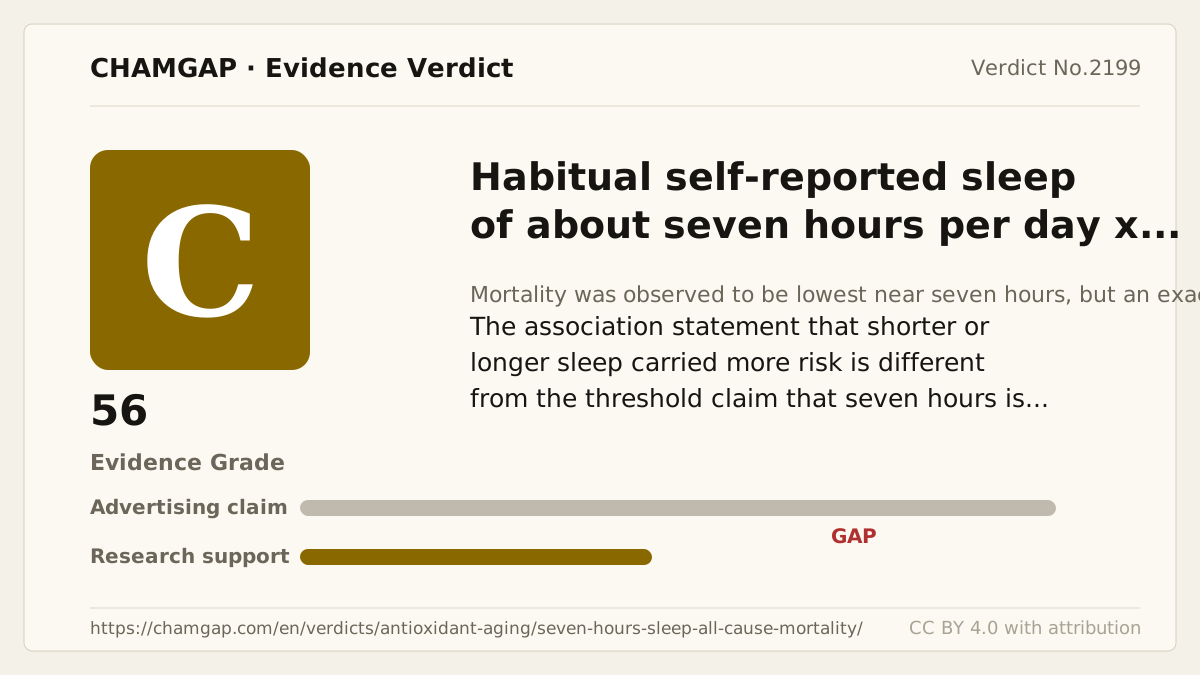
research showsThe grade is C with 54 points. A 2017 dose-response meta-analysis synthesized 67 articles with 3,582,016 participants and 241,107 all-cause deaths and found a U-shaped curve with lowest risk near seven hours. Below seven hours, each hour less had RR 1.06 (95% CI 1.04-1.07); above seven, each hour more had RR 1.13 (1.11-1.15). All exposure was questionnaire or interview self-report, so the association does not prove that changing sleep to seven hours extends life.
ads claimThe statement that observed risk was lowest near seven hours is not the same as proving that an individual will live longer by switching to exactly seven hours.
Useful facts when choosing a product
- The 2017 core meta-analysis included 67 articles, 3,582,016 participants, and 241,107 all-cause deaths.
- Sleep duration was assessed by self-completed questionnaire in 48 studies and interview in 19.
- Verdict 2197 is C with 56 points for sleep timing regularity and mortality. The two verdicts assess duration and regularity separately.
Chamgap Semantic Classification Code
Candidate index · review held
UNK.habitual-self-reported-sleep-of-about.UNK.all-cause-mortality-than-shorter-or-longer-sleep.reduce.UNKUnknown > Habitual self-reported sleep of about > Unknown > all-cause mortality than shorter or longer sleep > Reduction claim > Unknown
An automated migration candidate, not an issued permanent code; exact claim scope remains under review. This machine-generated migration candidate helps retrieval but is not a permanent assignment. The original verdict ID and URL remain authoritative.
What the research actually shows
All 67 articles in the 2017 analysis measured sleep by questionnaire or interview. Cohorts differed in early-death exclusion and adjustment for baseline illness, depression, sleep apnea, and employment, so early-event exclusion cannot be claimed uniformly. Reverse causation is especially strong for long sleep because preclinical illness can increase time in bed. Verdict 2197 is C with 56 points and adjusted for sleep duration in a sensitivity model, whereas this analysis did not adjust for a sleep-regularity index. Because of that asymmetry, the verdicts were not double-counted as independent replication. The meta-analysis had Chinese public funding, but funding for every underlying cohort was not uniformly verified.
Why this is classified as C (54)
Associations across millions of participants and more than 240,000 deaths are statistically robust, but all are observational self-report with inconsistent confounding and early-death handling, especially problematic for long sleep; this gives C with 54 points.
Counterpoint. Repeated objective sleep measurement with time-varying illness, employment, and depression and early-death exclusion is needed.
Rejudgment record. Cross-check applied — The 2017 and 2018 primary reviews were separated and cross-checked for study, participant, and death counts, self-report, short- and long-side risk ratios, overlapping cohorts, reverse causation, and funding
| Endpoint | H | Hard endpoint - actual events such as death |
| Replication | R1 | Single confirmatory trial |
| Independence | I1 | Mixed funding sources |
| Effect size | E+ | Meets the clinically important threshold |
Stored derived and displayed grades match; this is not a current recalculation or validity check (C).
Sub-claim grades by effect
This ingredient is marketed for several effects. A single overall grade blends strong and weak claims together, so each effect is graded separately here. The overall grade reflects the strongest disconfirming or core claim.
| Effect (sub-claim) | Grade | Basis |
|---|---|---|
| Observed all-cause mortality is lowest near seven hours | C | Large cohort syntheses show a U-shaped association. |
| Changing sleep to exactly seven hours extends life | ? | No human intervention study has tested mortality from this exact prescription. |
Cross-check — AI research and Codex final gate
Evidence Table
| Study | Design | Sample | Funding | Endpoint | Result | Weight |
|---|---|---|---|---|---|---|
| Yin J et al., Journal of the American Heart Association, 2017 | Dose-response meta-analysis of prospective cohorts | 67 articles, 3,582,016 participants, and 241,107 all-cause deaths | Chinese public funding including NSFC; funding for all source cohorts not uniformly verified | All-cause mortality and cardiovascular events | Below seven hours, RR 1.06 (1.04-1.07) per hour less; above seven, RR 1.13 (1.11-1.15) per hour more | Core evidence for a U-shaped relation near seven hours |
| Kwok CS et al., Journal of the American Heart Association, 2018 | Dose-response meta-analysis of self-reported sleep cohorts | 74 studies and 3,340,684 participants; 44 mortality-reporting studies with 2,564,029 participants and 242,240 deaths | No external funding reported | All-cause mortality and cardiovascular events | No linear increase below seven hours; RR 1.14 at nine, 1.30 at ten, and 1.47 at eleven hours | Supporting long-sleep evidence with overlapping source cohorts |
Receipt — 2 References
Of 2 cited sources, 1 had limited original-page access (blocked or summary-only) and were verified via index/summary, marked partial; the rest were verified at the original page. As of 2026-08-04.
Final verification and publication gate: Codex · Evidence date: 2026-08-04 · Corrections: none
Cite this verdict
[Chamgap] About seven hours of sleep x lowest all-cause mortality — Evidence Grade C·54. 2 cited sources checked. Source: https://chamgap.com/en/verdicts/antioxidant-aging/seven-hours-sleep-all-cause-mortality/ · CC BY 4.0CC BY 4.0 — free to use with attribution; do not distort grades, numbers, or verdict meaning.
What this document does and does not do
Chamgap is an information source. It reports what research has and has not confirmed; it does not tell readers what to take or buy. That decision belongs to readers and, when needed, medical or legal professionals. This verdict reflects literature available up to the search date and may change as new research appears. Nothing here is medical advice.