
Royal jelly,
does it really help with Slowed biological aging and extended healthspan or lifespan in healthy adults?
research showsRoyal jelly is rated ? because no human efficacy literature tests whether it slows biological aging or extends healthspan or lifespan in healthy adults. A 2019 review of aging and longevity found positive evidence mainly in honeybees, fruit flies, crickets, silkworms, nematodes, mice, and cultured human cells, and explicitly called for clinical trials of the rate of biological aging in humans. Lifespan extension from major royal-jelly proteins in fruit flies and changes in motor or gut function in naturally aging mice are preclinical evidence; they do not test human epigenetic age, survival free of frailty, disease-free survival, or total lifespan. Some human royal-jelly studies have measured metabolic, strength, fatigue, or stem-cell markers, but those studies do not match this composite aging and longevity claim. The score is therefore null. Rare anaphylaxis or asthma in people with atopy, asthma, or bee-product allergy remains a separate safety issue.
ads claimMarketing converts queen-bee longevity and 10-HDA or antioxidant measurements into human claims of stopped aging, longer healthspan, or longevity. An older United States Federal Trade Commission administrative record found a specific Gelee Royale royal-jelly product's claim that it helped delay the aging process false and misleading. That old product-specific advertising matter was not used to determine the current efficacy grade, and animal biology cannot establish human long-term survival efficacy.
Useful facts when choosing a product
- Royal jelly is a complex honeybee secretion whose 10-HDA, protein, and water content can vary with bee species, season, geography, harvesting, drying, and storage.
- A 10-HDA concentration can serve as a product-characterization or quality measure, but it is not a clinical efficacy marker proving slower biological aging or longer human life.
- No dose and duration have been validated for human biological aging, healthspan, or lifespan, so animal doses or short human trials for other purposes cannot be converted into a longevity regimen.
- Royal jelly can rarely cause urticaria, worsening asthma, or systemic anaphylaxis; people with atopy, asthma, or allergy to bees or other bee products should avoid it or seek specialist advice.
Chamgap Semantic Classification Code
Candidate index · review held
S.royal-jelly.UNK.slowed-biological-aging-and-extended-healthspan-or-lifespan.assess.UNKSupplements and nutraceuticals > Royal jelly > Unknown > Slowed biological aging and extended healthspan or lifespan > Association or change assessment > Unknown
An automated migration candidate, not an issued permanent code; exact claim scope remains under review. This machine-generated migration candidate helps retrieval but is not a permanent assignment. The original verdict ID and URL remain authoritative.
What the research actually shows
Kunugi and Ali reviewed royal jelly, royalactin, major royal-jelly proteins, 10-HDA, and the aging and longevity literature. Lifespan extension was observed mainly in invertebrates and mice, while human material concerned cells, age-related disorders, or limited health markers. Xin and colleagues fed fruit flies diets containing 1.25% to 5% major royal-jelly proteins and increased mean lifespan at some doses, but species, dose, and food intake differ fundamentally from human supplementation. Chen and colleagues used long-term administration in naturally aging mice and measured aging-related function and gut outcomes, not human survival. Human randomized trials identified in the search concerned strength, metabolic measures, bone metabolism, fatigue, or stem-cell markers rather than the target biological-aging, healthspan, or lifespan endpoints.
Why this is classified as ?
Positive aging and lifespan literature centers on honeybees, fruit flies, nematodes, mice, and cultured human cells, with zero oral human efficacy trials matching the target endpoints in healthy adults. Human metabolic, strength, and fatigue studies were not transferred because they do not measure biological-aging rate, healthspan, or lifespan. The result is ? with a null score. Product-composition variation and anaphylaxis risk remain safety issues independent of the evidence gap.
Counterpoint. Reassessment requires an independent trial of standardized royal jelly over an adequate duration that prespecifies validated aging clocks, survival free of frailty and multimorbidity, and long-term clinical events. Short-term antioxidant capacity or a single biomarker cannot establish healthspan or lifespan.
Rejudgment record. New verdict — Applied ? because no completed published human efficacy literature gives oral royal jelly to healthy adults and evaluates a validated biological-aging rate, healthspan, or total lifespan. Used positive bee, fruit-fly, nematode, mouse, and cultured-human-cell findings and human metabolic, strength, or fatigue outcomes only as preclinical or endpoint-mismatched context, and kept this longevity axis separate from fatigue and vitality verdict 281
Sub-claim grades by effect
This ingredient is marketed for several effects. A single overall grade blends strong and weak claims together, so each effect is graded separately here. The overall grade reflects the strongest disconfirming or core claim.
| Effect (sub-claim) | Grade | Basis |
|---|---|---|
| Slower biological-aging rate in healthy adults | ? | No completed published human efficacy trial has evaluated oral royal jelly with DNA-methylation age, multiple validated aging clocks, or comparable measures. The older Federal Trade Commission finding on advertising for a specific Gelee Royale product is a regulatory record, not evidence used to determine this question-mark grade. |
| Extended healthspan in healthy adults | ? | No human trial has compared royal jelly with placebo for survival free of frailty, multimorbidity, or disability. |
| Extended total lifespan in healthy adults | ? | No royal-jelly supplementation trial has used human mortality or survival time as an efficacy endpoint. |
Cross-check — AI research and Codex final gate
Evidence Table
| Study | Design | Sample | Funding | Endpoint | Result | Weight |
|---|---|---|---|---|---|---|
| Kunugi H and Ali AM. 2019 | Review of animal, cellular, and human aging-related literature | Multispecies preclinical literature; zero randomized human trials matching biological-aging, healthspan, or lifespan endpoints | Supported by the Japan AMED Strategic Research Program for Brain Sciences | Lifespan, healthspan, aging-related pathways, and human age-related health measures | Summarized positive signals across multiple animals and cultured human cells but concluded that clinical trials of human biological-aging rate are needed. | Evidence-gap confirmation for the human target |
| Xin XX et al. 2016 | Dietary lifespan experiment in fruit flies | Drosophila melanogaster; no human participants | Funding source not reported in the PubMed abstract | Mean lifespan, feeding, fecundity, antioxidant measures, and EGFR signaling | Some doses of major royal-jelly proteins increased mean lifespan in male and female fruit flies. | Positive preclinical evidence with major human indirectness |
| Chen L et al. 2024 | Long-term intervention study in naturally aging mice | Naturally aging mice; no human participants | Funding source not reported in the PubMed abstract | Aging-related functional and metabolic outcomes and gut function | Long-term royal jelly altered some aging-related disorders and gut function but did not test human aging rate or survival. | Mammalian preclinical evidence, not human efficacy |
Receipt — 4 References
All 4 cited sources were verified for existence at the original page (as of 2026-07-21).
Final verification and publication gate: Codex · Evidence date: 2026-07-21 · Corrections: none
Cite this verdict
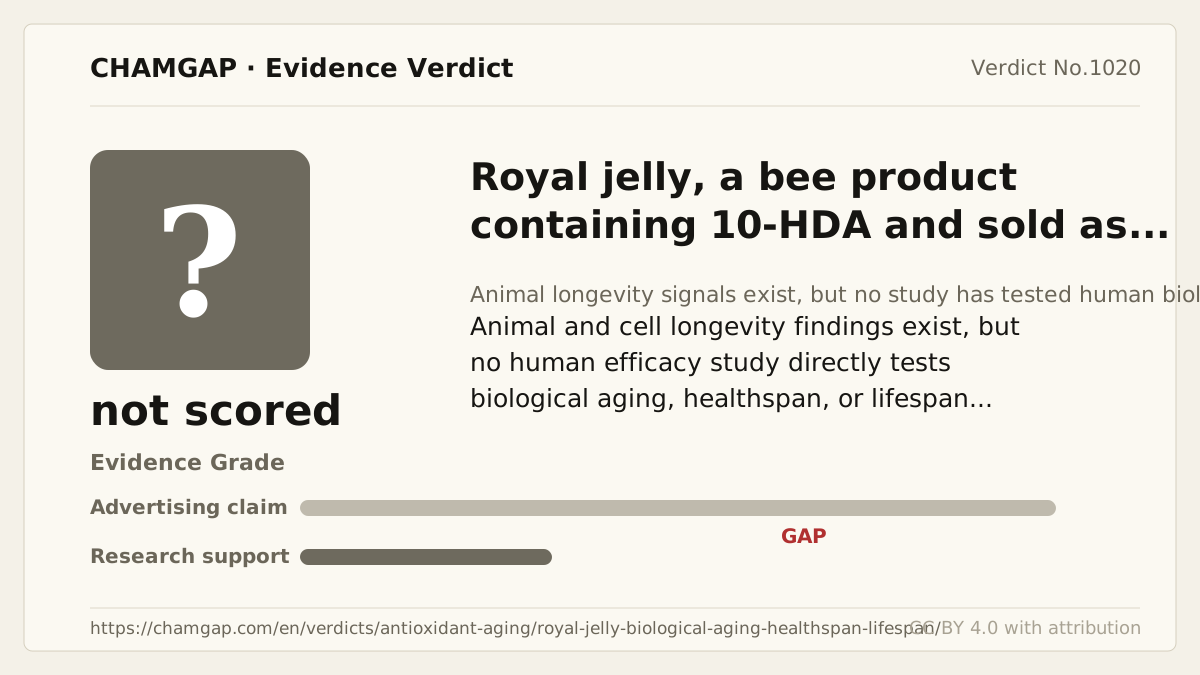
[Chamgap] Royal jelly x slowed biological aging and extended healthspan or lifespan in healthy adults — Evidence Grade ?. 4 cited sources checked. Source: https://chamgap.com/en/verdicts/antioxidant-aging/royal-jelly-biological-aging-healthspan-lifespan/ · CC BY 4.0CC BY 4.0 — free to use with attribution; do not distort grades, numbers, or verdict meaning.
What this document does and does not do
Chamgap is an information source. It reports what research has and has not confirmed; it does not tell readers what to take or buy. That decision belongs to readers and, when needed, medical or legal professionals. This verdict reflects literature available up to the search date and may change as new research appears. Nothing here is medical advice.