
Residential greenness,
does it really help with Lower hazard of nonaccidental all-cause mortality?
research showsThe grade is C with 56 points. A US cohort followed 108,630 nurses from 2000 through 2008 and recorded 8,604 deaths. Women in the highest quintile of cumulative NDVI within 250 meters of home had 12% lower nonaccidental mortality hazard than the lowest quintile, HR 0.88 (95% CI 0.82 to 0.94). Satellite greenness, however, did not measure how much nature each person actually used.
ads claimThis is an observational association with greener addresses. It does not guarantee that choosing a particular home, park, or tourism product will extend an individual's life.
Useful facts when choosing a product
- NDVI is calculated from red and near-infrared reflectance and does not directly measure time spent in nature.
- The cohort recorded 8,604 nonaccidental deaths over 627,008 person-years among 108,630 women.
- The highest-versus-lowest quintile HR for cumulative 250-meter NDVI was 0.88 (0.82-0.94).
Chamgap Semantic Classification Code
Candidate index · review held
UNK.satellite-derived-normalized-difference-vegetation-index-within-250-meters-of-residence.UNK.hazard-of-nonaccidental-all-cause-mortality.reduce.MULTIUnknown > Satellite-derived normalized difference vegetation index within 250 meters of residence > Unknown > hazard of nonaccidental all-cause mortality > Reduction claim > Multiple: primary unresolved
An automated migration candidate, not an issued permanent code; exact claim scope remains under review. This machine-generated migration candidate helps retrieval but is not a permanent assignment. The original verdict ID and URL remain authoritative.
What the research actually shows
The Nurses' Health Study analyzed 108,630 women, 627,008 person-years, and 8,604 nonaccidental deaths. Exposure was cumulative satellite NDVI in 250-meter and 1,250-meter buffers linked to address histories. The fully adjusted model included age, race and ethnicity, smoking status and pack-years, each parent's occupation, registered-nurse degree, marital status, spouse's education, and census-tract median home value and median income. US region was examined through stratification and effect-modification checks, not entered as a main-model adjustment variable; urbanicity, moves, physical activity, PM2.5, social engagement, and mental health were also examined. An analysis excluding deaths in the first one or two years was not identified in the paper. Restricting movers gave similar results but could not remove health-related residential selection. NIH grants funded the work. The observational comparator was the lowest NDVI quintile, not no treatment, a waitlist, or an active control.
Why this is classified as C (56)
The positive association with objective deaths is credible, but personal-exposure misclassification and residual confounding in a single observational evidence stream give C with 56 points.
Counterpoint. An association between greenness and mortality is different from evidence that greening or moving extends life.
Rejudgment record. Cross-check applied — Cross-checked satellite NDVI definition, death counts, socioeconomic, urbanicity and air-pollution adjustment, and whether early deaths were excluded
| Endpoint | H | Hard endpoint - actual events such as death |
| Replication | R1 | Single confirmatory trial |
| Independence | I2 | Decisive evidence is publicly or non-profit funded |
| Effect size | E+ | Meets the clinically important threshold |
Stored derived and displayed grades match; this is not a current recalculation or validity check (C).
Sub-claim grades by effect
This ingredient is marketed for several effects. A single overall grade blends strong and weak claims together, so each effect is graded separately here. The overall grade reflects the strongest disconfirming or core claim.
| Effect (sub-claim) | Grade | Basis |
|---|---|---|
| Lower nonaccidental all-cause mortality | C | The highest-versus-lowest quintile HR was 0.88. |
| Greater personal exposure to nature | ? | NDVI measured vegetation around home, not personal time in nature. |
| Longer life caused by greening or moving | ? | This evidence did not randomize a greening or residential-move intervention. |
Cross-check — AI research and Codex final gate
Evidence Table
| Study | Design | Sample | Funding | Endpoint | Result | Weight |
|---|---|---|---|---|---|---|
| James et al. Nurses' Health Study 2016 | Nationwide prospective cohort | 108,630 participants, 627,008 person-years, and 8,604 deaths | NIH grants T32 HL098048, UM1 CA186107, and R01 ES017017 | Nonaccidental all-cause and cause-specific mortality from 2000 to 2008 | Highest versus lowest quintile of cumulative 250-meter NDVI: HR 0.88 (0.82-0.94). | Pivotal large mortality-event evidence |
Receipt — 1 References
All 1 cited sources were verified for existence at the original page (as of 2026-08-04).
Final verification and publication gate: Codex · Evidence date: 2026-08-04 · Corrections: none
Cite this verdict
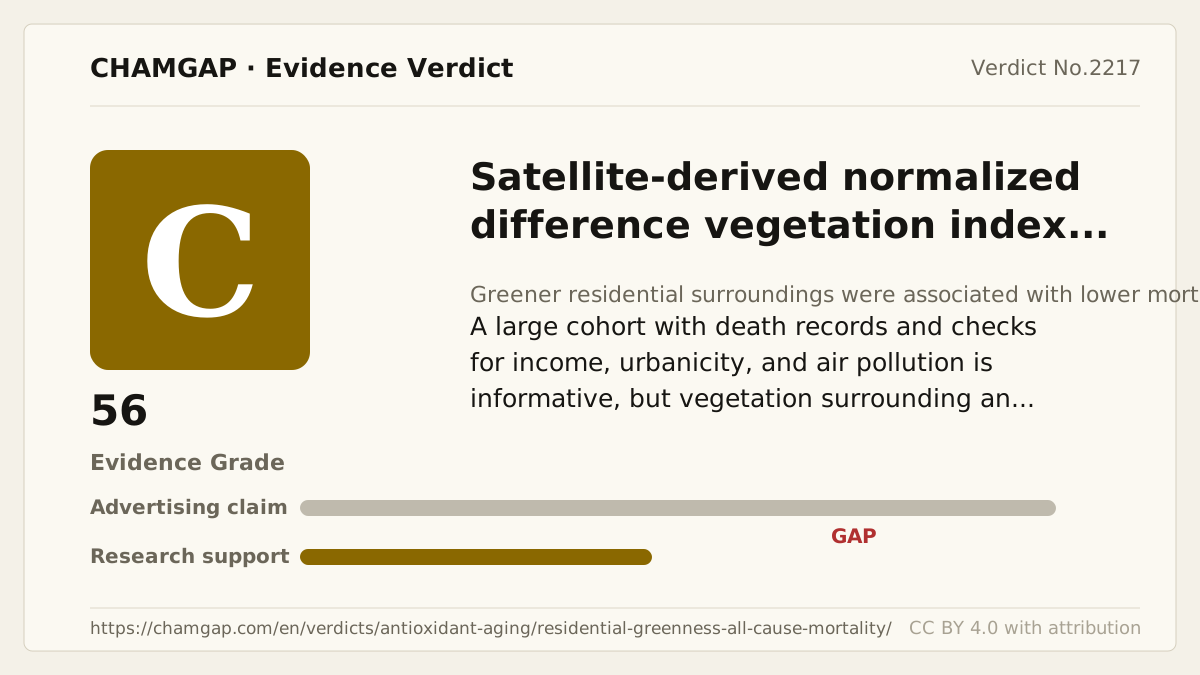
[Chamgap] Residential greenness x lower all-cause mortality — Evidence Grade C·56. 1 cited sources checked. Source: https://chamgap.com/en/verdicts/antioxidant-aging/residential-greenness-all-cause-mortality/ · CC BY 4.0CC BY 4.0 — free to use with attribution; do not distort grades, numbers, or verdict meaning.
What this document does and does not do
Chamgap is an information source. It reports what research has and has not confirmed; it does not tell readers what to take or buy. That decision belongs to readers and, when needed, medical or legal professionals. This verdict reflects literature available up to the search date and may change as new research appears. Nothing here is medical advice.