
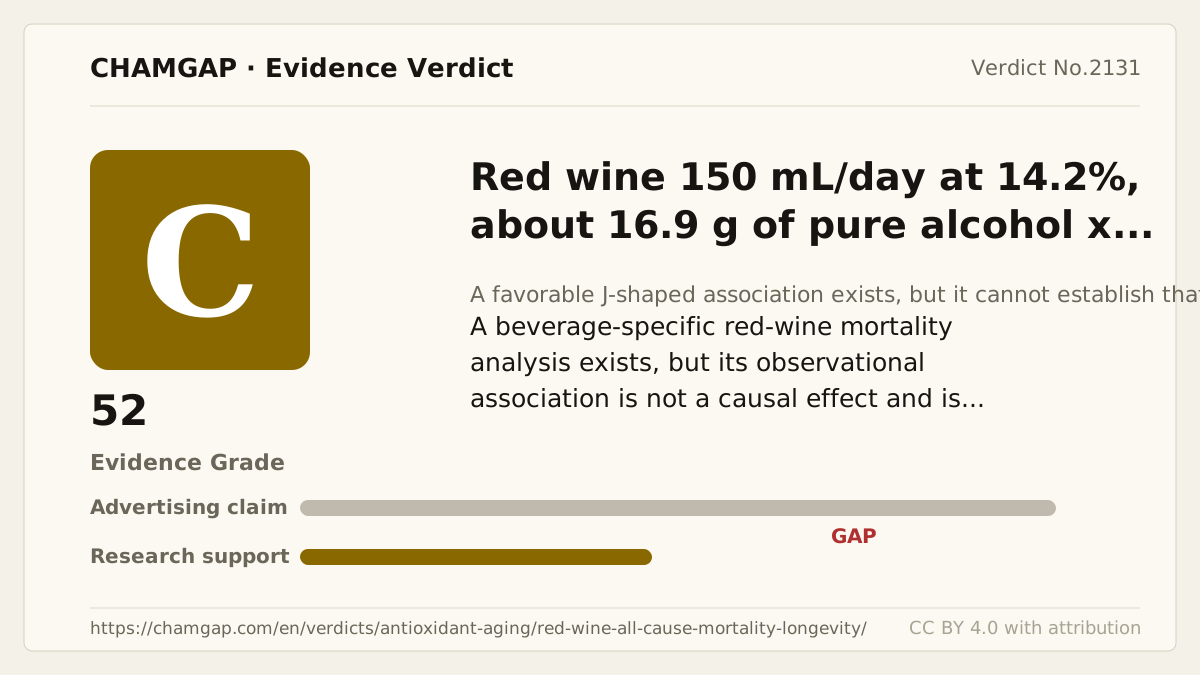
Red wine 150 mL/day,
does it really help with Lower all-cause mortality and longer life?
research showsThe grade is C. A cohort of 333,247 U.S. adults found 21%-22% lower all-cause mortality hazards among light and moderate drinkers, and a beverage-specific UK Biobank analysis reported a favorable association for 1-1.5 glasses of red wine per day. Neither was randomized, so the magnitude of association is not the magnitude of a causal longevity effect.
ads claimRed wine does contain resveratrol. The 0.362-1.979 mg/L range is a measured range for French Pinot Noir, not a universal range for all red wines; it gives about 0.054-0.297 mg in 150 mL. Human supplement trials often use 500-1,000 mg/day, roughly 1,700-18,500 times as much. This composition fact cannot be converted into longer life from one glass.
Useful facts when choosing a product
- At 14.2% alcohol by volume, 150 mL contains about 16.8-16.9 g ethanol using a density of 0.789 g/mL.
- The 0.362-1.979 mg/L measured in French Pinot Noir equals about 0.054-0.297 mg per 150 mL.
- Supplement verdict 090 is C with 48 points, verdict 1076 is D with 28 points, and verdict 1108 is D with 28 points; high-dose supplements are not wine consumed with alcohol.
Chamgap Semantic Classification Code
Candidate index · review held
F.red-wine-at-14-2-percent.food.all-cause-mortality-and-longer-life.reduce.UNKFoods and beverages > Red wine at 14.2% > Food consumption > all-cause mortality and longer life > Reduction claim > Unknown
An automated migration candidate, not an issued permanent code; exact claim scope remains under review. This machine-generated migration candidate helps retrieval but is not a permanent assignment. The original verdict ID and URL remain authoritative.
What the research actually shows
Xi linked 13 NHIS waves to mortality in 333,247 adults, with median follow-up of 8.2 years and 34,754 deaths. Schutte analyzed beverage type in 502,635 UK Biobank participants over about seven years. The red-wine HR of 0.81 (0.73-0.89) for 1-1.5 glasses/day comes from the U.S. National Academies review table and was not independently rechecked against the original article table. Both are self-reported observational datasets subject to exposure change, reference contamination, and model dependence.
Why this is classified as C (56)
A large beverage-specific mortality association exists, but it is not causal and is vulnerable to reference contamination, one-time self-report, and model dependence, giving C with 56 points.
Counterpoint. Lower mortality hazards were observed in both total-alcohol and beverage-specific red-wine analyses. Neither is a trial showing that starting 150 mL of red wine extends life.
Rejudgment record. Cross-check applied — Favorable total-alcohol and beverage-specific red-wine associations were retained while accounting for reference contamination, one-time self-report, model dependence, and noncausal interpretation
| Endpoint | H | Hard endpoint - actual events such as death |
| Replication | R1 | Single confirmatory trial |
| Independence | I2 | Decisive evidence is publicly or non-profit funded |
| Effect size | E+ | Meets the clinically important threshold |
Stored derived and displayed grades match; this is not a current recalculation or validity check (C).
Sub-claim grades by effect
This ingredient is marketed for several effects. A single overall grade blends strong and weak claims together, so each effect is graded separately here. The overall grade reflects the strongest disconfirming or core claim.
| Effect (sub-claim) | Grade | Basis |
|---|---|---|
| Observed association of low-to-moderate total drinking and red wine with lower mortality | C | It appeared in large total-alcohol and beverage-specific cohorts. |
| Starting 150 mL of red wine extends life | ? | No long-term trial randomized red wine itself and measured all-cause mortality. |
Cross-check — AI research and Codex final gate
Evidence Table
| Study | Design | Sample | Funding | Endpoint | Result | Weight |
|---|---|---|---|---|---|---|
| Xi B et al. 2017 | Prospective NHIS-mortality linkage cohort | 333,247 analyzed with 34,754 all-cause deaths | Shandong University Young Scholars Program | All-cause mortality over median 8.2 years | Versus lifetime abstainers, HR was 0.79 (0.76-0.82) for light and 0.78 (0.74-0.82) for moderate drinking. | Large favorable observational association |
| Schutte R et al. 2020 | Prospective beverage-specific UK Biobank analysis | 502,635 participants over about seven years | As reported in the original article | Red-wine intake and all-cause mortality | HR 0.81 (0.73-0.89) at 1-1.5 glasses/day; checked in the U.S. National Academies review table, not independently rechecked in the original table. | Large beverage-specific observational association |
| Stockwell T et al. 2016 | Systematic review and meta-regression of 87 cohorts | 87 studies | Public and nonprofit research support | Low-volume drinking and all-cause mortality | After bias correction, RR was 0.97 (95% CI 0.88-1.07) at 1.3-24.9 g/day. | Benefit disappeared after reference-group and quality correction |
Receipt — 4 References
All 4 cited sources were verified for existence at the original page (as of 2026-08-04).
Final verification and publication gate: Codex · Evidence date: 2026-08-04 · Corrections: none
Cite this verdict
[Chamgap] Red wine 150 mL/day x lower all-cause mortality and longevity — Evidence Grade C·56. 4 cited sources checked. Source: https://chamgap.com/en/verdicts/antioxidant-aging/red-wine-all-cause-mortality-longevity/ · CC BY 4.0CC BY 4.0 — free to use with attribution; do not distort grades, numbers, or verdict meaning.
What this document does and does not do
Chamgap is an information source. It reports what research has and has not confirmed; it does not tell readers what to take or buy. That decision belongs to readers and, when needed, medical or legal professionals. This verdict reflects literature available up to the search date and may change as new research appears. Nothing here is medical advice.