
Red and near-infrared photobiomodulation,
does it really help with Slower biological aging and longer healthspan and lifespan in healthy adults?
research showsRed and near-infrared photobiomodulation devices for slowing biological aging or extending healthspan and lifespan in healthy adults are rated ?. A 2025 umbrella review synthesized 15 meta-analyses, 204 randomized trials, more than 9,000 participants, and 35 pain, function, and disease endpoints across 15 conditions, but it did not evaluate biological aging rate, survival free of disease or frailty, or mortality. A 2024 systematic review of ten studies in older adults likewise addressed short-term condition-specific outcomes in neurodegenerative disease, wounds or ulcers, and macular degeneration, with no longevity endpoint. Direct positive evidence that 850-nm light improved cardiovascular aging and survival came from a mouse model of accelerated cardiac aging, and the authors called for controlled human validation. Because no identified human efficacy literature directly tested the three target endpoints, no numeric score is invented and the score remains null. Eye protection, excessive heat or burns, and photosensitivity are separate safety concerns.
ads claimMarketing expands ATP, mitochondrial, perfusion, and inflammatory mechanisms into cellular rejuvenation, reversed biological age, and longer life, while converting localized or disease-specific research into a longevity claim for whole-body consumer 660- and 850-nm panels and belts.
Useful facts when choosing a product
- Photobiomodulation delivers non-ionizing red or near-infrared light to tissue. Actual dose depends on irradiance, distance, exposure time, treated area, and pulsing in addition to wavelength.
- Consumer 660- and 850-nm LED panels or belts differ from research lasers and indication-specific medical devices in output, beam characteristics, and treatment site, so results cannot be transferred automatically.
- No validated wavelength combination, whole-body dose, frequency, or duration is established for slowing aging or extending healthspan or lifespan.
- Users should follow the device instructions for distance, duration, and eye protection and should not stare directly into the light source. Use should stop with excessive heat, pain, or skin reactions, while photosensitizing conditions or medicines and eye disease warrant clinical advice.
Chamgap Semantic Classification Code
Candidate index · review held
P.red-and-near-infrared-photobiomodulation-device.device.slower-biological-aging-and-longer-healthspan-and-lifespan.reduce.UNKProcedures, devices and tests > Red and near-infrared photobiomodulation device > Device delivered > Slower biological aging and longer healthspan and lifespan > Reduction claim > Unknown
An automated migration candidate, not an issued permanent code; exact claim scope remains under review. This machine-generated migration candidate helps retrieval but is not a permanent assignment. The original verdict ID and URL remain authoritative.
What the research actually shows
Son and colleagues umbrella-reviewed 15 randomized-trial meta-analyses through December 2023, covering 204 trials, more than 9,000 participants, 15 conditions, and 35 endpoints. Some pain, knee-osteoarthritis disability, fibromyalgia fatigue, androgenetic-alopecia hair density, and cognitive outcomes were positive, but most certainty was low or moderate and no aging clock, healthspan, or mortality endpoint was included. Godaert and colleagues identified ten photobiomodulation studies in adults aged 65 or older, comprising six randomized and four observational studies with heterogeneous devices, wavelengths, doses, and diseases. Syed and colleagues applied 850-nm near-infrared light to AC8 mice with accelerated cardiac aging and improved cardiac, gait, and survival outcomes, but enrolled no humans. No completed published efficacy trial was identified that assigns a consumer 660- and 850-nm panel or belt to healthy adults long term and assesses validated multiple aging clocks, multidomain function and disease-free survival, or all-cause mortality.
Why this is classified as ?
An umbrella review of 204 randomized trials and a review of ten older-adult studies assessed only condition-specific or functional outcomes, while positive survival evidence came from mice. No product- and claim-matched human efficacy literature directly evaluated validated aging rate, healthspan, or total lifespan in healthy adults, giving ? with a null score.
Counterpoint. An untested longevity claim should not be confused with potential efficacy for a specific condition or function. Validation requires an independent long-term randomized trial using a standardized actual device and prespecified multiple aging measures, long-term clinical function, and disease-free survival.
Rejudgment record. New verdict — Applied ? with a null score because the 2025 umbrella review of 204 randomized trials and more than 9,000 participants and the 2024 review of ten older-adult studies assessed only pain, function, and condition-specific outcomes rather than validated aging rate, healthspan, or total lifespan in healthy adults, while positive 850-nm survival evidence was limited to a mouse model of accelerated cardiac aging
Sub-claim grades by effect
This ingredient is marketed for several effects. A single overall grade blends strong and weak claims together, so each effect is graded separately here. The overall grade reflects the strongest disconfirming or core claim.
| Effect (sub-claim) | Grade | Basis |
|---|---|---|
| Slower biological aging rate in healthy adults | ? | No completed published human efficacy trial was identified that evaluated a consumer 660- and 850-nm panel or belt using multiple validated aging clocks. |
| Longer healthspan in healthy adults | ? | Short-term condition-specific and functional studies exist, but no human trial has assessed healthspan through long-term multidomain function and survival free of disease or frailty. |
| Longer lifespan in healthy adults | ? | Positive survival evidence comes from mice with accelerated cardiac aging, and no human photobiomodulation trial using all-cause mortality or survival time as an efficacy endpoint was identified. |
Cross-check — AI research and Codex final gate
Evidence Table
| Study | Design | Sample | Funding | Endpoint | Result | Weight |
|---|---|---|---|---|---|---|
| Son Y et al. 2025 | Umbrella review of meta-analyses of randomized photobiomodulation trials | 15 meta-analyses, 204 randomized trials, more than 9,000 participants, and 35 endpoints | Public ITRC and National Research Foundation support from the Korean Ministry of Science and ICT; authors reported no competing interests | Thirty-five clinical endpoints across 15 conditions, including pain, disability, fatigue, hair density, and cognition | Selected condition-specific endpoints were positive, but biological aging rate, healthspan, lifespan, and mortality were not included. | Broad human randomized-evidence map confirming the target-endpoint gap |
| Godaert L and Dramé M. 2024 | Systematic review of comparative photobiomodulation studies in adults aged 65 or older | Ten studies; six randomized and four observational studies | The article reported no external funding | Condition-specific efficacy in neurodegenerative disease, wounds or ulcers, macular degeneration, and related conditions | Devices, wavelengths, doses, and results were heterogeneous, and aging rate, healthspan, and overall survival were not assessed. | Confirmation of the longevity-endpoint gap in older-adult human research |
| Syed SB et al. 2023 | Long-term preclinical study in a mouse model of accelerated cardiac aging | AC8 and wild-type mice; zero human participants | Fully supported by the United States National Institute on Aging Intramural Research Program | Cardiac structure and function, aortic stiffness, gait symmetry, and cumulative survival | Eight-hundred-fifty-nanometer photobiomodulation improved several cardiovascular and gait measures and cumulative survival in AC8 mice, but no human validation was performed. | Direct positive longevity signal limited to preclinical evidence |
Receipt — 3 References
All 3 cited sources were verified for existence at the original page (as of 2026-07-23).
Final verification and publication gate: Codex · Evidence date: 2026-07-23 · Corrections: none
Cite this verdict
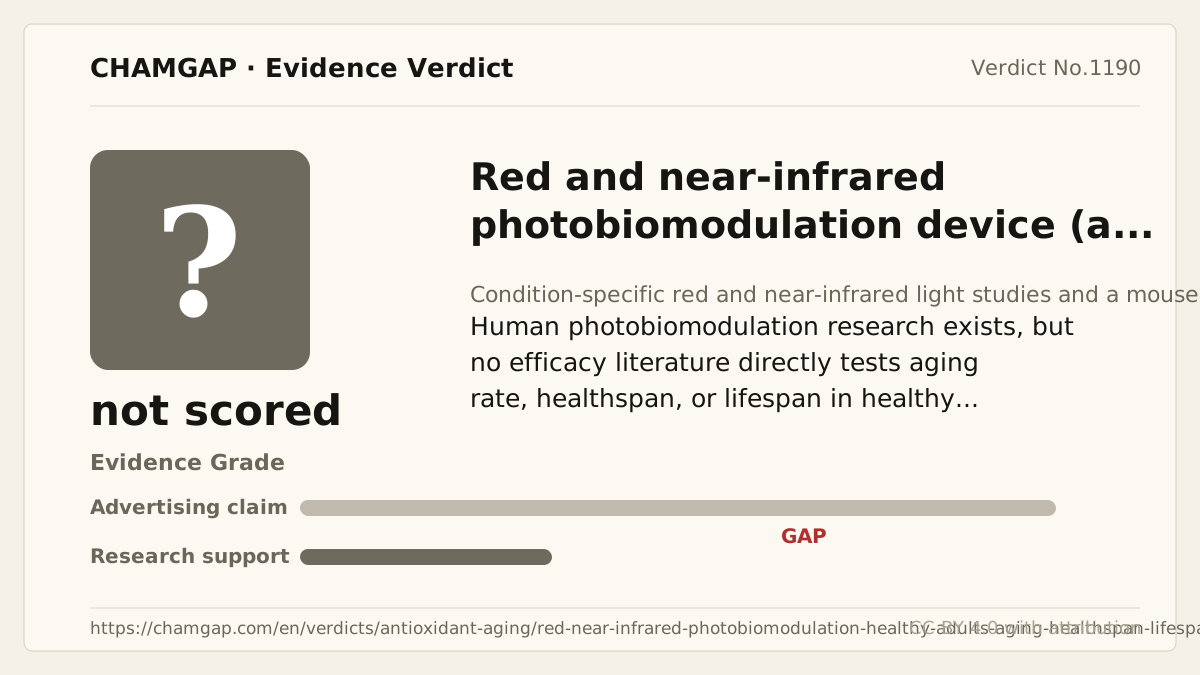
[Chamgap] Red and near-infrared photobiomodulation x aging rate, healthspan, and lifespan in healthy adults — Evidence Grade ?. 3 cited sources checked. Source: https://chamgap.com/en/verdicts/antioxidant-aging/red-near-infrared-photobiomodulation-healthy-adults-aging-healthspan-lifespan/ · CC BY 4.0CC BY 4.0 — free to use with attribution; do not distort grades, numbers, or verdict meaning.
What this document does and does not do
Chamgap is an information source. It reports what research has and has not confirmed; it does not tell readers what to take or buy. That decision belongs to readers and, when needed, medical or legal professionals. This verdict reflects literature available up to the search date and may change as new research appears. Nothing here is medical advice.