
Quercetin,
does it really help with Extension of human healthspan and lifespan by clearing senescent cells?
research showsThe claim that a quercetin supplement clears senescent cells and extends human healthspan or lifespan is rated D. Lifespan extension comes from preclinical mouse experiments using quercetin together with the prescription anticancer drug dasatinib, not quercetin alone. In humans, an open-label phase 1 pilot in nine people with diabetic kidney disease reduced adipose-tissue senescence markers, while a 12-person trial in idiopathic pulmonary fibrosis mainly assessed feasibility and tolerability. Both used dasatinib plus quercetin and neither demonstrated human survival, disability-free lifespan, or clinical efficacy of quercetin alone. This is a different efficacy axis from verdict 114 on allergy, antioxidant, and immune claims.
ads claimMarketing converts a mouse survival curve for dasatinib plus quercetin and a human adipose biomarker into a claim that a quercetin supplement alone cleans out senescent cells and extends life. Dasatinib is a prescription anticancer drug, and findings from the combination cannot be attributed to an ordinary quercetin capsule.
Useful facts when choosing a product
- Quercetin is a flavonol present in foods such as onions and apples, while supplements use aglycone, glycoside, or absorption-enhanced formulations with different bioavailability.
- The principal human senolytic studies used quercetin together with the prescription anticancer drug dasatinib rather than quercetin monotherapy, so they do not reproduce self-treatment with an ordinary supplement.
- Markers such as p16, p21, senescence-associated beta-galactosidase, and inflammatory mediators are mechanistic surrogates and do not replace healthspan outcomes such as survival, disability, hospitalization, or cognition.
- Food exposure and short supplementation are generally tolerated, but high-dose long-term use may pose renal and drug-metabolism or transporter interaction concerns, particularly in kidney disease and polypharmacy.
Chamgap Semantic Classification Code
Candidate index · review held
S.quercetin.UNK.extension-of-human-healthspan-and-lifespan-by-clearing-senescent-cells.assess.placeboSupplements and nutraceuticals > Quercetin > Unknown > Extension of human healthspan and lifespan by clearing senescent cells > Association or change assessment > Placebo
An automated migration candidate, not an issued permanent code; exact claim scope remains under review. This machine-generated migration candidate helps retrieval but is not a permanent assignment. The original verdict ID and URL remain authoritative.
What the research actually shows
Xu and colleagues intermittently treated mice with transplanted senescent cells or naturally aged mice using dasatinib plus quercetin and reported improvements in physical function and post-treatment survival. In the translational human study, Hickson and colleagues gave the combination for three days to nine people with diabetic kidney disease in an open-label phase 1 before-and-after design and measured senescence markers in adipose tissue, skin, and blood. Nambiar and colleagues randomized 12 people with idiopathic pulmonary fibrosis to the combination or placebo, but the primary objective was safety and feasibility and the study was not sized to establish efficacy. Later studies, including a 60-person bone-metabolism trial in postmenopausal women, still do not provide a quercetin-only lifespan or healthspan endpoint.
Why this is classified as D (23)
There are zero human lifespan or healthspan trials. Positive survival findings came from mice given dasatinib plus quercetin, and the nine-person human study was an uncontrolled combination biomarker trial, so quercetin's isolated contribution cannot be determined. With no quercetin-only human efficacy and only combination or preclinical evidence, the verdict sits at the lower end of D with 23 points.
Counterpoint. Senolytics are a rapidly developing experimental field, so a future large trial with direct clinical outcomes could change the verdict. At present, quercetin should not replace interventions with demonstrated human healthspan benefit, including exercise, smoking cessation, vaccination, and management of blood pressure, lipids, and diabetes.
Rejudgment record. Cross-check revision — Cross-check: placed the verdict at the lower end of D because there is no quercetin-only human efficacy and only combination or preclinical evidence. No human lifespan or healthspan trial exists, and the mouse survival and small human biomarker or feasibility findings all used dasatinib plus quercetin
Sub-claim grades by effect
This ingredient is marketed for several effects. A single overall grade blends strong and weak claims together, so each effect is graded separately here. The overall grade reflects the strongest disconfirming or core claim.
| Effect (sub-claim) | Grade | Basis |
|---|---|---|
| Extension of human lifespan through senescent-cell clearance | D | Positive survival findings come only from mice given dasatinib plus quercetin, with no human survival trial. |
| Extension of human healthspan through senescent-cell clearance | D | Human studies are small combination biomarker and feasibility trials that did not establish disability-free survival or long-term function. |
| Clearance of human senescent cells by quercetin alone | D | Human target-engagement signals came from combination with prescription dasatinib, so quercetin's isolated contribution cannot be determined. |
Cross-check — AI research and Codex final gate
Evidence Table
| Study | Design | Sample | Funding | Endpoint | Result | Weight |
|---|---|---|---|---|---|---|
| Xu M et al. 2018 | Senescent-cell transplantation and naturally aged mouse experiments plus ex vivo human adipose tissue | 71 mice receiving dasatinib plus quercetin and 76 controls in survival analysis; zero humans in a lifespan trial | United States NIH, academic, and foundation support | Mouse physical function, senescence markers, and post-treatment survival | Intermittent dasatinib plus quercetin improved physical function and post-treatment survival in old mice. | Key preclinical lifespan evidence, not quercetin monotherapy |
| Hickson LJ et al. 2019 | Open-label single-arm phase 1 before-and-after pilot | Nine participants with diabetic kidney disease | United States NIH, Mayo Clinic, and foundation support; related patent interests reported | Senescence markers including p16, p21, and senescence-associated beta-galactosidase in adipose tissue, skin, and blood | Adipose senescence markers decreased after three days of dasatinib plus quercetin, but there was no control group or lifespan or healthspan endpoint. | Human target-engagement surrogate from a small combination study |
| Nambiar A et al. 2023 | Phase 1 single-blind randomized placebo-controlled pilot | Twelve participants with idiopathic pulmonary fibrosis | United States NIH and foundation support; related patent interests reported | Adverse events, adherence, trial feasibility, and exploratory functional measures | The study showed feasibility of dosing and assessment but was not sized to establish clinical efficacy or a lifespan effect. | Human combination feasibility evidence |
Receipt — 3 References
All 3 cited sources were verified for existence at the original page (as of 2026-07-20).
Final verification and publication gate: Codex · Evidence date: 2026-07-20 · Corrections: none
Cite this verdict
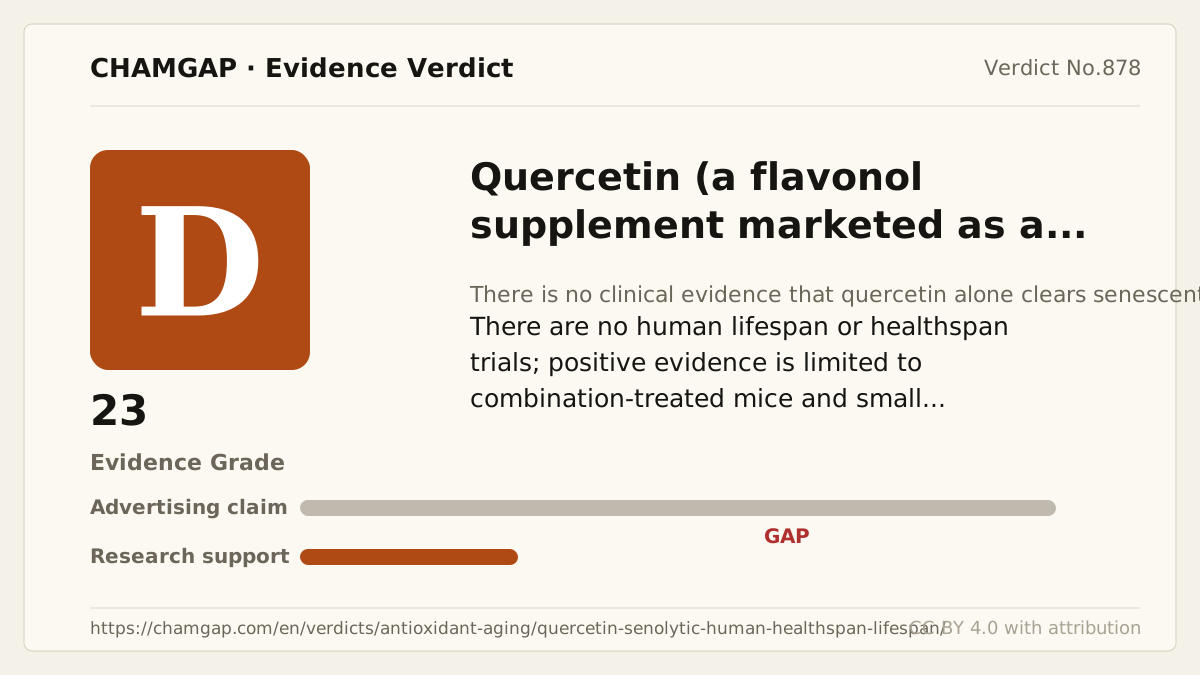
[Chamgap] Quercetin x extension of human healthspan and lifespan through senescent-cell clearance — Evidence Grade D·23. 3 cited sources checked. Source: https://chamgap.com/en/verdicts/antioxidant-aging/quercetin-senolytic-human-healthspan-lifespan/ · CC BY 4.0CC BY 4.0 — free to use with attribution; do not distort grades, numbers, or verdict meaning.
What this document does and does not do
Chamgap is an information source. It reports what research has and has not confirmed; it does not tell readers what to take or buy. That decision belongs to readers and, when needed, medical or legal professionals. This verdict reflects literature available up to the search date and may change as new research appears. Nothing here is medical advice.