
PQQ disodium,
does it really help with Slower aging, longer healthspan, and longer lifespan in healthy adults?
research showsPQQ disodium for slower aging or longer healthspan and lifespan in healthy adults is rated ?. A 2026 healthy-longevity mini-review summarized mitochondrial biogenesis, AMPK and SIRT1 signaling, and redox mechanisms, but it presented no human lifespan or healthspan randomized trial and left long-term randomized functional-outcome studies as a future need. A positive 2024 aging study was a manufacturer study in aged male mice, six per group, and cell models measuring muscle, skin, inflammatory, and mitochondrial outcomes. Early human trials on cognition, fatigue, or energy belong to different efficacy axes and cannot substitute for aging rate or survival. With no direct human efficacy literature, the score is null. Short-term tolerability is separate from long-term aging efficacy, and high-dose and long-term safety remain limited.
ads claimMarketing can connect mitochondrial biogenesis, a longevity vitamin, or cellular energy to slower human aging and lifespan extension. Pathway activation and changes in memory, fatigue, or a mitochondrial marker are not direct evidence that people stay healthy longer or survive longer.
Useful facts when choosing a product
- PQQ is commonly sold as the more stable disodium salt, but ingredient brand, purity, formulation, and actual content can vary across supplements.
- Early human studies commonly used about 20 mg daily, but no dose or duration is established for slowing aging or extending healthspan or lifespan.
- Small short-term studies generally report tolerability, but higher intake can cause gastrointestinal discomfort or headache, and safety data for continuous long-term use, pregnancy, lactation, or liver and kidney disease are limited.
- PQQ does not replace sleep, exercise, smoking cessation, vaccination, or cardiovascular and metabolic risk management, which have direct links to health and mortality outcomes.
Chamgap Semantic Classification Code
Candidate index · review held
S.pyrroloquinoline-quinone-disodium.UNK.slower-aging-longer-healthspan-and-longer-lifespan.reduce.UNKSupplements and nutraceuticals > Pyrroloquinoline quinone disodium > Unknown > Slower aging, longer healthspan, and longer lifespan > Reduction claim > Unknown
An automated migration candidate, not an issued permanent code; exact claim scope remains under review. This machine-generated migration candidate helps retrieval but is not a permanent assignment. The original verdict ID and URL remain authoritative.
What the research actually shows
Numaguchi and colleagues conducted a structured review of 2020 to 2025 literature on how PQQ and spermidine intersect with hallmarks of aging. The PQQ section covered AMPK, SIRT1, PGC-1 alpha, mitochondrial biogenesis, redox and inflammatory pathways, and early cognitive or functional studies, but it included no randomized human healthspan or lifespan trial. Mitsubishi Gas Chemical, a PQQ ingredient producer, fully funded the review and employed all authors. Mohamad Ishak and colleagues assigned young mice, old mice, and PQQ-fed old mice with six animals per group and administered about 20 mg/kg daily for nine weeks. Muscle atrophy, strength, skin, inflammatory, and gut-related outcomes improved in aged mice, but this was not a human trial and did not measure lifespan itself.
Why this is classified as ?
The 2026 healthy-longevity review summarized mitochondrial and redox mechanisms and early human research but presented no randomized human aging-rate, multidimensional healthspan, or lifespan trial. Direct positive aging data came from a manufacturer-funded and manufacturer-authored mouse and cell study with six mice per group. No direct human efficacy literature gives ? with a null score.
Counterpoint. Changing the verdict would require an independent long randomized trial in healthy adults with prespecified validated aging rate, multisystem function, disease-free survival, or mortality outcomes. A single mitochondrial biomarker or cognition score cannot establish longer healthspan.
Rejudgment record. New verdict — Applied ? with a null score because the 2026 PQQ healthy-longevity review presented mitochondrial and redox mechanisms and early research on other outcomes but no randomized human aging-rate, healthspan, or lifespan trial, while direct positive aging data were limited to a manufacturer study in cells and six mice per group
Sub-claim grades by effect
This ingredient is marketed for several effects. A single overall grade blends strong and weak claims together, so each effect is graded separately here. The overall grade reflects the strongest disconfirming or core claim.
| Effect (sub-claim) | Grade | Basis |
|---|---|---|
| Slower aging in healthy adults | ? | Positive aging data were from manufacturer mouse and cell studies, with no human efficacy literature directly testing aging rate. |
| Longer healthspan in healthy adults | ? | Human studies exist on other axes such as cognition, fatigue, or energy, but none assessed healthspan through multisystem function and disease-free survival. |
| Longer lifespan in healthy adults | ? | No human randomized trial linking PQQ supplementation to overall survival or mortality was identified. |
Cross-check — AI research and Codex final gate
Evidence Table
| Study | Design | Sample | Funding | Endpoint | Result | Weight |
|---|---|---|---|---|---|---|
| Numaguchi T et al. 2026 | Structured mini-review of PQQ, spermidine, and healthy longevity | Mechanistic, preclinical, and early clinical literature from 2020 to 2025; zero human lifespan randomized trials presented | Fully funded by Mitsubishi Gas Chemical; all authors were company employees | Hallmarks of aging and mechanisms related to mitochondrial biogenesis, redox regulation, and autophagy | The review proposed mechanistic potential but presented no human healthspan or lifespan randomized trial and called for long-term functional-outcome studies. | Current evidence-scope assessment; manufacturer dominated with no direct human efficacy |
| Mohamad Ishak NS et al. 2024 | Preclinical study in naturally aged male mice and induced-senescence cell models | Six mice per young, old, and PQQ-treated old group, plus cell models | Funded by Mitsubishi Gas Chemical; all authors were company employees | Muscle atrophy, strength, body composition, skin, inflammation, gut barrier, and mitochondrial markers | About 20 mg/kg daily improved several functional and biomarker outcomes in aged mice, but the study was not in humans and did not assess lifespan itself. | Positive preclinical signal; manufacturer study with no direct relevance to human lifespan efficacy |
Receipt — 2 References
All 2 cited sources were verified for existence at the original page (as of 2026-07-22).
Final verification and publication gate: Codex · Evidence date: 2026-07-22 · Corrections: none
Cite this verdict
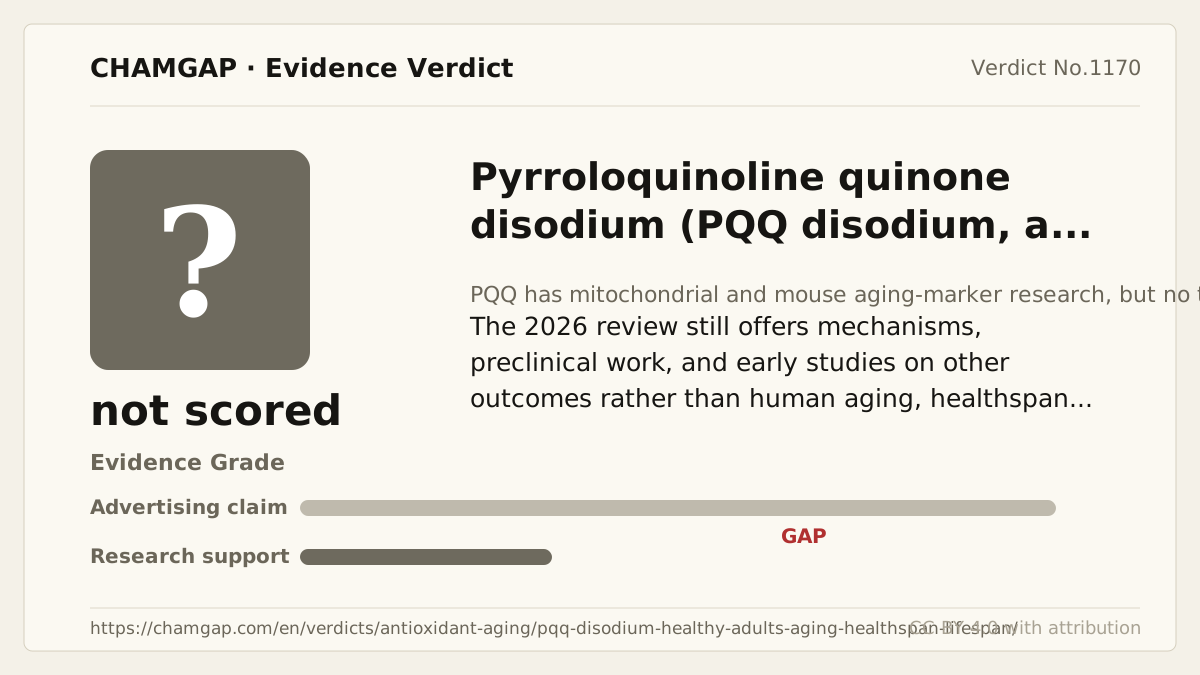
[Chamgap] PQQ disodium x slower aging and longer healthspan and lifespan in healthy adults — Evidence Grade ?. 2 cited sources checked. Source: https://chamgap.com/en/verdicts/antioxidant-aging/pqq-disodium-healthy-adults-aging-healthspan-lifespan/ · CC BY 4.0CC BY 4.0 — free to use with attribution; do not distort grades, numbers, or verdict meaning.
What this document does and does not do
Chamgap is an information source. It reports what research has and has not confirmed; it does not tell readers what to take or buy. That decision belongs to readers and, when needed, medical or legal professionals. This verdict reflects literature available up to the search date and may change as new research appears. Nothing here is medical advice.