
Trehalose,
does it really help with Oral activation of autophagy with slower human aging and improved healthspan and overall lifespan?
research showsThe claim that oral trehalose activates autophagy to slow human aging and extend healthspan or overall lifespan is rated ?. Cell studies report mTOR-independent autophagy and clearance of protein aggregates, and animal disease models provide mechanistic signals, but neither is human longevity efficacy. A 12-week oral trial in 32 middle-aged and older adults improved resistance-artery function only in a subgroup that maintained body weight; conduit-artery function, arterial stiffness, and oxidative and inflammatory markers were null. A 12-week trial in 50 healthy adults assessed only glucose tolerance and was conducted by manufacturer employees. No identified human literature directly assessed autophagy activation, validated whole-person aging rate, multisystem healthspan, disease-free survival, or mortality, so the grade is ? with a null score.
ads claimMarketing can present an autophagy switch, cellular cleaning, removal of senescent cells, and lifespan extension as one causal chain. Protein clearance in cultured cells, a vascular surrogate in middle-aged adults, or a postprandial glucose change does not show that humans age more slowly, remain healthy longer, or die later.
Useful facts when choosing a product
- Trehalose is a nonreducing disaccharide made of two glucose molecules and used as a food ingredient and sweetener; intestinal trehalase breaks most of it down into glucose.
- Human trial doses ranged widely from 3.3 to 100 g/day, but no dose or duration is established for activating autophagy, slowing aging, extending healthspan, or extending lifespan.
- Food-level intake is generally tolerated, but larger amounts can cause bloating, gas, abdominal pain, or diarrhea, especially in people with trehalase deficiency.
- Trehalose is still a digestible carbohydrate, so people with diabetes or carbohydrate restrictions should check total sugars, calories, and serving size.
Chamgap Semantic Classification Code
Candidate index · review held
S.trehalose.UNK.oral-activation-of-autophagy-with-slower-human-aging-and-improved-healthspan-and-overall-lifespan.reduce.activeSupplements and nutraceuticals > Trehalose > Unknown > Oral activation of autophagy with slower human aging and improved healthspan and overall lifespan > Reduction claim > Active comparator
An automated migration candidate, not an issued permanent code; exact claim scope remains under review. This machine-generated migration candidate helps retrieval but is not a permanent assignment. The original verdict ID and URL remain authoritative.
What the research actually shows
Sarkar and colleagues reported that trehalose activated autophagy independently of mTOR and increased clearance of huntingtin and alpha-synuclein aggregates in cell models. Kaplon and colleagues randomized 32 healthy adults aged 50 to 77 years to trehalose or maltose at 100 g/day. Resistance-artery dilation improved by about 30% in a post hoc subgroup with less than 2.3 kg of weight change, but the effect was nonsignificant when all participants were included, and conduit-artery endothelial function, large-artery stiffness, oxidative stress, and inflammation did not change. Yoshizane and colleagues gave 50 healthy Japanese adults 3.3 g/day for 78 days and evaluated oral-glucose-tolerance outcomes, reporting a signal only among participants with higher postprandial glucose within the normal range. All authors were employees of the ingredient manufacturer. None of these studies assessed systemic autophagy, biological aging rate, a multisystem healthspan composite involving frailty, cognition, and mobility, disease-free survival, or mortality.
Why this is classified as ?
Human randomized trials evaluated other surrogates such as vascular function or glucose tolerance rather than systemic autophagy after oral intake, validated biological aging rate, multisystem healthspan, disease-free survival, or overall survival. Evidence for autophagy activation and protein clearance is mainly cellular or animal. No human efficacy literature for the stated outcomes gives ? with a null score.
Counterpoint. Changing the verdict requires confirmation that oral intake activates autophagy in humans using tissue or validated markers, followed by a long randomized trial with prespecified aging rate, frailty, cognition, mobility, disease-free survival, or mortality. Vascular and glucose outcomes belong to separate efficacy axes.
Rejudgment record. New verdict — Applied ? with a null score because cell evidence for mTOR-independent autophagy and aggregate clearance and human trials of vascular function in 32 participants and glucose tolerance in 50 participants were identified, but no human efficacy literature directly assessed systemic autophagy after oral intake, validated biological aging rate, multisystem healthspan, disease-free survival, or overall lifespan
Sub-claim grades by effect
This ingredient is marketed for several effects. A single overall grade blends strong and weak claims together, so each effect is graded separately here. The overall grade reflects the strongest disconfirming or core claim.
| Effect (sub-claim) | Grade | Basis |
|---|---|---|
| Slower biological aging | ? | Cell and animal autophagy work and human vascular or metabolic surrogates exist, but no human efficacy literature directly assessed validated whole-person aging rate. |
| Longer healthspan | ? | No human trial was identified that followed multisystem function such as frailty, cognition, and mobility together with disease-free survival. |
| Longer overall lifespan | ? | No oral trehalose efficacy trial directly assessed overall survival or mortality in humans. |
Cross-check — AI research and Codex final gate
Evidence Table
| Study | Design | Sample | Funding | Endpoint | Result | Weight |
|---|---|---|---|---|---|---|
| Sarkar S et al. 2007 | Cultured-cell mechanistic study of autophagy and protein aggregates | Zero human participants; cell models | United Kingdom public and academic research support | Autophagy activation and clearance of mutant huntingtin and alpha-synuclein | Trehalose induced mTOR-independent autophagy and increased aggregate-prone protein clearance, but this was not an oral human trial. | Key mechanistic evidence with no direct human efficacy |
| Kaplon RE et al. 2016 | Twelve-week randomized double-blind active-controlled parallel trial | 32 healthy adults aged 50 to 77 years | United States NIH and public academic support; trial ingredients were purchased from Hayashibara | Resistance- and conduit-artery endothelial function, large-artery stiffness, and oxidative and inflammatory markers | Only resistance-artery function in the weight-stable subgroup improved; overall and other vascular and biomarker outcomes were null, and aging rate, healthspan, and survival were not assessed. | Different vascular-surrogate axis with no direct aging efficacy |
| Yoshizane C et al. 2020 | Seventy-eight-day randomized double-blind sucrose-controlled trial | 50 healthy Japanese adults | Fully funded by Hayashibara; all authors were company employees | Body composition, serum biochemistry, and glucose during a 75-g oral glucose tolerance test | There were no overall between-group body-composition or biochemical differences and a glucose signal appeared in a higher-postprandial-glucose subgroup, but aging, autophagy, and survival were not assessed. | Different metabolic-surrogate axis; manufacturer concentrated and not direct |
Receipt — 3 References
All 3 cited sources were verified for existence at the original page (as of 2026-07-24).
Final verification and publication gate: Codex · Evidence date: 2026-07-24 · Corrections: none
Cite this verdict
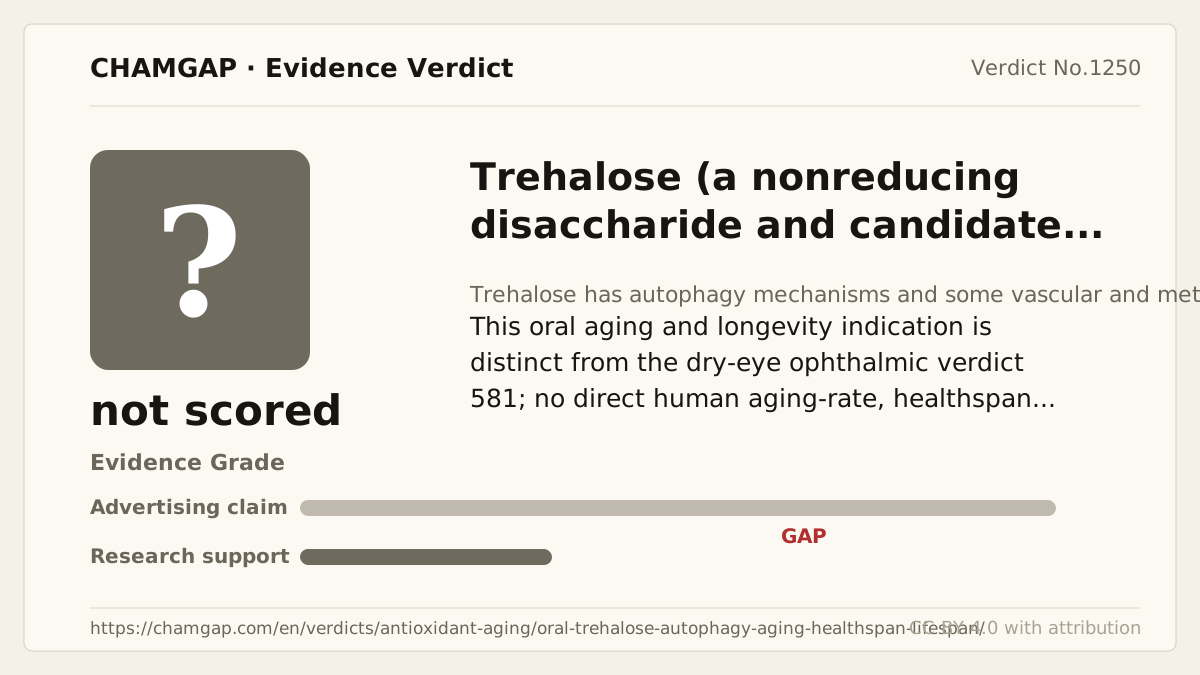
[Chamgap] Trehalose x slower human aging and longer healthspan and lifespan through autophagy activation — Evidence Grade ?. 3 cited sources checked. Source: https://chamgap.com/en/verdicts/antioxidant-aging/oral-trehalose-autophagy-aging-healthspan-lifespan/ · CC BY 4.0CC BY 4.0 — free to use with attribution; do not distort grades, numbers, or verdict meaning.
What this document does and does not do
Chamgap is an information source. It reports what research has and has not confirmed; it does not tell readers what to take or buy. That decision belongs to readers and, when needed, medical or legal professionals. This verdict reflects literature available up to the search date and may change as new research appears. Nothing here is medical advice.