
Oleuropein,
does it really help with Delayed biological aging and extended healthspan or lifespan in healthy adults?
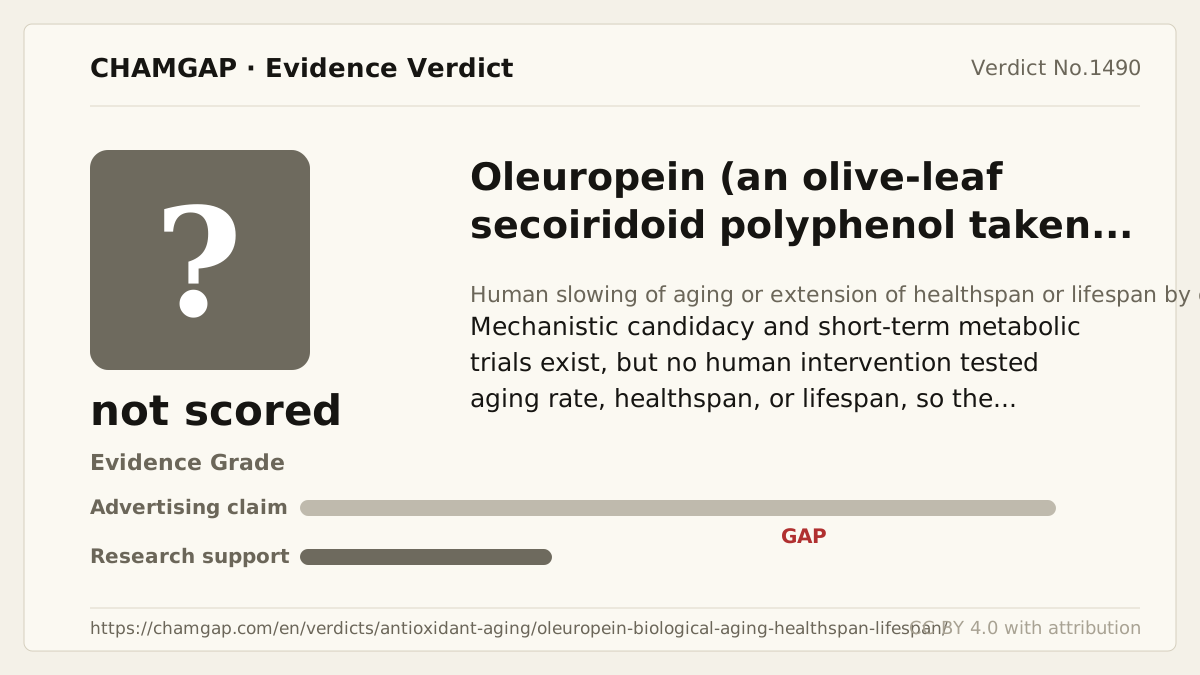
research showsOleuropein is rated ? for slowing biological aging or extending healthspan or lifespan in healthy adults. A 2024 systematic review identified 12 human randomized trials with 683 participants, but they assessed heterogeneous short-term blood-pressure, lipid, glucose, bone, joint, and cognitive outcomes rather than aging rate, healthspan, or survival. A 2026 GeroScience review likewise discusses geroprotective potential mainly through mechanisms, cells, and animal models. Absence of a human intervention trial on the claimed endpoints means untested, not ineffective, so the score is null.
ads claimMarketing translates antioxidant, anti-inflammatory, AMPK, autophagy, or animal findings into cellular age reversal, longer healthspan, or a longevity supplement. Human blood-pressure and metabolic signals likewise cannot be converted into survival benefits.
Useful facts when choosing a product
- Oleuropein is a secoiridoid polyphenol in olive leaves and fruit and is commonly used as a standardization marker for olive-leaf extracts.
- Purified oleuropein and olive-leaf extract are not the same intervention; dose, extraction, hydroxytyrosol, and other co-constituents vary.
- Short-term human studies generally report acceptable tolerability, but gastrointestinal symptoms, headache, or allergy are possible and long-term high-dose safety is not established.
- Potential blood-pressure and glucose lowering warrants caution with antihypertensive or diabetes medicines; professional advice is prudent before surgery and during pregnancy or breastfeeding.
Chamgap Semantic Classification Code
Candidate index · review held
S.oleuropein.oral.delayed-biological-aging-and-extended-healthspan-or-lifespan.reduce.UNKSupplements and nutraceuticals > Oleuropein > Oral > Delayed biological aging and extended healthspan or lifespan > Reduction claim > Unknown
An automated migration candidate, not an issued permanent code; exact claim scope remains under review. This machine-generated migration candidate helps retrieval but is not a permanent assignment. The original verdict ID and URL remain authoritative.
What the research actually shows
Frumuzachi and colleagues reviewed 12 randomized trials and 683 participants receiving oleuropein or hydroxytyrosol as pure compounds, supplements, or enriched foods. Outcomes spanned weight, lipids, glucose, inflammation, bone, joints, and cognition and were mixed or exploratory; aging rate, healthspan, and survival were absent. Calabrò and colleagues described oleuropein as a candidate geroprotector in a 2026 review, but the evidence base centered on molecular pathways and biological models and emphasized the need to establish dose and long-term effects.
Why this is classified as ?
Human supplementation trials exist, but no identified intervention directly assessed the claimed endpoints of biological-aging rate, healthspan, or lifespan. Mechanistic, animal, and short-term metabolic findings were not repurposed as longevity evidence, so rule ④ gives ? with a null score.
Counterpoint. Future trials require chemically defined single-ingredient products, preregistration, validated multi-domain aging biomarkers, and long-term functional and disease-burden follow-up. Prior verdicts on olive-leaf extract for blood pressure or extra-virgin olive oil for mortality involve different compositions and efficacy axes.
Rejudgment record. New verdict — Applied rule ④ because human oleuropein or hydroxytyrosol trials were limited to short-term cardiometabolic, bone, joint, and cognitive outcomes and no human intervention directly assessed biological-aging rate, healthspan, or lifespan
Sub-claim grades by effect
This ingredient is marketed for several effects. A single overall grade blends strong and weak claims together, so each effect is graded separately here. The overall grade reflects the strongest disconfirming or core claim.
| Effect (sub-claim) | Grade | Basis |
|---|---|---|
| Slower biological aging in healthy adults | ? | No human intervention preregistering validated aging clocks or multi-domain aging biomarkers was identified. |
| Extended healthspan | ? | No human intervention directly assessed long-term function or disability-free survival. |
| Extended lifespan | ? | No randomized human intervention assessed total survival or lifespan. |
Cross-check — AI research and Codex final gate
Evidence Table
| Study | Design | Sample | Funding | Endpoint | Result | Weight |
|---|---|---|---|---|---|---|
| Frumuzachi O et al. 2024 | Systematic review of human randomized trials of oleuropein and hydroxytyrosol | 12 randomized trials and 683 participants | Academic research from Romanian and German institutions; the article reported no external funding | Cardiovascular risk factors, liver, bone, joint, cognitive, and other systemic outcomes | Some short-term results were encouraging but mixed; aging rate, healthspan, and survival were not evaluated. | Defines the human-trial scope and confirms the endpoint gap |
| Calabrò A et al. 2026 | Narrative mechanistic review organized by hallmarks of aging | Cell, animal, and limited human literature | EU Horizon 2020 and university open-access support | Aging pathways, inflammation, oxidative stress, and model-organism healthspan | Proposed geroprotective potential but did not establish an intervention effect on human aging rate, healthspan, or lifespan. | Separates preclinical plausibility from the clinical gap |
Receipt — 2 References
All 2 cited sources were verified for existence at the original page (as of 2026-07-23).
Final verification and publication gate: Codex · Evidence date: 2026-07-23 · Corrections: none
Cite this verdict
[Chamgap] Oleuropein x biological aging, healthspan, and lifespan extension — Evidence Grade ?. 2 cited sources checked. Source: https://chamgap.com/en/verdicts/antioxidant-aging/oleuropein-biological-aging-healthspan-lifespan/ · CC BY 4.0CC BY 4.0 — free to use with attribution; do not distort grades, numbers, or verdict meaning.
What this document does and does not do
Chamgap is an information source. It reports what research has and has not confirmed; it does not tell readers what to take or buy. That decision belongs to readers and, when needed, medical or legal professionals. This verdict reflects literature available up to the search date and may change as new research appears. Nothing here is medical advice.