
Muscle-strengthening exercise,
does it really help with Lower all-cause mortality independent of aerobic exercise?
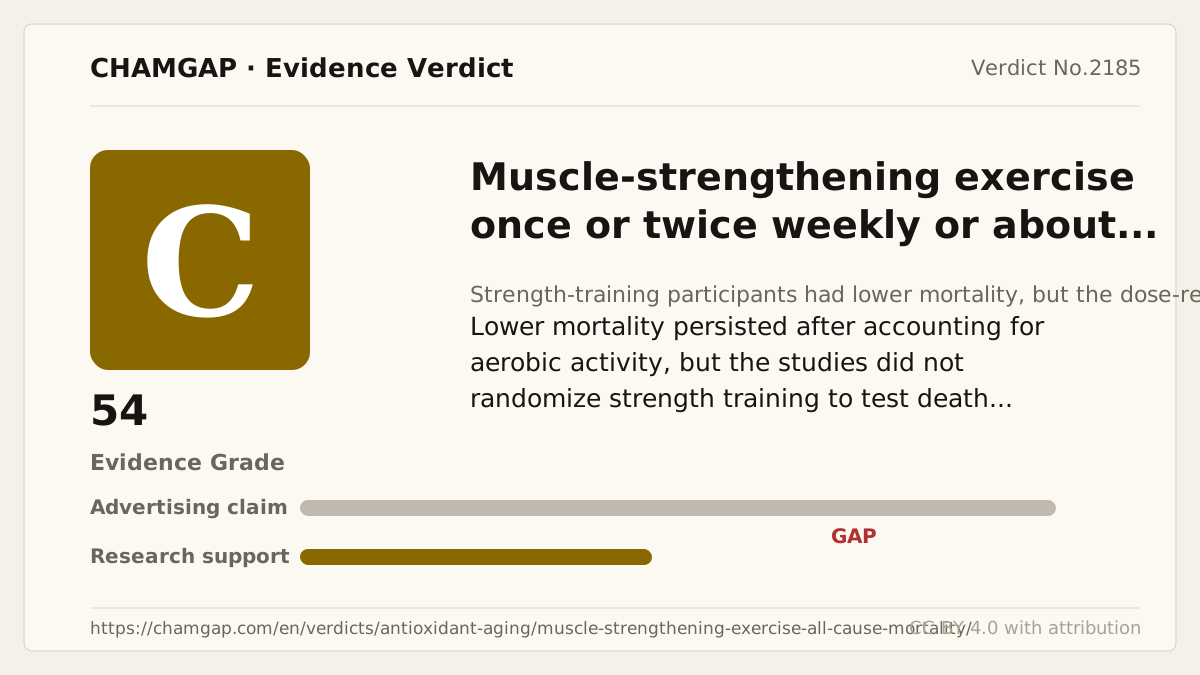
research showsThe grade is C. Across seven cohorts with 263,058 participants and 42,133 deaths, any muscle-strengthening activity versus none had RR 0.85 (95% CI 0.79 to 0.93), with every study pointing below 1. In PLCO participants reporting no aerobic activity, weightlifting once or twice weekly had all-cause mortality HR 0.80 (0.71 to 0.92) versus neither activity. All exposure was observational and self-reported, so healthy-user selection and residual confounding remain.
ads claimTwice weekly is a common low-risk observational category and overlaps musculoskeletal guidance, but it is not a guaranteed longevity dose. Benefits of aerobic exercise cannot be relabeled as strength-training-only effects.
Useful facts when choosing a product
- Seven cohorts with 263,058 participants and 42,133 deaths yielded RR 0.85 (0.79 to 0.93), with all study estimates below 1.
- Maximum associated risk reduction occurred around 30 to 60 minutes weekly rather than falling monotonically forever.
- PLCO analyzed 99,713 people, not all 104,002 who were mailed the follow-up questionnaire.
- Weight, resistance, or calisthenic activity frequency and duration were self-reported rather than device measured.
- Verdict 074 is B with 78 points and concerns whey protein and muscle outcomes, whereas this verdict concerns strength training itself and all-cause mortality.
Chamgap Semantic Classification Code
Candidate index · review held
X.muscle-strengthening-exercise-once-or-twice-or-about.behavioral.all-cause-mortality-independent-of-aerobic-exercise.reduce.UNKBehaviors, exposures and policies > Muscle-strengthening exercise once or twice or about > Behavioral delivery > all-cause mortality independent of aerobic exercise > Reduction claim > Unknown
An automated migration candidate, not an issued permanent code; exact claim scope remains under review. This machine-generated migration candidate helps retrieval but is not a permanent assignment. The original verdict ID and URL remain authoritative.
What the research actually shows
The Momma review searched MEDLINE and Embase and included 16 cohorts overall; seven studies with 263,058 participants and 42,133 deaths contributed the any-versus-none mortality analysis. Thirteen studies used questionnaires and three used interviews, while all considered aerobic or other activity. It was registered as PROSPERO CRD42020219808, but the registered systematic-review plan was not directly compared with the analyses as published. The review used Japanese Ministry of Health, Labour and Welfare grant JPMH20FA1006 and declared no competing interests. PLCO mailed follow-up questionnaires to 104,002 people but analyzed 99,713, with median nine-year follow-up and 28,477 deaths. Excluding first-two-year deaths did not materially change point estimates.
Why this is classified as C (56)
Consistent large cohorts, aerobic adjustment, and a publicly funded synthesis are strengths, but self-reported observational exposure, residual confounding, and very-low certainty give C with 56 points.
Counterpoint. C does not grade strength or functional benefits as weak. It applies to the narrower and harder causal claim of reducing long-term death.
Rejudgment record. Cross-check applied — Multiple large cohorts linked strength activity to lower mortality after considering aerobic activity, but the registered review plan was not directly compared with the published analyses, and self-report, healthy-user selection, and residual confounding remained
| Endpoint | H | Hard endpoint - actual events such as death |
| Replication | R1 | Single confirmatory trial |
| Independence | I2 | Decisive evidence is publicly or non-profit funded |
| Effect size | E+ | Meets the clinically important threshold |
Stored derived and displayed grades match; this is not a current recalculation or validity check (C).
Sub-claim grades by effect
This ingredient is marketed for several effects. A single overall grade blends strong and weak claims together, so each effect is graded separately here. The overall grade reflects the strongest disconfirming or core claim.
| Effect (sub-claim) | Grade | Basis |
|---|---|---|
| Association of strength training with lower all-cause mortality | C | Pooled RR was 0.85 across cohorts, but evidence was observational. |
| Thirty to sixty minutes weekly as a universal optimal mortality-prevention dose | C | It was the associated nadir, but exposure was self-reported and higher volumes were uncertain. |
Cross-check — AI research and Codex final gate
Evidence Table
| Study | Design | Sample | Funding | Endpoint | Result | Weight |
|---|---|---|---|---|---|---|
| Momma H et al. 2022 systematic review | Systematic review and dose-response meta-analysis of prospective cohorts | Seven mortality studies, 263,058 participants, 42,133 deaths | Japanese Ministry of Health, Labour and Welfare grant JPMH20FA1006 | All-cause mortality, cardiovascular disease, cancer, and diabetes | Any versus none all-cause mortality RR 0.85 (0.79 to 0.93), I-squared 83%; every study estimate was below 1. | Principal prospectively registered synthesis |
| Gorzelitz JS et al. 2022 PLCO | Prospective cohort secondary analysis | 99,713 analyzed, median nine years, 28,477 deaths | Public US NCI PLCO research program | All-cause, cardiovascular, and cancer mortality | Among those reporting no aerobic activity, HR was 0.80 (0.71 to 0.92) at once or twice weekly and 0.91 (0.80 to 1.04) at three to seven or more. | Large supporting analysis separating aerobic activity |
Receipt — 2 References
All 2 cited sources were verified for existence at the original page (as of 2026-08-04).
Final verification and publication gate: Codex · Evidence date: 2026-08-04 · Corrections: none
Cite this verdict
[Chamgap] Muscle-strengthening exercise x lower all-cause mortality — Evidence Grade C·56. 2 cited sources checked. Source: https://chamgap.com/en/verdicts/antioxidant-aging/muscle-strengthening-exercise-all-cause-mortality/ · CC BY 4.0CC BY 4.0 — free to use with attribution; do not distort grades, numbers, or verdict meaning.
What this document does and does not do
Chamgap is an information source. It reports what research has and has not confirmed; it does not tell readers what to take or buy. That decision belongs to readers and, when needed, medical or legal professionals. This verdict reflects literature available up to the search date and may change as new research appears. Nothing here is medical advice.