
MOTS-c,
does it really help with Slower aging and functional decline through improved mitochondrial function in healthy adults?
research showsNo human efficacy publication shows that subcutaneous MOTS-c improves mitochondrial function or slows aging or functional decline in healthy adults. A 2026 FDA review found no clinical study or human exposure data for MOTS-c by any route and judged the efficacy literature to be limited to cellular and rodent models. The first registered phase 2a MOTS-MET study plans to enroll 120 participants, but it studies insulin sensitivity in adults with prediabetes and overweight or obesity, remains recruiting, and has posted no results. With no human intervention result for the healthy-aging claim, the verdict is ?.
ads claimResearch-peptide sellers connect mouse performance and metabolism findings plus exercise-induced endogenous MOTS-c in humans to an injectable exercise mimetic or anti-aging treatment. It is not established that injection produces active human exposure, improves function, or is safe over time.
Useful facts when choosing a product
- MOTS-c is described as a 16-amino-acid peptide encoded by a short open reading frame within the mitochondrial 12S rRNA region, but online research products do not carry the quality, purity, or sterility assurance of an approved medicine.
- The FDA review identified an in-vitro study showing rapid hydrolysis of MOTS-c in human blood and stated that sustained pharmacologically active exposure after administration is unknown.
- There is no approved anti-aging indication, standard dose, or subcutaneous schedule for MOTS-c, and the registered phase 2a metabolic study has not produced clinical results.
- Human pharmacokinetics, repeat-dose toxicity, immunogenicity, reproductive toxicity, carcinogenicity, and long-term systemic safety are not established.
Chamgap Semantic Classification Code
Candidate index · review held
M.mots-c.subcutaneous.slower-aging-and-functional-decline-through-improved-mitochondrial-function.reduce.placeboMedicinal interventions > MOTS-c > Subcutaneous > Slower aging and functional decline through improved mitochondrial function > Reduction claim > Placebo
An automated migration candidate, not an issued permanent code; exact claim scope remains under review. This machine-generated migration candidate helps retrieval but is not a permanent assignment. The original verdict ID and URL remain authoritative.
What the research actually shows
Lee 2015 identified MOTS-c and used cellular metabolism experiments plus high-fat-diet and age-related insulin-resistance mouse models. Reynolds 2021 administered MOTS-c to young, middle-aged, and old mice and measured physical performance and late-life functional outcomes; its human component observed endogenous MOTS-c before and after exercise in ten healthy young men. The FDA's 2026 PCAC review found no exposure, pharmacokinetic, safety, or efficacy clinical study involving MOTS-c administration to humans. NCT07505745 is a registered phase 2a trial planning 120 participants, but it targets insulin sensitivity in adults with prediabetes and overweight or obesity and has posted no results.
Why this is classified as ?
No published human efficacy trial has administered exogenous MOTS-c to healthy adults and measured mitochondrial function, aging rate, or functional decline. The FDA confirmed the human-data gap, and the only registered phase 2a study is an ongoing no-results metabolic trial in a different population, so the verdict is ?.
Counterpoint. The ongoing metabolic phase 2a trial could provide an initial human dosing, safety, and insulin-sensitivity evidence base. A separate long-term randomized study would still be required for slower aging or functional decline in healthy adults.
Rejudgment record. New verdict — Applied the no-human-efficacy-literature rule because cellular and rodent studies and observation of endogenous MOTS-c after exercise exist, but no published study administered exogenous MOTS-c to healthy adults and assessed mitochondrial function, aging rate, or functional decline, while the registered phase 2a study is an ongoing no-results metabolic trial in a different population
Sub-claim grades by effect
This ingredient is marketed for several effects. A single overall grade blends strong and weak claims together, so each effect is graded separately here. The overall grade reflects the strongest disconfirming or core claim.
| Effect (sub-claim) | Grade | Basis |
|---|---|---|
| Improved mitochondrial function in healthy adults | ? | No published clinical trial has administered exogenous MOTS-c to healthy adults and measured mitochondrial function. |
| Slower aging rate in healthy adults | ? | No human intervention publication evaluates aging rate or biological age, and the evidence remains preclinical. |
| Delay of age-related functional decline | ? | Functional benefit from exogenous dosing has been reported only in mice; human data merely observe endogenous peptide after exercise. |
Cross-check — AI research and Codex final gate
Evidence Table
| Study | Design | Sample | Funding | Endpoint | Result | Weight |
|---|---|---|---|---|---|---|
| Lee C et al. 2015 | Cellular mechanistic and mouse preclinical study | Cell systems and multiple mouse experiments; zero humans dosed | Support including the United States NIH and Glenn Foundation; related company interests of some investigators were disclosed in later literature | AMPK-related metabolism, obesity, and insulin sensitivity | MOTS-c prevented diet- and age-related insulin resistance and diet-induced obesity in mice but was not administered to humans. | Discovery and preclinical evidence |
| Reynolds JC et al. 2021 | Mouse dosing experiments and a small before-and-after human exercise observation | Mice of several ages; ten healthy young men had endogenous levels measured only | Academic and public support; P. Cohen and C. Lee disclosed consultancy and shareholding in CohBar | Mouse physical performance and healthspan, and endogenous human MOTS-c after exercise | Exogenous dosing effects were demonstrated only in mice; the human study merely observed an exercise-induced rise in naturally produced MOTS-c. | Aging plausibility, not human efficacy |
| FDA PCAC briefing document 2026 | Regulatory review of literature, safety, and human exposure | Zero identified human MOTS-c dosing data sets | United States Food and Drug Administration | Human exposure, pharmacokinetics, clinical safety, and efficacy | Found no clinical study or human exposure data by any route and judged the nonclinical efficacy findings to be restricted to rodent models. | Confirmation of the human evidence gap |
| MOTS-MET NCT07505745 | Recruiting randomized placebo-controlled phase 2a registered trial | Planned enrollment of 120 adults with prediabetes and overweight or obesity | Hudson Biotech | Twelve-week insulin sensitivity and safety | Recruiting with no posted results and does not assess aging or functional decline in healthy adults. | Future human metabolic evidence; currently no results |
Receipt — 4 References
All 4 cited sources were verified for existence at the original page (as of 2026-07-24).
Final verification and publication gate: Codex · Evidence date: 2026-07-24 · Corrections: none
Cite this verdict
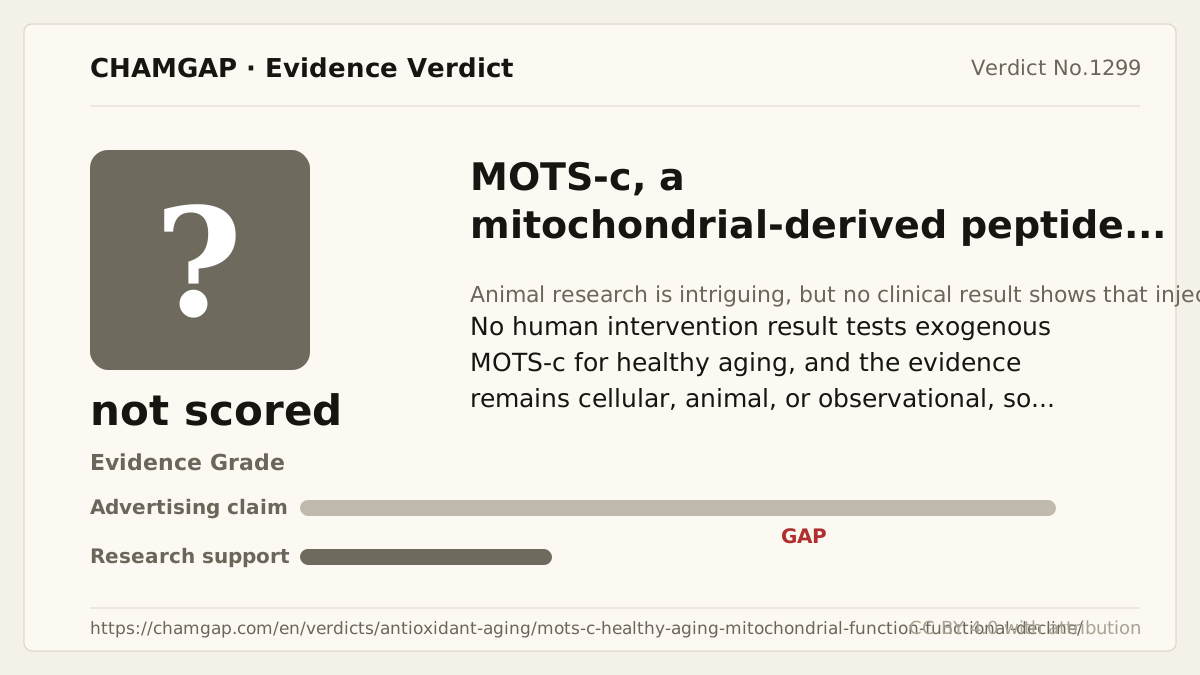
[Chamgap] MOTS-c x improved mitochondrial function and slower aging in healthy adults — Evidence Grade ?. 4 cited sources checked. Source: https://chamgap.com/en/verdicts/antioxidant-aging/mots-c-healthy-aging-mitochondrial-function-functional-decline/ · CC BY 4.0CC BY 4.0 — free to use with attribution; do not distort grades, numbers, or verdict meaning.
What this document does and does not do
Chamgap is an information source. It reports what research has and has not confirmed; it does not tell readers what to take or buy. That decision belongs to readers and, when needed, medical or legal professionals. This verdict reflects literature available up to the search date and may change as new research appears. Nothing here is medical advice.