
Low-dose lithium orotate,
does it really help with Delayed aging and extension of healthspan and lifespan?
research showsNo efficacy trial has tested whether low-dose lithium orotate delays human aging or extends healthspan or lifespan, so the grade is ? and the score is null. The identified human supplement study gave 5 mg to nine healthy men for up to 28 days and measured brain distribution by MRI, not aging or longevity. Ecologic associations involving lithium in drinking water, mood or anxiety studies, and prescription data for other lithium salts are not lifespan trials of this product and dose. Lithium toxicity and renal, thyroid, and dose-management concerns are separate safety issues.
ads claimMarketing turns trace-lithium epidemiology and animal lifespan findings into a microdose longevity mineral and claims that the orotate carrier is safer or superior. Evidence across different salts, doses, populations, and outcomes cannot be merged into proof of lifespan extension for this supplement.
Useful facts when choosing a product
- Lithium-orotate compound mass differs from elemental lithium mass, so users must determine what a label stating 5 mg actually represents.
- Therapeutic lithium requires serum, renal, and thyroid monitoring, and a lower supplement dose does not automatically establish long-term safety.
- Dehydration, low sodium, kidney disease, and some diuretics, ACE inhibitors, ARBs, and NSAIDs can increase lithium accumulation risk.
- Medication and renal and thyroid status should be reviewed with a clinician before anti-aging self-use, and use is especially inappropriate during pregnancy or breastfeeding.
Chamgap Semantic Classification Code
Candidate index · review held
S.lithium-orotate-supplement.UNK.delayed-aging-and-extension-of-healthspan-and-lifespan.reduce.UNKSupplements and nutraceuticals > lithium orotate supplement > Unknown > Delayed aging and extension of healthspan and lifespan > Reduction claim > Unknown
An automated migration candidate, not an issued permanent code; exact claim scope remains under review. This machine-generated migration candidate helps retrieval but is not a permanent assignment. The original verdict ID and URL remain authoritative.
What the research actually shows
Zarse 2011 reported an inverse correlation between tap-water lithium and all-cause mortality across 18 Japanese municipalities and separately observed lifespan extension in nematodes, but this was not an individual-level supplement trial with control of confounding. Neal 2024 administered 5 mg of lithium orotate to nine healthy men for up to 28 days and explored brain lithium MRI signal without aging biomarkers or clinical outcomes. The lithium-orotate review confirmed the scarcity of clinical data, and a case report documented mild acute lithium toxicity after intentional overuse of an online supplement.
Why this is classified as ?
The only directly relevant human 5-mg orotate study was a short distribution study in nine men, with no aging, healthspan, or lifespan endpoint. Once other lithium salts, drinking-water epidemiology, and animal data are separated, there is no human efficacy literature, yielding ? with a null score.
Counterpoint. Future long-term randomized trials could make grading possible, but current evidence does not permit a numerical efficacy score.
Rejudgment record. New verdict — Applied ? because no efficacy trial evaluates low-dose lithium orotate for human aging, healthspan, or lifespan, while the nine-person MRI distribution study, drinking-water ecology, mood literature, and data from other lithium salts do not directly address the claim
Sub-claim grades by effect
This ingredient is marketed for several effects. A single overall grade blends strong and weak claims together, so each effect is graded separately here. The overall grade reflects the strongest disconfirming or core claim.
| Effect (sub-claim) | Grade | Basis |
|---|---|---|
| Delayed biological aging in humans | ? | No human efficacy trial has assessed aging biomarkers with low-dose lithium orotate. |
| Extension of human healthspan | ? | No supplement trial has longitudinally assessed function, disease onset, or healthspan. |
| Extension of overall human lifespan | ? | There is no orotate intervention trial beyond indirect drinking-water ecology and animal data. |
| Mood or anxiety benefit or drinking-water lithium epidemiology | ? | These are separate efficacy domains and do not directly address the longevity claim. |
Cross-check — AI research and Codex final gate
Evidence Table
| Study | Design | Sample | Funding | Endpoint | Result | Weight |
|---|---|---|---|---|---|---|
| Neal MA et al. 2024 | Short uncontrolled brain 7Li-MRI distribution study | Nine healthy adult men | United Kingdom noncommercial academic support | Brain lithium MRI signal after 5 mg of lithium orotate | Low brain lithium signal was detected, but aging, healthspan, and lifespan efficacy were not measured. | Direct product human data but not efficacy evidence |
| Pacholko AG and Bekar LK. 2021 | Narrative review of lithium orotate | Review of clinical and preclinical literature | Academic work with no commercial sponsorship reported | Pharmacokinetics, psychiatric efficacy, toxicity, and evidence gaps | The literature on benefits and risks was too sparse for clinical use, and no aging efficacy trial was identified. | Direct confirmation of the evidence gap |
| Zarse K et al. 2011 | Municipality-level ecological correlation and nematode experiment | 1,206,174 residents across 18 Japanese municipalities plus nematode experiments | Public and academic support | Tap-water lithium and standardized mortality ratio plus nematode lifespan | Reported a municipality-level inverse correlation and nematode lifespan extension but did not test a causal orotate supplement effect. | Indirect hypothesis-generating evidence |
| Pauzé DK and Brooks DE. 2007 | Case report of overdose with an online lithium-orotate supplement | One 18-year-old woman | Not reported | Serum lithium, nausea, vomiting, and tremor | Mild acute lithium toxicity occurred after intentional ingestion of 18 tablets. | Safety evidence, not efficacy evidence |
Receipt — 5 References
All 5 cited sources were verified for existence at the original page (as of 2026-07-20).
Final verification and publication gate: Codex · Evidence date: 2026-07-20 · Corrections: none
Cite this verdict
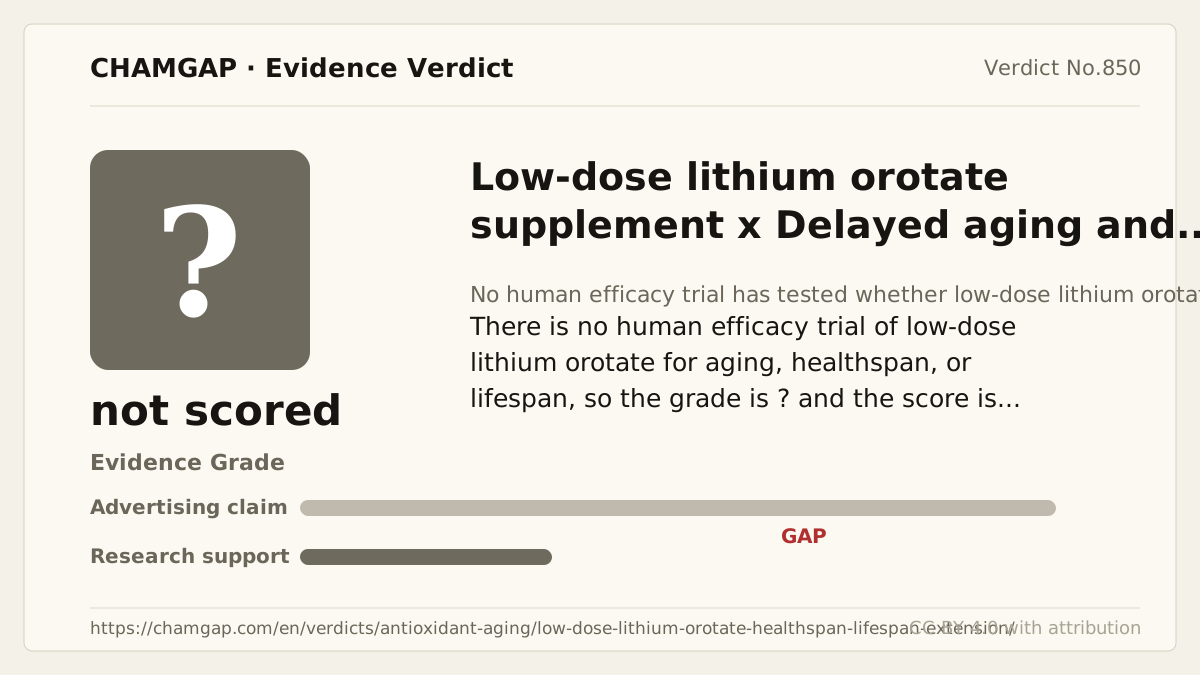
[Chamgap] Low-dose lithium orotate x delayed aging, healthspan, and lifespan extension — Evidence Grade ?. 5 cited sources checked. Source: https://chamgap.com/en/verdicts/antioxidant-aging/low-dose-lithium-orotate-healthspan-lifespan-extension/ · CC BY 4.0CC BY 4.0 — free to use with attribution; do not distort grades, numbers, or verdict meaning.
What this document does and does not do
Chamgap is an information source. It reports what research has and has not confirmed; it does not tell readers what to take or buy. That decision belongs to readers and, when needed, medical or legal professionals. This verdict reflects literature available up to the search date and may change as new research appears. Nothing here is medical advice.