
Low-dose aspirin 100 mg,
does it really help with Extension of disability-free survival and healthy lifespan in healthy adults aged 70 years or older without cardiovascular disease?
research showsThe claim that healthy adults aged 70 years or older without cardiovascular disease can start low-dose aspirin to extend disability-free survival or healthspan is rated F. The independent large ASPREE randomized trial assigned 19,114 participants to aspirin 100 mg daily or placebo. At a median 4.7 years, the primary composite of death, dementia, or persistent physical disability was completely null at HR 1.01. Major hemorrhage increased at HR 1.38 and all-cause mortality was also higher at HR 1.14, although the unexpected mortality signal was driven by cancer death and requires caution. Direct failure of the healthspan endpoint plus harm gives F with 8 points, consistent with the F verdicts for cardiovascular prevention and dementia prevention in healthy older adults. Secondary prevention after myocardial infarction or ischemic stroke is a separate indication.
ads claimMarketing or self-treatment logic can claim that thinning the blood protects the brain and heart and extends healthspan. ASPREE directly tested that net-benefit claim in healthy older adults, found no benefit, and increased bleeding; nonprescription status is not efficacy evidence.
Useful facts when choosing a product
- ASPREE tested enteric-coated aspirin 100 mg every day, which differs in purpose, duration, and risk from aspirin used occasionally for pain or fever.
- Participants had no established cardiovascular disease, dementia, or major physical disability, so this question differs from antiplatelet secondary prevention after myocardial infarction, ischemic stroke, or coronary stenting.
- There is no evidence to start aspirin for the purpose of extending healthspan, and anyone already taking clinician-directed aspirin should not stop solely because of this verdict without confirming the indication and bleeding risk.
- Gastrointestinal bleeding, peptic ulcer, intracranial hemorrhage, and anemia can occur, while anticoagulants, other antiplatelet drugs, nonsteroidal anti-inflammatory drugs, and heavy alcohol use can increase risk. Black stools, vomiting blood, sudden severe headache, or neurologic deficits require urgent assessment.
Chamgap Semantic Classification Code
Candidate index · review held
M.aspirin.UNK.extension-of-disability-free-survival-and-healthy-lifespan-aged-or-older-without-cardiovascular-disease.assess.placeboMedicinal interventions > aspirin > Unknown > Extension of disability-free survival and healthy lifespan aged or older without cardiovascular disease > Association or change assessment > Placebo
An automated migration candidate, not an issued permanent code; exact claim scope remains under review. This machine-generated migration candidate helps retrieval but is not a permanent assignment. The original verdict ID and URL remain authoritative.
What the research actually shows
The 2018 ASPREE trial led by McNeil enrolled 19,114 community-dwelling older adults, mainly aged at least 70 years in Australia while allowing Black and Hispanic adults aged at least 65 years in the United States. Disability-free survival was null at HR 1.01, and the trial stopped at a median 4.7 years after concluding that continued use would not benefit the primary endpoint. The cardiovascular and bleeding analysis from the same trial found no cardiovascular benefit at HR 0.95 and more major hemorrhage at HR 1.38. The prespecified mortality analysis reported 1,052 deaths and HR 1.14 for all-cause mortality, driven mainly by cancer death and described by the investigators as unexpected. These publications report distinct efficacy and safety outcomes from the same randomized trial.
Why this is classified as F (8)
ASPREE directly tested disability-free survival in 19,114 healthy older adults and found a null HR of 1.01. Major hemorrhage at HR 1.38 and an unexpected all-cause mortality HR of 1.14 further worsened net benefit. This is consistent with the F-rated cardiovascular and dementia prevention verdicts from the same ASPREE corpus. Direct efficacy refutation gives F with 8 points, while bleeding and mortality signals are also recorded separately under safety.
Counterpoint. Blood-pressure control, smoking cessation, exercise, vaccination, and individualized lipid and diabetes treatment belong to separate evidence pathways for healthspan. Nonprescription availability does not make aspirin appropriate for unsupervised preventive initiation in an older adult with bleeding risk.
Rejudgment record. New verdict — Applied F with 8 points because the independent 19,114-participant ASPREE trial directly found no benefit for the claimed primary endpoint of disability-free survival (HR 1.01) and found increased major hemorrhage (HR 1.38) and all-cause mortality (HR 1.14)
Sub-claim grades by effect
This ingredient is marketed for several effects. A single overall grade blends strong and weak claims together, so each effect is graded separately here. The overall grade reflects the strongest disconfirming or core claim.
| Effect (sub-claim) | Grade | Basis |
|---|---|---|
| Extension of disability-free survival in healthy adults aged 70 years or older | F | The primary composite of death, dementia, or persistent physical disability was directly null at HR 1.01 in 19,114 ASPREE participants. |
| Extension of healthspan in healthy adults aged 70 years or older | F | Disability-free survival did not improve, while major hemorrhage at HR 1.38 and all-cause mortality at HR 1.14 worsened net benefit. |
| Improvement of long-term net clinical benefit in healthy older adults | F | There was no cardiovascular benefit and bleeding increased, so combined health and independent-living net benefit did not improve. |
Cross-check — AI research and Codex final gate
Evidence Table
| Study | Design | Sample | Funding | Endpoint | Result | Weight |
|---|---|---|---|---|---|---|
| McNeil JJ et al. ASPREE disability-free survival analysis. 2018 | Large multinational randomized double-blind placebo-controlled trial | 19,114 healthy older adults followed for a median of 4.7 years | Public funding including the United States NIA and NCI and Australian NHMRC; Bayer supplied study drug | Disability-free survival as the first occurrence of death, dementia, or persistent physical disability | There was no benefit at 21.5 versus 21.2 events per 1,000 person-years, HR 1.01 (95% CI 0.92 to 1.11), while major hemorrhage increased at HR 1.38. | Decisive direct null randomized healthspan trial |
| McNeil JJ et al. ASPREE cardiovascular and bleeding analysis. 2018 | Prespecified cardiovascular and bleeding analysis of the same randomized trial | 19,114 healthy older adults | Primarily public funding; Bayer supplied aspirin and placebo | Composite cardiovascular disease and major hemorrhage | Cardiovascular disease was null at HR 0.95, while major hemorrhage increased from 6.2 to 8.6 per 1,000 person-years, HR 1.38. | Supports absent net benefit and provides key safety evidence |
| McNeil JJ et al. ASPREE all-cause mortality analysis. 2018 | Prespecified all-cause and cause-specific mortality analysis of the same randomized trial | 19,114 participants and 1,052 deaths | Public funding including NIA, NCI, and NHMRC | All-cause mortality and cancer, cardiovascular, and major-hemorrhage-related death | All-cause mortality increased at HR 1.14, unexpectedly driven by cancer death and requiring cautious interpretation. | Supports absent healthspan benefit with an unexpected harm signal |
Receipt — 3 References
All 3 cited sources were verified for existence at the original page (as of 2026-07-21).
Final verification and publication gate: Codex · Evidence date: 2026-07-21 · Corrections: none
Cite this verdict
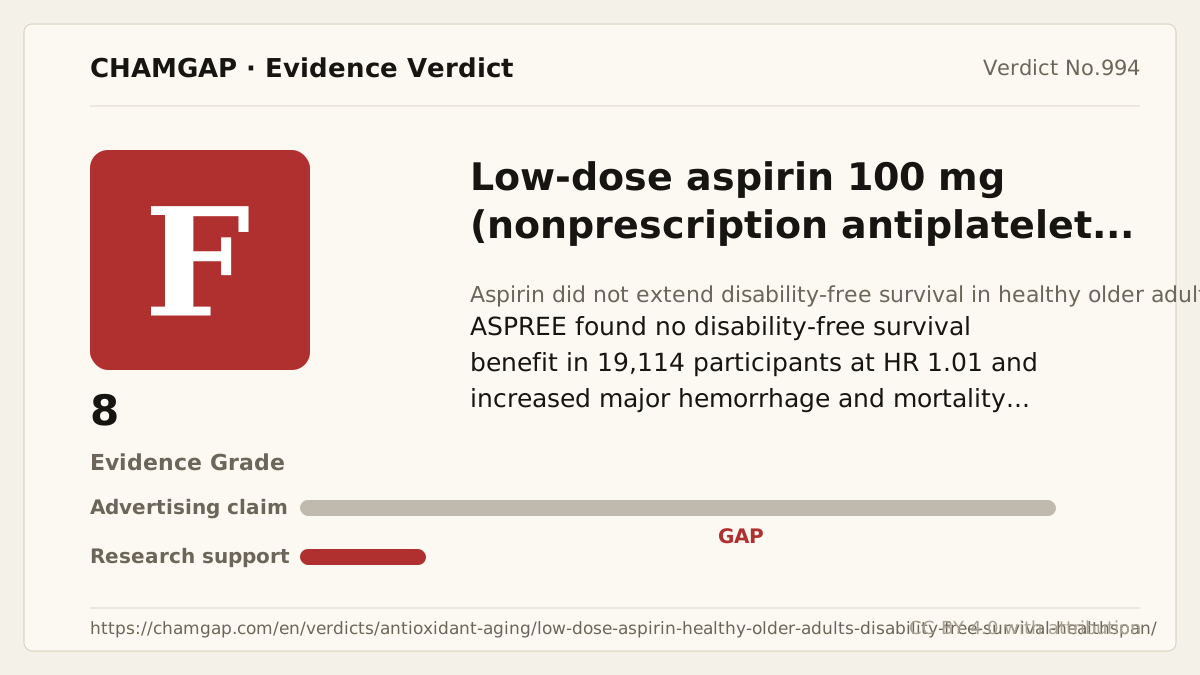
[Chamgap] Low-dose aspirin 100 mg x longer disability-free survival and healthspan in healthy adults aged 70 years or older — Evidence Grade F·8. 3 cited sources checked. Source: https://chamgap.com/en/verdicts/antioxidant-aging/low-dose-aspirin-healthy-older-adults-disability-free-survival-healthspan/ · CC BY 4.0CC BY 4.0 — free to use with attribution; do not distort grades, numbers, or verdict meaning.
What this document does and does not do
Chamgap is an information source. It reports what research has and has not confirmed; it does not tell readers what to take or buy. That decision belongs to readers and, when needed, medical or legal professionals. This verdict reflects literature available up to the search date and may change as new research appears. Nothing here is medical advice.