
Long-term structured physical activity,
does it really help with Prevention of major mobility disability, inability to walk 400 m within 15 minutes?
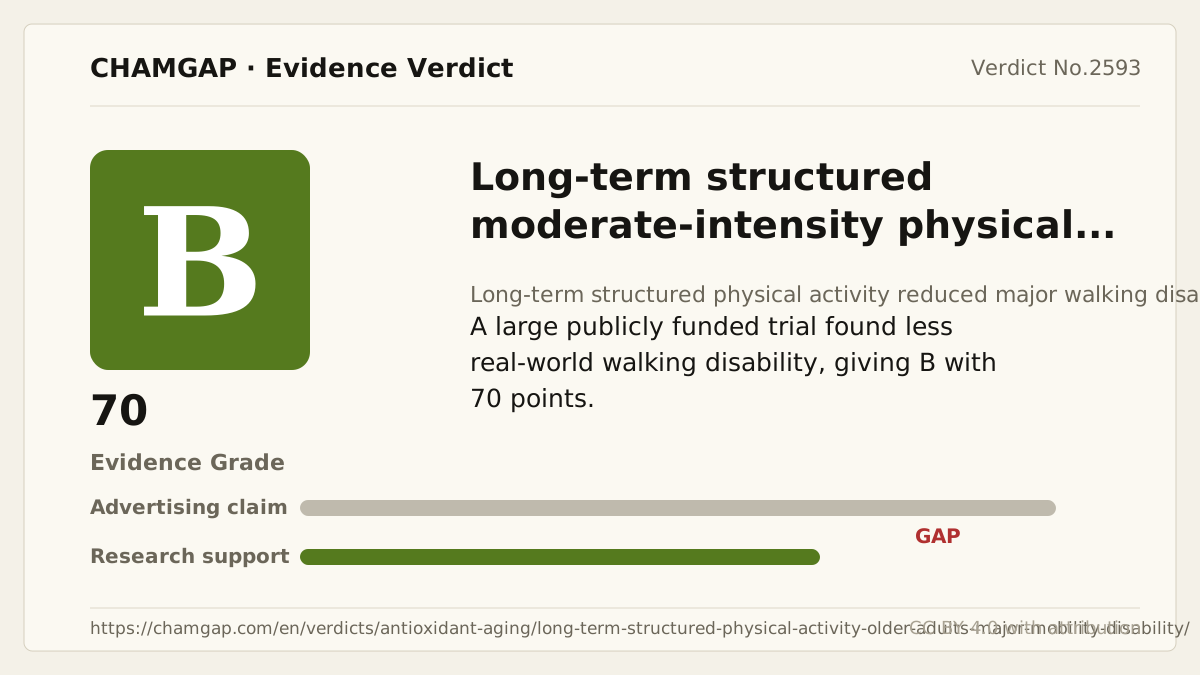
research showsThe grade is B with 70 points. LIFE randomized 1,635 participants to physical activity, 818, or health education, 817. Over a mean 2.6 years, first major mobility disability occurred in 246/818 (30.1%) versus 290/817 (35.5%), HR 0.82 (95% CI 0.69-0.98). The ability to complete a 400-m walk is a patient-centered performance outcome, not a laboratory surrogate.
ads claimThis was not generic advice to move more. It was a long-term program combining center and home sessions with walking, resistance, flexibility, and balance work.
Useful facts when choosing a product
- Participants could walk 400 m at baseline but were sedentary and functionally limited.
- The program centered on walking plus resistance, flexibility, and balance training.
- Health education with upper-extremity stretching was the active control.
Chamgap Semantic Classification Code
Candidate index · review held
X.structured-moderate-physical-activity.behavioral.major-mobility-disability.prevent.UNKBehaviors, exposures and policies > Structured moderate-intensity physical activity > Behavioral delivery > Major mobility disability > Occurrence-prevention claim > Unknown
An automated migration candidate, not an issued permanent code; exact claim scope remains under review. This machine-generated migration candidate helps retrieval but is not a permanent assignment. The original verdict ID and URL remain authoritative.
What the research actually shows
Eight US centers used a computer-generated allocation sequence, masked walking assessors, randomized-group analysis, and a registered primary outcome matching the paper. Participant masking was impossible because of the intervention, and masked assessment, assigned-group analysis, and registry concordance were present; however, there was no evidence that participants remained masked, so the evidentiary requirements for B0 were not met. Verdicts 1723 and 1773 concern intermittent claudication and colon-cancer recurrence, different populations and outcomes.
Why this is classified as B (70)
A large publicly funded trial improved a patient-centered mobility outcome, but absent independent replication and insufficient support for B0 give B with 70 points.
Counterpoint. The result applies to functionally limited but ambulatory older adults and requires individualized safety screening.
Rejudgment record. Cross-check applied — Cross-checked the registered primary outcome, allocation, assessor masking, assigned-group analysis, funding, and absence of participant masking against the JAMA article and NCT01072500
| Endpoint | P | Symptom or function itself is the target - including patient reports and performance tests |
| Replication | R1 | Single confirmatory trial |
| Independence | I2 | Decisive evidence is publicly or non-profit funded |
| Effect size | E+ | Meets the clinically important threshold |
Stored derived and displayed grades match; this is not a current recalculation or validity check (B).
Sub-claim grades by effect
This ingredient is marketed for several effects. A single overall grade blends strong and weak claims together, so each effect is graded separately here. The overall grade reflects the strongest disconfirming or core claim.
| Effect (sub-claim) | Grade | Basis |
|---|---|---|
| Structured physical activity reduces major mobility disability | B | The HR was 0.82 (0.69-0.98). |
Cross-check — AI research and Codex final gate
Evidence Table
| Study | Design | Sample | Funding | Endpoint | Result | Weight |
|---|---|---|---|---|---|---|
| Pahor M et al.; LIFE study investigators. 2014 LIFE | Eight-center assessor-masked randomized trial | 1,635 randomized and analyzed by assigned group, 818/817 | Public funding from NIH/NIA, NHLBI, and associated centers | First major mobility disability | 246/818 (30.1%) versus 290/817 (35.5%); HR 0.82 (95% CI 0.69-0.98), P=.03 | Pivotal large publicly funded functional-outcome trial |
Receipt — 1 References
All 1 cited sources were verified for existence at the original page (as of 2026-08-14).
Final verification and publication gate: Codex · Evidence date: 2026-08-14 · Corrections: none
Cite this verdict
[Chamgap] Long-term structured physical activity x major mobility disability in older adults — Evidence Grade B·70. 1 cited sources checked. Source: https://chamgap.com/en/verdicts/antioxidant-aging/long-term-structured-physical-activity-older-adults-major-mobility-disability/ · CC BY 4.0CC BY 4.0 — free to use with attribution; do not distort grades, numbers, or verdict meaning.
What this document does and does not do
Chamgap is an information source. It reports what research has and has not confirmed; it does not tell readers what to take or buy. That decision belongs to readers and, when needed, medical or legal professionals. This verdict reflects literature available up to the search date and may change as new research appears. Nothing here is medical advice.