
Glycine alone,
does it really help with Slowing human aging and extending healthspan and lifespan?
research showsGlycine alone is rated ? for slowing human aging or extending healthspan or lifespan because no human efficacy literature directly tests those outcomes. In the US National Institute on Aging Interventions Testing Program, an 8% glycine diet extended mean lifespan by 4% to 6% in genetically heterogeneous male and female mice, but that is not a human result. A 2024 systematic review found 50 human glycine studies, yet administration lasted no more than 14 days in healthy participants and four months in diseased populations, with no trial of lifespan, healthspan, or a validated clinical aging-rate endpoint. GlyNAC studies combine glycine with N-acetylcysteine and assess physiological measures such as oxidative stress and physical function; they do not establish a lifespan effect for glycine alone. This axis is distinct from sleep verdicts 194 and 358 and the GlyNAC combination aging-marker axis in verdict 387.
ads claimMarketing combines a 4% to 6% mouse lifespan gain, glycine's role as a glutathione precursor, and GlyNAC aging-marker changes into a claim that glycine alone helps people live longer in better health. No human lifespan or healthspan trial of glycine alone exists.
Useful facts when choosing a product
- Glycine is a nonessential amino acid synthesized by the body and present in protein foods. The 8% rodent diet used in lifespan research cannot be simply converted into a human supplement dose.
- A glycine-only product and GlyNAC, a combination of glycine and N-acetylcysteine, are different interventions whose mechanisms and trial results are not interchangeable.
- Powders and capsules differ in serving size, purity, sweeteners, and other ingredients. Short-term doses studied for sleep or metabolism have not been validated as long-term longevity doses.
- Short human studies suggest generally acceptable tolerability, but high doses can cause nausea, abdominal discomfort, or loose stools, and long-term high-dose safety remains inadequately characterized.
Chamgap Semantic Classification Code
Candidate index · review held
S.glycine-alone.UNK.slowing-human-aging-and-extending-healthspan-and-lifespan.assess.placeboSupplements and nutraceuticals > Glycine alone > Unknown > Slowing human aging and extending healthspan and lifespan > Association or change assessment > Placebo
An automated migration candidate, not an issued permanent code; exact claim scope remains under review. This machine-generated migration candidate helps retrieval but is not a permanent assignment. The original verdict ID and URL remain authoritative.
What the research actually shows
Miller and colleagues in 2019 fed an 8% glycine diet to genetically heterogeneous mice at three independent sites and reported a 4% to 6% increase in mean lifespan in both sexes. One investigator had an interest in a glycine-supplement business, although the experiment used the multicenter National Institute on Aging Interventions Testing Program design. Soh and colleagues in 2024 reviewed 50 human studies of glycine alone. Forty-two were randomized trials, but studies lasted no longer than 14 days in healthy populations or four months in diseased populations and addressed heterogeneous physiological systems, diseases, or sleep. None directly tested delayed human aging, healthspan, or lifespan. The 2023 trial by Kumar and colleagues gave the GlyNAC combination to 24 older adults for 16 weeks and measured glutathione, oxidative stress, mitochondria, and physical-function surrogates, so it is not evidence for glycine alone or a lifespan endpoint.
Why this is classified as ?
The systematic review of glycine alone found 50 human studies but no clinical endpoint of aging rate, healthspan, or lifespan. Rodent lifespan extension and physiological markers from a GlyNAC combination cannot be treated as direct human efficacy. Because human efficacy literature is absent, the grade is ? and the score is null. Gastrointestinal tolerability and uncertain long-term high-dose safety remain separate safety issues.
Counterpoint. Using glycine in food or for another short-term purpose is separate from claiming human lifespan extension. A real answer would require long-term randomized trials of glycine alone that assess functional independence, disease burden, mortality, and prespecified validated aging measures.
Rejudgment record. New verdict — Applied ? for absence of human efficacy literature because no direct clinical trial of aging rate, healthspan, or lifespan was identified for glycine alone, while available evidence consists of rodent survival and surrogate outcomes from the GlyNAC combination
Sub-claim grades by effect
This ingredient is marketed for several effects. A single overall grade blends strong and weak claims together, so each effect is graded separately here. The overall grade reflects the strongest disconfirming or core claim.
| Effect (sub-claim) | Grade | Basis |
|---|---|---|
| Slowing the rate of human aging with glycine alone | ? | Human glycine-alone studies address brief physiological or disease outcomes, with no identified trial of a validated clinical aging-rate endpoint. |
| Extension of human healthspan with glycine alone | ? | No human trial has assessed healthspan outcomes such as duration of functional independence or survival free of multimorbidity. |
| Extension of human lifespan with glycine alone | ? | Only a mouse lifespan signal exists, with no human mortality or survival trial. GlyNAC combination and sleep studies are separate efficacy axes. |
Cross-check — AI research and Codex final gate
Evidence Table
| Study | Design | Sample | Funding | Endpoint | Result | Weight |
|---|---|---|---|---|---|---|
| Miller RA et al. 2019 | Multisite rodent survival experiment in the NIA Interventions Testing Program | Genetically heterogeneous male and female mice at three independent testing sites | Public funding from the US NIA; one coauthor had an interest in a glycine-supplement company | Mean and maximum lifespan and postmortem pathology with an 8% glycine diet | Mean lifespan increased by 4% to 6% and maximum lifespan also increased in male and female mice. | Preclinical lifespan signal with no direct human applicability |
| Soh J et al. 2024 | Systematic review of glycine-alone administration in human adults | Fifty studies in 47 articles; 42 randomized trials | Academic research; no industry sponsorship reported | Short-term physiological, disease, and sleep outcomes across 11 physiological systems | Studies lasted at most 14 days in healthy people and four months in diseased populations, with no trial of aging rate, healthspan, or lifespan. | Confirms the direct human-efficacy gap |
| Kumar P et al. 2023 GlyNAC trial | Randomized placebo-controlled combination-supplement trial in older adults | 24 older adults randomized; 12 younger comparators | Academic research associated with Baylor College of Medicine; patents and conflicts disclosed | Glutathione, oxidative stress, mitochondrial, and physical-function surrogates after 16 weeks of GlyNAC | Some aging-related surrogate measures improved, but the intervention was not glycine alone and did not assess lifespan or healthspan. | Combination and surrogate example excluded from direct evidence |
Receipt — 3 References
All 3 cited sources were verified for existence at the original page (as of 2026-07-20).
Final verification and publication gate: Codex · Evidence date: 2026-07-20 · Corrections: none
Cite this verdict
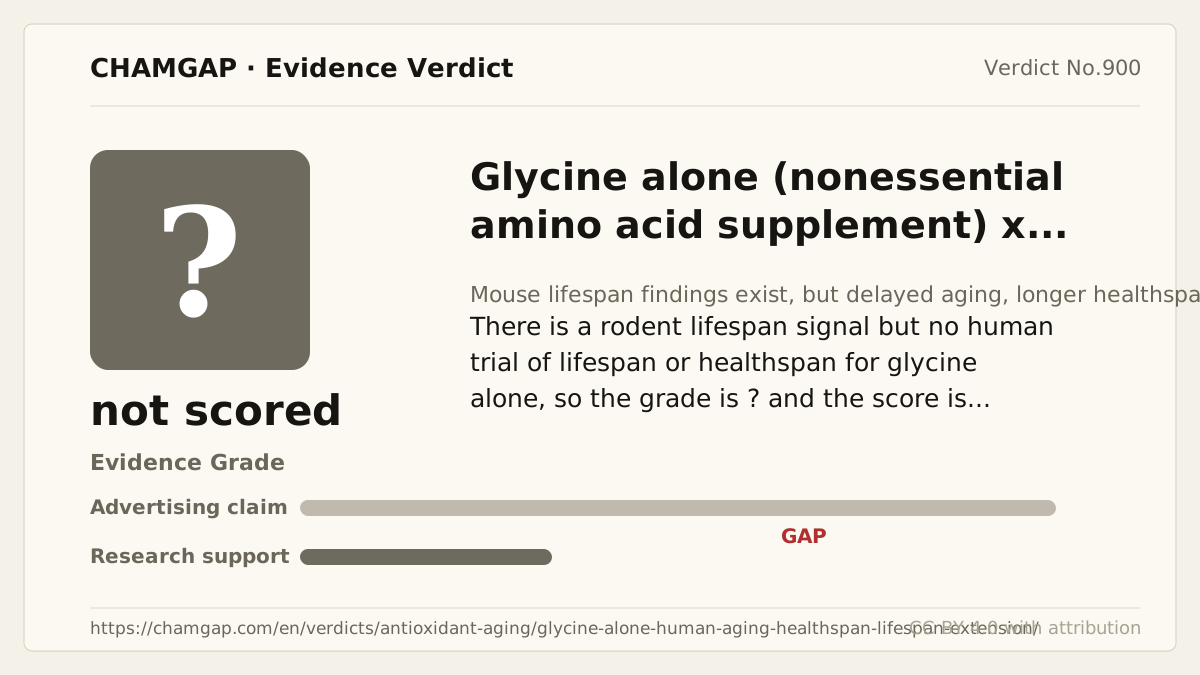
[Chamgap] Glycine alone x slowing human aging and extending healthspan and lifespan — Evidence Grade ?. 3 cited sources checked. Source: https://chamgap.com/en/verdicts/antioxidant-aging/glycine-alone-human-aging-healthspan-lifespan-extension/ · CC BY 4.0CC BY 4.0 — free to use with attribution; do not distort grades, numbers, or verdict meaning.
What this document does and does not do
Chamgap is an information source. It reports what research has and has not confirmed; it does not tell readers what to take or buy. That decision belongs to readers and, when needed, medical or legal professionals. This verdict reflects literature available up to the search date and may change as new research appears. Nothing here is medical advice.