
Glucosamine,
does it really help with Lower all-cause mortality and longer healthspan or lifespan through regular use?
research showsThe claim that regular glucosamine use helps people live longer is rated D. An observational UK Biobank study of 495,077 adults associated regular use with 15% lower all-cause mortality, with a hazard ratio of 0.85 and a 95% confidence interval of 0.82 to 0.89, but use was not randomized and was entangled with health behavior, joint disease, and other supplement use. A United States NHANES analysis of 38,021 adults with broader covariate adjustment found no remaining association, with a hazard ratio of 1.02 and a 95% confidence interval of 0.86 to 1.21. No randomized trial has tested glucosamine for mortality, healthspan, or lifespan extension.
ads claimMarketing changes the observational statement that users had fewer deaths into the causal statement that glucosamine extended life. Lifestyle and health-care behavior among people taking a joint supplement cannot be fully separated, and real-world products may combine glucosamine with chondroitin or other ingredients.
Useful facts when choosing a product
- Glucosamine is sold as sulfate and hydrochloride salts and is often combined with chondroitin, methylsulfonylmethane, or other joint ingredients. Observational regular-use data do not establish a longevity effect for a specific salt, dose, or product.
- Longevity evidence is separate from evidence about joint pain or osteoarthritis. Trials for a joint indication cannot be converted into evidence of lower mortality or longer healthspan.
- Glucosamine is generally tolerated, but nausea, heartburn, diarrhea, or constipation can occur. People with diabetes should monitor glycemia after starting it.
- Use with warfarin has been associated with higher international normalized ratio and bleeding risk, requiring avoidance or close clinical supervision. Anyone sensitive to shellfish-derived materials should verify the ingredient source and allergy labeling.
Chamgap Semantic Classification Code
Candidate index · review held
S.glucosamine.oral.all-cause-mortality-and-longer-healthspan-or-lifespan-through-regular-use.reduce.UNKSupplements and nutraceuticals > Glucosamine > Oral > all-cause mortality and longer healthspan or lifespan through regular use > Reduction claim > Unknown
An automated migration candidate, not an issued permanent code; exact claim scope remains under review. This machine-generated migration candidate helps retrieval but is not a permanent assignment. The original verdict ID and URL remain authoritative.
What the research actually shows
Li in 2020 prospectively followed 495,077 middle-aged and older UK adults and reported hazard ratios of 0.85 for all-cause mortality, 0.82 for cardiovascular mortality, and 0.94 for cancer mortality among regular glucosamine users. Extensive covariates were adjusted, but formulation, dose, and duration were not randomized and exposure was self-reported at baseline. Bhimani in 2023 linked 38,021 United States adults in NHANES 1999 to 2014 to mortality records. Associations appeared favorable under minimal adjustment but became neutral after extensive adjustment, with a hazard ratio of 1.02 for all-cause mortality and no association with cancer mortality. Neither study was an intervention trial of healthspan or maximum lifespan.
Why this is classified as D (30)
The favorable mortality signal came from a large but nonrandomized, self-reported cohort and was not reproduced after extensive adjustment in another representative cohort, where the hazard ratio was 1.02. With no randomized trial of lifespan or healthspan, conflicting observational evidence supports D with 30 points.
Counterpoint. Using glucosamine for joint symptoms after clinical discussion is a different decision from long-term use by a healthy person seeking life extension. There is no causal evidence for the latter purpose.
Rejudgment record. Cross-check applied — Applied D because the lower-mortality association in UK Biobank came from nonrandomized self-reported exposure vulnerable to residual confounding and healthy-user bias, the association was not reproduced after extensive adjustment in United States NHANES, and no randomized lifespan or healthspan trial exists
Sub-claim grades by effect
This ingredient is marketed for several effects. A single overall grade blends strong and weak claims together, so each effect is graded separately here. The overall grade reflects the strongest disconfirming or core claim.
| Effect (sub-claim) | Grade | Basis |
|---|---|---|
| Lower all-cause mortality through regular glucosamine use | D | The UK Biobank association of HR 0.85 was not reproduced in extensively adjusted NHANES data, where HR was 1.02, and no randomized trial exists. |
| Extension of healthspan | D | No intervention trial directly measured healthspan, and mortality cohorts cannot establish preserved function. |
| Extension of lifespan | D | Human observational mortality data exist but conflict, and no randomized trial has tested causal lifespan extension. |
Cross-check — AI research and Codex final gate
Evidence Table
| Study | Design | Sample | Funding | Endpoint | Result | Weight |
|---|---|---|---|---|---|---|
| Li ZH et al. 2020 | Prospective observational UK Biobank cohort | 495,077 adults | Public and academic research support; nonindustry cohort analysis | All-cause and cardiovascular, cancer, respiratory, and digestive mortality | Regular use was associated with all-cause mortality HR 0.85 (95% CI 0.82 to 0.89), but exposure was nonrandomized and self-reported. | Large favorable observational signal |
| Bhimani J et al. 2023 | United States NHANES mortality-linked observational cohort | 38,021 adults and 4,905 deaths | United States National Cancer Institute and Memorial Sloan Kettering academic support | All-cause and cause-specific mortality | After extensive multivariable adjustment, glucosamine was not associated with all-cause mortality: HR 1.02 (95% CI 0.86 to 1.21). | Nonreplication of the favorable observational signal |
Receipt — 2 References
All 2 cited sources were verified for existence at the original page (as of 2026-07-23).
Final verification and publication gate: Codex · Evidence date: 2026-07-23 · Corrections: none
Cite this verdict
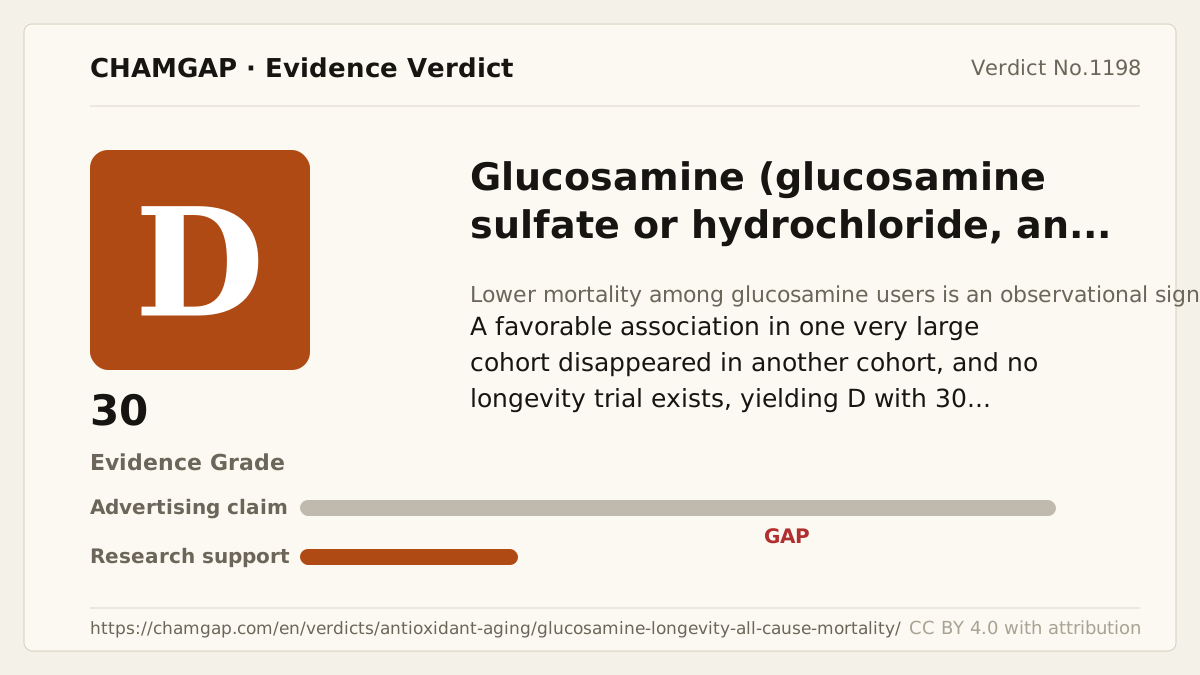
[Chamgap] Glucosamine x lowering all-cause mortality and extending healthspan or lifespan through regular use — Evidence Grade D·30. 2 cited sources checked. Source: https://chamgap.com/en/verdicts/antioxidant-aging/glucosamine-longevity-all-cause-mortality/ · CC BY 4.0CC BY 4.0 — free to use with attribution; do not distort grades, numbers, or verdict meaning.
What this document does and does not do
Chamgap is an information source. It reports what research has and has not confirmed; it does not tell readers what to take or buy. That decision belongs to readers and, when needed, medical or legal professionals. This verdict reflects literature available up to the search date and may change as new research appears. Nothing here is medical advice.