
Frozen gloves and socks,
does it really help with Prevention of paclitaxel-induced peripheral neuropathy?
research showsThe grade is C. Forty people entered a self-controlled trial and 36 completed 12 weekly cycles. Patient-reported neuropathy interfering with daily activities occurred in 1/36 cooled hands (2.8%) versus 15/36 untreated hands (41.7%), and 1/36 cooled feet versus 13/36 untreated feet (36.1%); the time-to-event hazard ratio was 0.13 for both hands and feet. The effect was large, but only 36 participants were analyzed and cooling was assigned nonrandomly to the dominant side, giving C with 54 points.
ads claimFeeling cold and lowering distal temperature are not themselves clinical neuroprotection. The supported claim is narrower: less neuropathy on the cooled limb during one specific weekly paclitaxel schedule.
Useful facts when choosing a product
- Elasto-Gel gloves and socks were cooled to -20°C for 90 minutes, with gloves replaced at 45 minutes.
- Cooling was always applied to the dominant side, with the opposite side untreated.
- The registration was UMIN000013398, not the later bilateral-cooling trial UMIN000034966.
Chamgap Semantic Classification Code
Candidate index · review held
UNK.frozen-gloves-and-socks-during-paclitaxel-infusion.UNK.paclitaxel-induced-peripheral-neuropathy.prevent.noneUnknown > Frozen gloves and socks during paclitaxel infusion > Unknown > paclitaxel-induced peripheral neuropathy > Occurrence-prevention claim > No intervention
An automated migration candidate, not an issued permanent code; exact claim scope remains under review. This machine-generated migration candidate helps retrieval but is not a permanent assignment. The original verdict ID and URL remain authoritative.
What the research actually shows
Hanai and colleagues enrolled 40 people with breast cancer scheduled for twelve weekly paclitaxel doses of 80 mg/m². Gloves and socks cooled to -20°C were applied to the dominant side for 90 minutes, while the nondominant side was untreated. The prespecified primary endpoint was tactile deterioration by Semmes-Weinstein monofilament at 960 mg/m². Four did not complete chemotherapy, leaving 36 for the 12-cycle analysis; all 40 contributed to censored time-to-event analysis. Registration UMIN000013398 matched the trial. Funding came from the Japan Society for the Promotion of Science and a Japanese education-ministry program.
Why this is classified as C (54)
A large patient-centered effect and public funding are offset by a small 36-person analysis and nonrandom assignment of cooling to the dominant side, giving C with 54 points.
Counterpoint. C reflects limited replication and design confirmation, not a small observed effect.
Rejudgment record. Cross-check applied — The JNCI report was checked against UMIN registration for the primary endpoint, analyzed sample, side assignment, effect estimates, and public funding
| Endpoint | P | Symptom or function itself is the target - including patient reports and performance tests |
| Replication | R1 | Single confirmatory trial |
| Independence | I2 | Decisive evidence is publicly or non-profit funded |
| Effect size | E+ | Meets the clinically important threshold |
Stored derived and displayed grades match; this is not a current recalculation or validity check (C).
Sub-claim grades by effect
This ingredient is marketed for several effects. A single overall grade blends strong and weak claims together, so each effect is graded separately here. The overall grade reflects the strongest disconfirming or core claim.
| Effect (sub-claim) | Grade | Basis |
|---|---|---|
| Prevention of neuropathy interfering with daily activities | C | Large absolute differences and lower hazards were found for hands and feet. |
| Prevention of tactile deterioration | C | The prespecified primary endpoint also favored cooling. |
Cross-check — AI research and Codex final gate
Evidence Table
| Study | Design | Sample | Funding | Endpoint | Result | Weight |
|---|---|---|---|---|---|---|
| Hanai A, Ishiguro H, Sozu T, et al. 2018 | Prospective self-controlled clinical trial | 40 enrolled; 36 analyzed at 12 cycles; 40 in time-to-event analysis | Japan Society for the Promotion of Science DC1-6751 and education-ministry human-resource program grant 12 | Prespecified tactile-deterioration primary endpoint plus severe PNQ neuropathy, sensation, and dexterity | PNQ D/E occurred in 1/36 versus 15/36 hands and 1/36 versus 13/36 feet; time-to-event HR 0.13 (0.05-0.34) for hands and 0.13 (0.04-0.38) for feet. | Only peer-reviewed original study with a large signal |
Receipt — 1 References
All 1 cited sources were verified for existence at the original page (as of 2026-08-15).
Final verification and publication gate: Codex · Evidence date: 2026-08-15 · Corrections: none
Cite this verdict
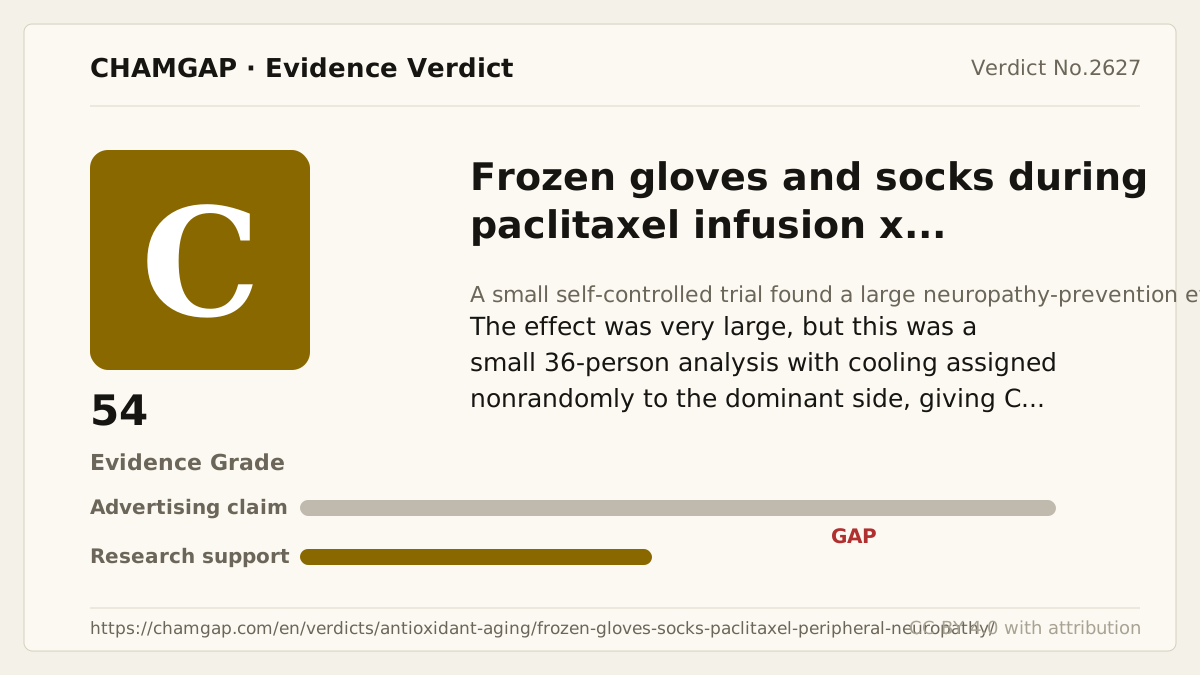
[Chamgap] Frozen gloves and socks x prevention of paclitaxel neuropathy — Evidence Grade C·54. 1 cited sources checked. Source: https://chamgap.com/en/verdicts/antioxidant-aging/frozen-gloves-socks-paclitaxel-peripheral-neuropathy/ · CC BY 4.0CC BY 4.0 — free to use with attribution; do not distort grades, numbers, or verdict meaning.
What this document does and does not do
Chamgap is an information source. It reports what research has and has not confirmed; it does not tell readers what to take or buy. That decision belongs to readers and, when needed, medical or legal professionals. This verdict reflects literature available up to the search date and may change as new research appears. Nothing here is medical advice.