
Finnish dry sauna,
does it really help with Longer healthspan through lower cardiovascular and all-cause mortality with regular use?
research showsRegular Finnish sauna use is associated with lower cardiovascular and all-cause mortality, but the claim is graded D because no randomized intervention establishes causation. In the 2,315-man KIHD cohort, use four to seven times weekly was associated with all-cause mortality HR 0.60 versus once weekly. Healthy-user bias and residual confounding remain.
ads claimA 40% lower observed mortality risk is converted into a causal claim that sauna extends life by 40%.
Useful facts when choosing a product
- Finnish dry sauna generally involves brief exposure to high heat and low humidity and is neither a drug nor disease treatment.
- The cohort frequency reflects a long-standing habit and does not establish equivalent effects for any commercial facility.
- Dehydration, dizziness, orthostatic hypotension, and syncope can occur. Avoid use after alcohol and seek medical advice for unstable cardiovascular disease or low blood pressure.
Chamgap Semantic Classification Code
Candidate index · review held
X.finnish-dry-sauna.environmental.longer-healthspan-through-lower-cardiovascular-and-all-cause-mortality-with-regular-use.reduce.UNKBehaviors, exposures and policies > Finnish dry sauna > Environmental exposure > Longer healthspan through lower cardiovascular and all-cause mortality with regular use > Reduction claim > Unknown
An automated migration candidate, not an issued permanent code; exact claim scope remains under review. This machine-generated migration candidate helps retrieval but is not a permanent assignment. The original verdict ID and URL remain authoritative.
What the research actually shows
Laukkanen 2015 followed 2,315 men aged 42 to 60 for a median 20.7 years. Compared with once-weekly use, four to seven sessions weekly were associated with HR 0.37 for sudden cardiac death, 0.50 for fatal cardiovascular disease, and 0.60 for all-cause mortality. Follow-up reports remain nonrandomized and largely derive from related Finnish cohorts.
Why this is classified as D (30)
Despite a large association on hard mortality endpoints, evidence is confined to nonrandomized cohorts and cannot establish causality. The observational-only rule gives D with 30 points.
Counterpoint. Choosing sauna for comfort or acute physiology is distinct from using it as a life-extension treatment.
Rejudgment record. Cross-check applied — Accepted the dose-related cardiovascular and all-cause mortality associations in KIHD but applied the observational-only rule because exposure was self-selected, healthy-user bias and residual confounding remain, and no mortality or healthspan intervention trial exists
Sub-claim grades by effect
This ingredient is marketed for several effects. A single overall grade blends strong and weak claims together, so each effect is graded separately here. The overall grade reflects the strongest disconfirming or core claim.
| Effect (sub-claim) | Grade | Basis |
|---|---|---|
| Reduced cardiovascular mortality | D | Only cohort associations exist, without randomized causal testing. |
| Reduced all-cause mortality | D | The HR of 0.60 is observational and cannot exclude healthy-user bias. |
| Longer healthspan | D | No intervention trial directly measured healthspan. |
Cross-check — AI research and Codex final gate
Evidence Table
| Study | Design | Sample | Funding | Endpoint | Result | Weight |
|---|---|---|---|---|---|---|
| Laukkanen T et al. 2015 | Prospective population cohort | 2,315 Finnish men | Finnish public and academic research support | Sudden cardiac death, fatal coronary and cardiovascular disease, and all-cause mortality | Four to seven weekly sessions were associated with all-cause mortality HR 0.60 and other dose-related associations. | Key observational hard-endpoint evidence |
| Laukkanen T et al. 2018 | Prospective cohort analysis | 1,688 men and women aged 53 to 74 | Public and academic research support | Cardiovascular mortality prediction | Reported an inverse association between sauna frequency and cardiovascular mortality without randomization. | Observational replication |
Receipt — 2 References
All 2 cited sources were verified for existence at the original page (as of 2026-07-23).
Final verification and publication gate: Codex · Evidence date: 2026-07-23 · Corrections: none
Cite this verdict
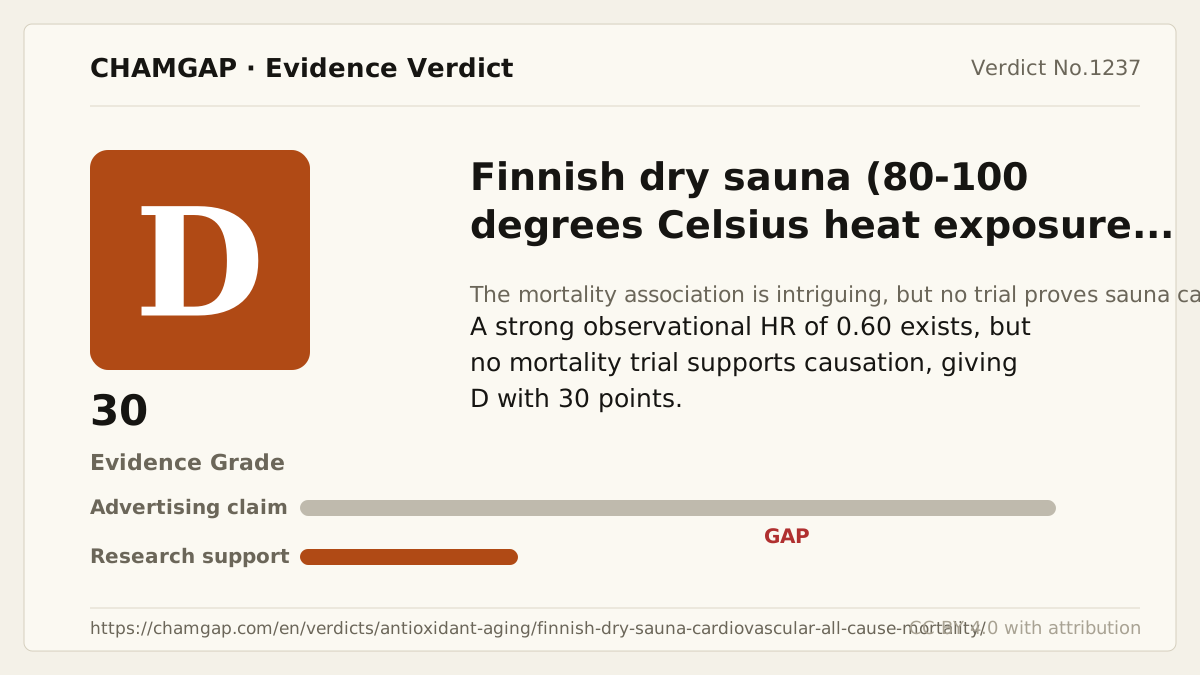
[Chamgap] Finnish dry sauna x lower mortality and longer healthspan — Evidence Grade D·30. 2 cited sources checked. Source: https://chamgap.com/en/verdicts/antioxidant-aging/finnish-dry-sauna-cardiovascular-all-cause-mortality/ · CC BY 4.0CC BY 4.0 — free to use with attribution; do not distort grades, numbers, or verdict meaning.
What this document does and does not do
Chamgap is an information source. It reports what research has and has not confirmed; it does not tell readers what to take or buy. That decision belongs to readers and, when needed, medical or legal professionals. This verdict reflects literature available up to the search date and may change as new research appears. Nothing here is medical advice.