
DHEA,
does it really help with General anti-aging rejuvenation of strength, body composition, cognition, and quality of life in healthy older adults?
research showsThe claim that DHEA broadly rejuvenates strength, body composition, cognition, and quality of life in healthy older adults is rated F. In a two-year double-blind trial, DHEA restored hormone levels to a youthful range but produced no physiologically relevant benefit in body composition, physical performance, insulin sensitivity, or quality of life. A meta-analysis of 25 placebo-controlled trials involving 1,353 older men found that a small fat-mass reduction disappeared after adjustment for conversion to sex hormones, with no benefit on quality of life or other clinical measures. A Cochrane review did not support cognitive benefit in healthy middle-aged or older adults, and a 2023 Endocrine Society scientific statement did not support widespread use of DHEA as an anti-aging agent.
ads claimMarketing labels the age-related decline in DHEA sulfate as a deficiency and claims that restoring the number restores youth, muscle, memory, and vitality. An age-associated biomarker decline is not automatically a treatable disease, and biochemical normalization is not a patient-centered clinical benefit.
Useful facts when choosing a product
- DHEA is an adrenal steroid precursor that can be converted in peripheral tissues into testosterone and estrogens.
- It is sold as a supplement in countries including the United States but is not an approved general healthy-aging or rejuvenation treatment, and national regulation and sports anti-doping rules vary.
- This verdict covers DHEA itself and a broad anti-aging claim; verdict 369 on 7-keto-DHEA and body fat concerns a different molecule, metabolism, and efficacy axis.
- Acne, hirsutism, hair loss, mood changes, and lipid changes can occur, and conversion to androgens and estrogens raises concern for hormone-sensitive cancer, prostate or breast conditions, liver disease, and uncertain long-term safety.
Chamgap Semantic Classification Code
Candidate index · review held
S.dhea.UNK.general-anti-aging-rejuvenation-of-strength-body-composition-cognition-and-quality-of-life.assess.placeboSupplements and nutraceuticals > DHEA > Unknown > General anti-aging rejuvenation of strength, body composition, cognition, and quality of life > Association or change assessment > Placebo
An automated migration candidate, not an issued permanent code; exact claim scope remains under review. This machine-generated migration candidate helps retrieval but is not a permanent assignment. The original verdict ID and URL remain authoritative.
What the research actually shows
Nair and colleagues randomized older men and women with low DHEA sulfate to DHEA or placebo for two years and assessed physical performance, body composition, bone density, glucose metabolism, and quality of life. Selected small changes in bone density or lean mass did not amount to a broad clinical anti-aging effect. Corona and colleagues pooled 25 double-blind placebo-controlled trials in older men and found no benefit on metabolic, bone, sexual-function, or quality-of-life outcomes apart from a small fat-mass change dependent on conversion to active sex hormones. A Cochrane review found no support for cognitive benefit in dementia-free adults over 50. The Endocrine Society's 2023 scientific statement concluded that these studies do not support widespread DHEA use as an anti-aging agent.
Why this is classified as F (15)
F rests on repeated refutation, not an explicit guideline recommendation against use. The Nair 2006 two-year direct trial was null for core anti-aging clinical benefits; a 25-trial meta-analysis and a Cochrane review of cognition in dementia-free middle-aged and older adults were also null. The 2023 Endocrine Society document is a scientific statement, not a prohibition, and its conclusion that evidence does not support widespread anti-aging use serves only as corroborating context. The score remains F 15.
Counterpoint. Progressive resistance training, adequate protein and energy intake, and review of fall risk and medicines are priorities for strength and function. Fatigue, weakness, or cognitive change calls for evaluation of anemia, thyroid disease, sleep, depression, medicines, and neurologic causes rather than masking the cause with self-administered DHEA.
Rejudgment record. New verdict — Applied F for repeated refutation rather than an explicit recommendation against use: the Nair 2006 two-year direct trial was null, the 25-trial meta-analysis was null, and the Cochrane review found no cognitive benefit in dementia-free middle-aged and older adults. The 2023 Endocrine Society document is a scientific statement, not a prohibition, and was used only as corroborating context
Sub-claim grades by effect
This ingredient is marketed for several effects. A single overall grade blends strong and weak claims together, so each effect is graded separately here. The overall grade reflects the strongest disconfirming or core claim.
| Effect (sub-claim) | Grade | Basis |
|---|---|---|
| Rejuvenation of strength and physical function in healthy older adults | F | A direct two-year trial found no physiologically relevant physical-performance benefit, and the broader evidence does not support consistent strength improvement. |
| Restoration of youthful body composition in healthy older adults | F | The small fat-mass change disappeared after adjustment for sex-hormone conversion, and broad body-composition rejuvenation was not demonstrated. |
| Broad improvement of cognition and quality of life in healthy older adults | F | The Cochrane review, long-term trial, and meta-analysis do not support clinically meaningful improvement in cognition or quality of life. |
Cross-check — AI research and Codex final gate
Evidence Table
| Study | Design | Sample | Funding | Endpoint | Result | Weight |
|---|---|---|---|---|---|---|
| Nair KS et al. 2006 | Two-year randomized double-blind placebo-controlled trial | 87 older men and 57 older women with low DHEA sulfate | United States NIH and Mayo Foundation public and academic support | Physical performance, body composition, bone density, glucose tolerance, and quality of life | DHEA sulfate rose into a youthful range, but there was no physiologically relevant benefit in body composition, physical performance, insulin sensitivity, or quality of life. | Key long-term direct null trial |
| Corona G et al. 2013 | Meta-analysis of double-blind placebo-controlled trials | 25 trials and 1,353 older men | Academic research; funding varied across source trials | Body composition, metabolic, bone, sexual-function, and quality-of-life outcomes | A small fat-mass reduction disappeared after adjustment for increased sex hormones, and other clinical outcomes did not improve. | Null synthesis across repeated trials |
| Grimley Evans J et al. 2006 | Cochrane systematic review of randomized trials | Trials in dementia-free adults older than 50 years | Cochrane academic review | Memory, cognitive tests, and cognitive function | The limited controlled-trial evidence did not support cognitive benefit in healthy middle-aged or older adults. | Repeated refutation of the cognitive subclaim |
| Cappola AR et al. 2023 Endocrine Society scientific statement | Professional-society scientific statement and evidence synthesis | Synthesis of observational and trial evidence across endocrine aging axes | Endocrine Society | Efficacy and safety of DHEA for healthy aging and anti-aging use | The available studies were concluded not to support widespread DHEA supplementation as an anti-aging agent. | Professional-society non-support for anti-aging use |
Receipt — 4 References
All 4 cited sources were verified for existence at the original page (as of 2026-07-20).
Final verification and publication gate: Codex · Evidence date: 2026-07-20 · Corrections: none
Cite this verdict
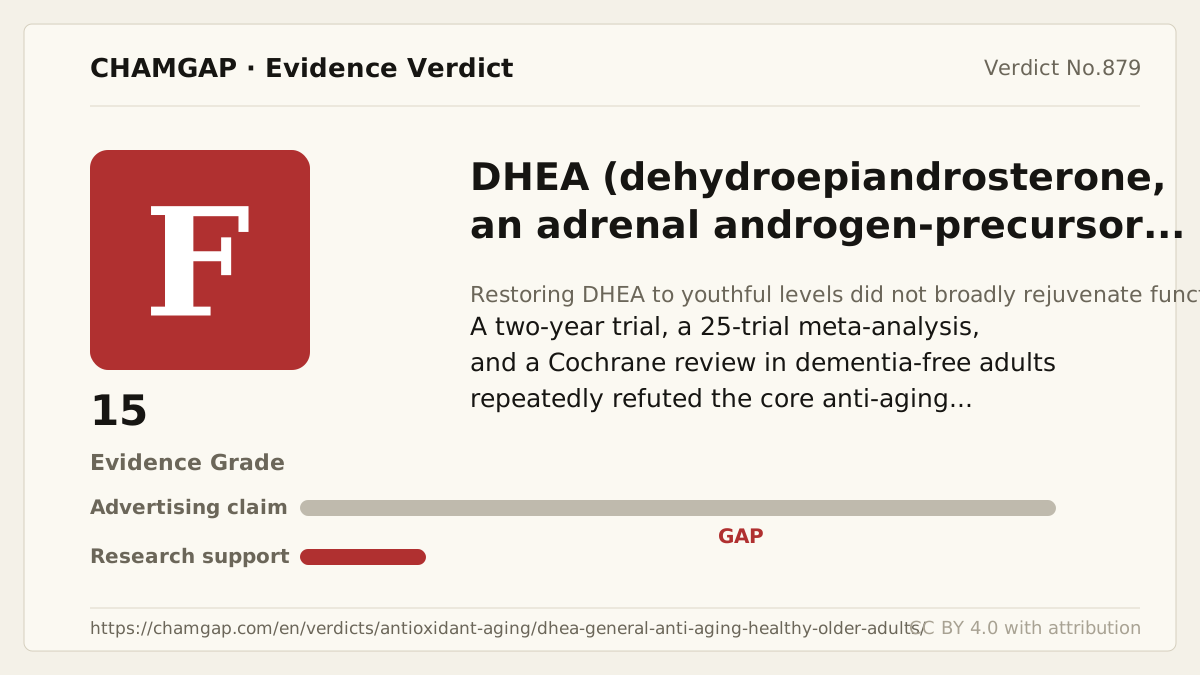
[Chamgap] DHEA x general anti-aging improvement in healthy older adults — Evidence Grade F·15. 4 cited sources checked. Source: https://chamgap.com/en/verdicts/antioxidant-aging/dhea-general-anti-aging-healthy-older-adults/ · CC BY 4.0CC BY 4.0 — free to use with attribution; do not distort grades, numbers, or verdict meaning.
What this document does and does not do
Chamgap is an information source. It reports what research has and has not confirmed; it does not tell readers what to take or buy. That decision belongs to readers and, when needed, medical or legal professionals. This verdict reflects literature available up to the search date and may change as new research appears. Nothing here is medical advice.