
Creatine monohydrate,
does it really help with Slowed biological aging and extended healthspan or lifespan in healthy adults?
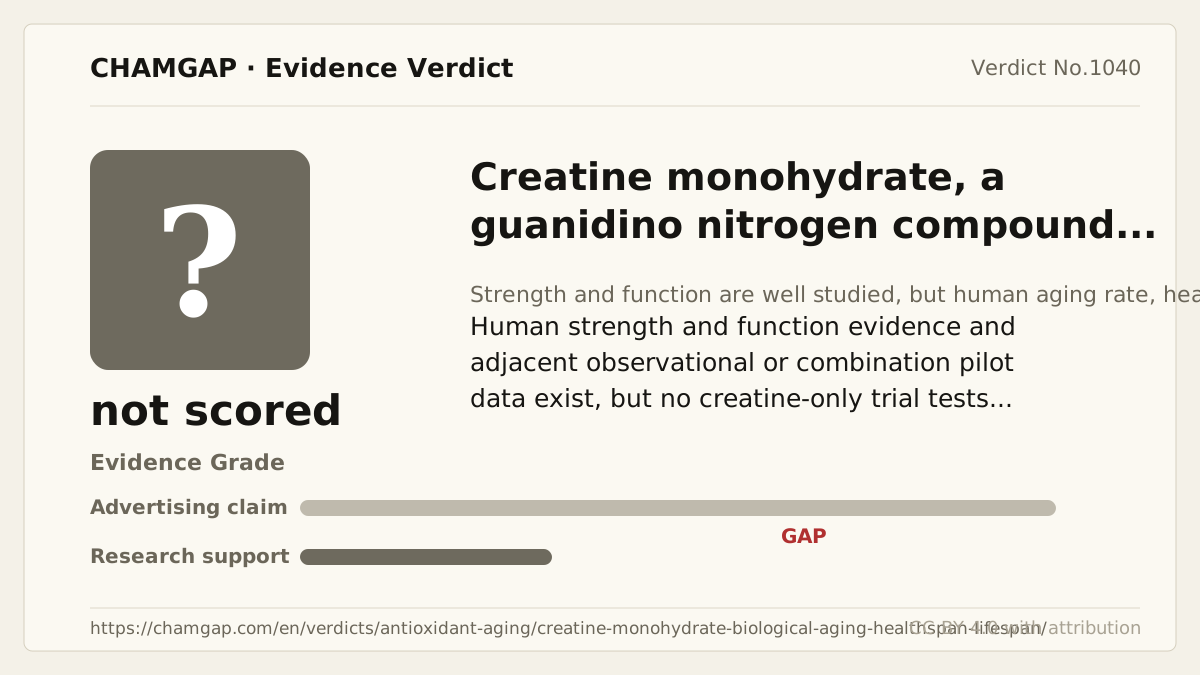
research showsCreatine monohydrate is rated ? because no product- and claim-matched human efficacy literature tests whether it slows biological aging or extends healthspan or lifespan in healthy adults. Trials and reviews in older adults assess strength, lean mass, physical function, bone, and cognition, but not validated multiple aging clocks, survival free of disease or frailty, or total lifespan. A 2025 association between dietary creatine intake and DNA-methylation mortality predictors was not a supplement-assignment trial. A 2026 open-label study in 30 men coadministered creatine and vitamin D, lacked a baseline telomere comparison, and used an external control, so it cannot identify creatine-only efficacy or a rate of aging. The score is therefore null. Extensive safety evidence in healthy adults is a separate question and does not fill the longevity-efficacy gap.
ads claimMarketing converts adenosine-triphosphate regeneration, muscle or brain function, antioxidant mechanisms, and attenuation of age-related functional decline into reversed biological age, longer healthspan, or longer life. Functional or body-composition benefits can be useful without being equivalent to a human aging-rate or survival endpoint.
Useful facts when choosing a product
- Creatine monohydrate is the formulation with the largest clinical evidence base; other salts, esters, or blends cannot be assumed to have identical absorption and evidence.
- Maintenance doses of 3 to 5 grams per day are widely studied for conventional uses, but no dose or duration has been validated for slowing human aging or extending healthspan or lifespan.
- Early weight gain can reflect increased intramuscular water and some users experience gastrointestinal discomfort, although a large clinical-trial safety analysis found no overall adverse-event excess over placebo.
- People with pre-existing kidney disease, elevated renal risk, or medicines affecting the kidneys should seek clinical advice, and a creatinine rise may need interpretation apart from a true change in kidney function.
Chamgap Semantic Classification Code
Candidate index · review held
S.creatine-monohydrate.UNK.slowed-biological-aging-and-extended-healthspan-or-lifespan.assess.placeboSupplements and nutraceuticals > Creatine monohydrate > Unknown > Slowed biological aging and extended healthspan or lifespan > Association or change assessment > Placebo
An automated migration candidate, not an issued permanent code; exact claim scope remains under review. This machine-generated migration candidate helps retrieval but is not a permanent assignment. The original verdict ID and URL remain authoritative.
What the research actually shows
Most older-adult creatine trials combine supplementation with resistance exercise and measure lean mass, strength, daily function, bone area or thickness, and memory. The randomized-trial review by Stares and Bains likewise synthesized musculoskeletal, bone, and mental-health indices rather than aging clocks or survival. Ostojic and Kavecan in 2025 reported an inverse association between dietary creatine intake and GrimAge-based mortality predictors in people aged 50 or older, but this was not a supplement trial and cannot eliminate residual confounding. Ostojic and colleagues in 2026 gave 30 men aged 65 or older creatine 2.5 g plus vitamin D3 2,000 international units for 12 months and reported longer telomeres than an external age-matched comparison, but the open-label, nonrandomized, combined intervention without a baseline telomere comparison cannot isolate creatine.
Why this is classified as ?
Older-adult function trials, an observational dietary-creatine study, and an open-label creatine-plus-vitamin-D telomere pilot exist, but there are zero trials of creatine monohydrate alone using validated aging rate, healthspan, or total lifespan endpoints. Endpoint- and intervention-mismatched human data were not transferred into a direct longevity claim, giving ? with a null score. Broad short-term safety evidence and kidney-disease precautions remain separate.
Counterpoint. Reassessment requires a long independent placebo-controlled trial of standardized creatine monohydrate alone that prespecifies multiple validated aging clocks, survival free of frailty, multimorbidity or disability, and clinical events. A single telomere measurement or greater strength cannot establish healthspan or lifespan.
Rejudgment record. New verdict — Applied ? after identifying older-adult strength and function trials, an observational association between dietary creatine and DNA-methylation mortality predictors, and an open-label creatine-plus-vitamin-D telomere pilot, because no completed published trial gives creatine monohydrate alone to healthy adults and evaluates validated aging rate, healthspan, or total lifespan; kept this longevity axis separate from strength verdict 65, cognition verdict 377, and depression verdict 463
Sub-claim grades by effect
This ingredient is marketed for several effects. A single overall grade blends strong and weak claims together, so each effect is graded separately here. The overall grade reflects the strongest disconfirming or core claim.
| Effect (sub-claim) | Grade | Basis |
|---|---|---|
| Slower biological-aging rate in healthy adults | ? | No completed published human efficacy trial has evaluated creatine alone with multiple validated aging clocks. A dietary association and vitamin-D combination telomere pilot do not match the claim. |
| Extended healthspan in healthy adults | ? | No human trial has compared creatine alone with placebo for years lived free of disease, frailty, or disability. |
| Extended lifespan in healthy adults | ? | No creatine-monohydrate supplementation trial has used all-cause mortality or survival time as an efficacy endpoint. |
Cross-check — AI research and Codex final gate
Evidence Table
| Study | Design | Sample | Funding | Endpoint | Result | Weight |
|---|---|---|---|---|---|---|
| Candow DG et al. 2025 | Narrative review of creatine monohydrate in older adults and clinical populations | Multiple human trials; zero trials matching aging-rate, healthspan, or lifespan endpoints | Multiple authors disclosed creatine-research or advisory relationships | Lean mass, strength, function, bone, metabolism, and cognition | Summarized potential functional benefits in older adults but presented no human efficacy trial of aging rate, healthspan, or total lifespan. | Evidence-gap confirmation for target endpoints |
| Ostojic SM and Kavecan I. 2025 | Observational analysis of dietary intake and DNA-methylation markers | Human sample aged 50 or older; no randomized supplement assignment | No commercial funding identified from the article information reviewed | GrimAge-based biological-age and mortality-prediction markers | Higher dietary creatine was associated with lower DNA-methylation mortality predictors, but causal efficacy was not tested. | Human observational evidence, not supplement efficacy |
| Ostojic SM et al. 2026 | Open-label nonrandomized exploratory combination pilot | 30 healthy men aged 65 or older; external age-matched comparison | Funding source not reported on the article page | Leukocyte telomere length after 12 months | Telomeres were longer than in an external comparison after creatine 2.5 g plus vitamin D3 2,000 IU, but baseline, randomization, and creatine-only effects were absent. | Adjacent positive signal that cannot identify creatine-only efficacy |
| Kreider RB et al. 2025 | Safety analysis of clinical trials and adverse-event databases | 685 human creatine trials with 12,839 exposed participants; 13,452 placebo participants | Some authors disclosed manufacturer advisory and industry-research relationships | Overall and specific adverse events and kidney-function markers | Overall adverse-event frequency was 4.60% with creatine and 4.21% with placebo, with no significant difference or increase in kidney-function markers. | Safety-only evidence with industry relationships noted |
Receipt — 4 References
All 4 cited sources were verified for existence at the original page (as of 2026-07-21).
Final verification and publication gate: Codex · Evidence date: 2026-07-21 · Corrections: none
Cite this verdict
[Chamgap] Creatine monohydrate x slowed biological aging and extended healthspan or lifespan in healthy adults — Evidence Grade ?. 4 cited sources checked. Source: https://chamgap.com/en/verdicts/antioxidant-aging/creatine-monohydrate-biological-aging-healthspan-lifespan/ · CC BY 4.0CC BY 4.0 — free to use with attribution; do not distort grades, numbers, or verdict meaning.
What this document does and does not do
Chamgap is an information source. It reports what research has and has not confirmed; it does not tell readers what to take or buy. That decision belongs to readers and, when needed, medical or legal professionals. This verdict reflects literature available up to the search date and may change as new research appears. Nothing here is medical advice.