
Coenzyme Q10,
does it really help with Slower biological aging and longer healthspan or lifespan in healthy adults?
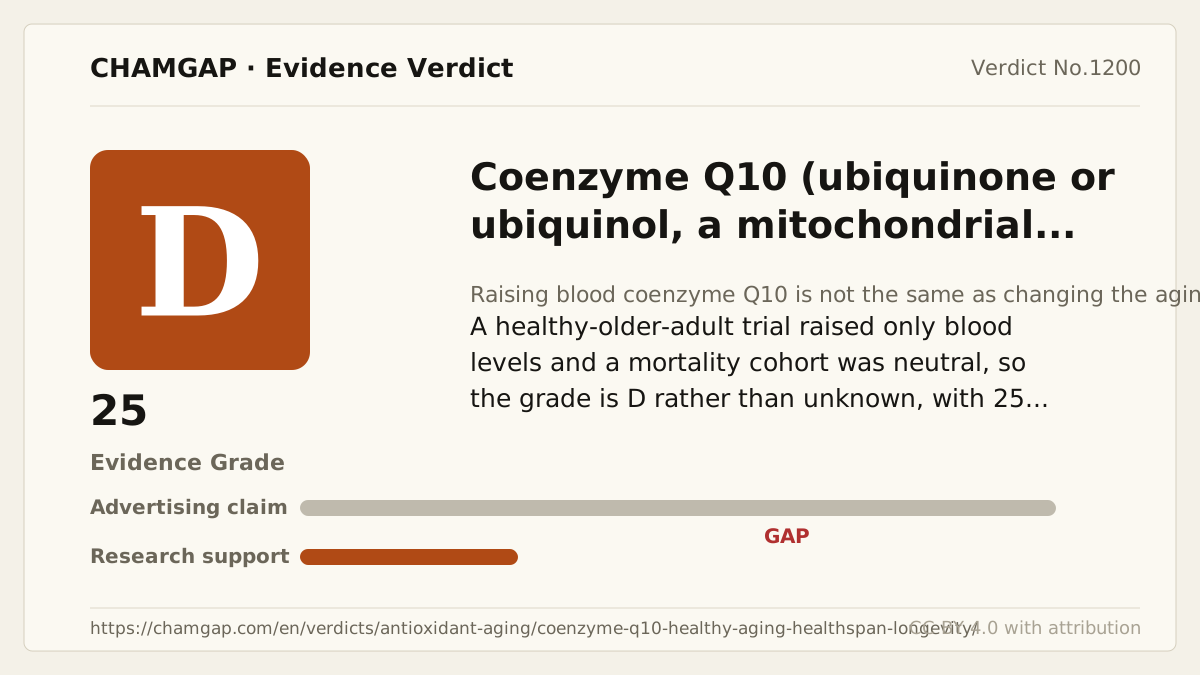
research showsThe claim that coenzyme Q10 slows aging or extends healthspan or lifespan in healthy adults is rated D. In a 2026 randomized trial of 40 healthy community-dwelling older adults, 400 mg per day for 12 weeks increased plasma coenzyme Q10 but did not improve coenzyme Q10 in muscle or isolated mitochondria, mitochondrial respiration, hydrogen peroxide emission, mitochondrial content, glucose homeostasis, maximal oxygen uptake, or body composition. A 2025 NHANES cohort likewise found no association between coenzyme Q10 supplement use and all-cause mortality over an average 9.8 years of follow-up, with a hazard ratio of 1.00 and a 95% confidence interval of 0.77 to 1.30. No direct randomized trial of aging rate or healthspan exists, but null human efficacy data mean the grade is D rather than unknown.
ads claimMarketing turns age-related changes in endogenous coenzyme Q10 and its mitochondrial role into claims of restored cellular energy, slower aging, and longevity. A higher blood concentration demonstrates ingestion and absorption, not better muscle mitochondrial function, disability-free survival, or longer life.
Useful facts when choosing a product
- Supplements contain oxidized ubiquinone or reduced ubiquinol, and absorption varies with crystalline state, oil formulation, meals, and individual factors. A higher blood concentration alone does not establish long-term efficacy.
- The null trial in healthy older adults used 400 mg per day for 12 weeks. It was not a long-term lifespan trial, and there is no evidence that a higher dose produces an anti-aging effect.
- Coenzyme Q10 is generally tolerated, but gastrointestinal discomfort, nausea, diarrhea, headache, or insomnia can occur. Dividing doses with meals may reduce gastrointestinal discomfort, but product labeling takes priority.
- Coenzyme Q10 may reduce the anticoagulant response to warfarin and can overlap with blood-pressure or glucose-lowering treatment. People using anticoagulants or multiple chronic-disease medicines should seek clinical advice.
Chamgap Semantic Classification Code
Candidate index · review held
S.coenzyme-q10.UNK.slower-biological-aging-and-longer-healthspan-or-lifespan.reduce.placeboSupplements and nutraceuticals > Coenzyme Q10 > Unknown > Slower biological aging and longer healthspan or lifespan > Reduction claim > Placebo
An automated migration candidate, not an issued permanent code; exact claim scope remains under review. This machine-generated migration candidate helps retrieval but is not a permanent assignment. The original verdict ID and URL remain authoritative.
What the research actually shows
The 2026 Danish trial assigned 40 robust community-dwelling older adults with a mean age of 74 years to coenzyme Q10 at 400 mg per day or placebo for 12 weeks. Muscle biopsy, high-resolution mitochondrial respiration, redox status, oral glucose tolerance, maximal oxygen uptake, cognition, and body composition were assessed. Only plasma coenzyme Q10 increased; muscle uptake and mitochondrial, metabolic, and performance outcomes did not. Pharma Nord donated active product and placebo, and one investigator disclosed consultancy for the company. The 2025 United States NHANES cohort analyzed supplement use from 1999 to 2018 and observed 5,237 deaths over an average 9.8 years; hazard ratios were 1.00 for all-cause and 1.30 for cardiovascular mortality. The cohort was not a causal trial and did not measure biological aging rate.
Why this is classified as D (25)
No randomized trial directly measures an aging clock or healthspan, but a healthy-older-adult surrogate trial was null beyond blood concentration and a general-adult mortality cohort was neutral, with a hazard ratio of 1.00. Human efficacy data therefore rule out an unknown grade; small null trial evidence, observation, and no direct longevity trial give D with 25 points.
Counterpoint. Heart failure, mitochondrial deficiency, and statin-associated symptoms are separate populations and claims. Even if evidence exists for one of them, a dedicated trial is required before claiming slower aging, longer healthspan, or longer life in healthy adults.
Rejudgment record. Cross-check applied — Applied D rather than unknown because a double-masked trial in healthy older adults increased plasma coenzyme Q10 without improving muscle or mitochondrial function, metabolism, or physical performance, and an NHANES cohort found an all-cause mortality hazard ratio of 1.00; no direct aging-rate or healthspan trial exists
Sub-claim grades by effect
This ingredient is marketed for several effects. A single overall grade blends strong and weak claims together, so each effect is graded separately here. The overall grade reflects the strongest disconfirming or core claim.
| Effect (sub-claim) | Grade | Basis |
|---|---|---|
| Slower biological aging rate in healthy adults | ? | No human coenzyme Q10 trial was identified that directly assessed an epigenetic clock or validated composite biological age. |
| Longer healthspan or preservation of function | ? | No human trial has directly assessed healthspan or long-term preservation of function, and a 12-week trial in healthy older adults found no improvement in short-term functional or surrogate measures. |
| Longer lifespan or lower all-cause mortality | D | The observational NHANES hazard ratio for all-cause mortality was 1.00, and no randomized lifespan trial exists. |
Cross-check — AI research and Codex final gate
Evidence Table
| Study | Design | Sample | Funding | Endpoint | Result | Weight |
|---|---|---|---|---|---|---|
| Schmücker M et al. 2026 | Randomized double-blind placebo-controlled trial | 40 healthy community-dwelling older adults; mean age 74 years | Nordea-fonden and internal support; Pharma Nord donated active product and placebo, and one investigator consulted for the company | Twelve-week plasma and muscle coenzyme Q10, mitochondrial respiration, redox and content measures, glucose homeostasis, maximal oxygen uptake, and body composition | Only plasma coenzyme Q10 increased; muscle and mitochondrial concentration, function, metabolism, and physical performance did not improve. | Key null surrogate-endpoint trial in healthy people |
| Liang L et al. 2025 | Population-based NHANES mortality-linked observational cohort | General adults in NHANES 1999 to 2018; mean 9.8-year follow-up and 5,237 deaths | Academic analysis of public NHANES data; no conflicts reported | All-cause and cardiovascular mortality | Coenzyme Q10 use was not associated with all-cause mortality, HR 1.00 (95% CI 0.77 to 1.30), or cardiovascular mortality, HR 1.30 (0.89 to 1.90). | Direct null observational mortality evidence |
Receipt — 2 References
All 2 cited sources were verified for existence at the original page (as of 2026-07-23).
Final verification and publication gate: Codex · Evidence date: 2026-07-23 · Corrections: none
Cite this verdict
[Chamgap] Coenzyme Q10 x slowing biological aging and extending healthspan or lifespan in healthy adults — Evidence Grade D·25. 2 cited sources checked. Source: https://chamgap.com/en/verdicts/antioxidant-aging/coenzyme-q10-healthy-aging-healthspan-longevity/ · CC BY 4.0CC BY 4.0 — free to use with attribution; do not distort grades, numbers, or verdict meaning.
What this document does and does not do
Chamgap is an information source. It reports what research has and has not confirmed; it does not tell readers what to take or buy. That decision belongs to readers and, when needed, medical or legal professionals. This verdict reflects literature available up to the search date and may change as new research appears. Nothing here is medical advice.