
Periodontitis,
does it really help with Long-term association with all-cause mortality?
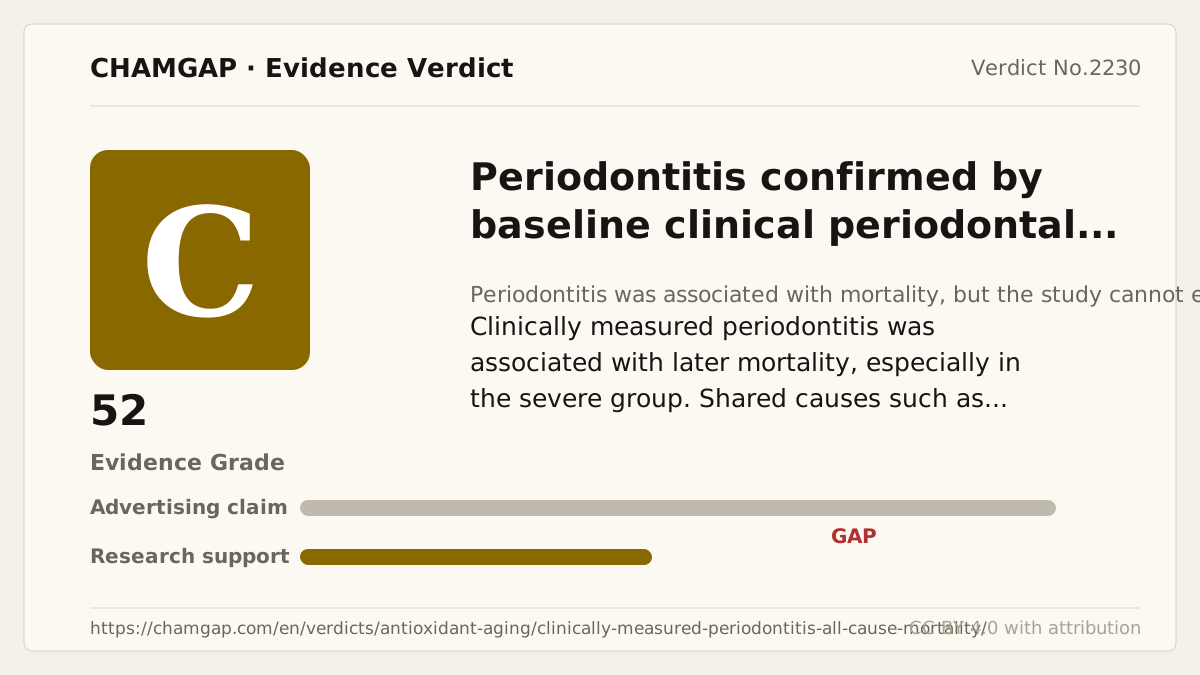
research showsThe grade is C. In a US NHANES cohort of 15,030 people followed for a median of nine years with 1,356 deaths, periodontitis was associated with adjusted HR 1.22 (95% CI 1.12 to 1.31). The association with death was present, but observational data cannot establish that periodontitis shortens life or that treatment reduces mortality. The score is 52.
ads claimPeople with periodontitis dying more often is not the same as periodontitis shortening life. No treatment was randomized, so the study cannot show that scaling or periodontal therapy reduces mortality.
Useful facts when choosing a product
- Periodontitis was classified by trained clinical examiners rather than self-report.
- The main analysis recorded 1,356 deaths over a median 117 months.
- Pack-year adjustment did not change the direction, but a never-smoker-only estimate was not verified.
Chamgap Semantic Classification Code
Candidate index · review held
UNK.periodontitis-confirmed-by-baseline-clinical-periodontal-examination.UNK.long-term-association-with-all-cause-mortality.assess.reference-exposureUnknown > Periodontitis confirmed by baseline clinical periodontal examination > Unknown > Long-term association with all-cause mortality > Association or change assessment > Reference exposure
An automated migration candidate, not an issued permanent code; exact claim scope remains under review. This machine-generated migration candidate helps retrieval but is not a permanent assignment. The original verdict ID and URL remain authoritative.
What the research actually shows
From 24,958 clinically examined NHANES participants in 1999-2014, investigators age- and sex-matched 7,515 with periodontal disease to 7,515 controls and linked them to national mortality data through 2019. Median follow-up was 117 months (IQR 81 to 198), with 1,356 deaths in the main analysis. Trained calibrated examiners measured attachment loss and probing depth. The final model adjusted for age, sex, BMI, ethnicity, household-income quintile, smoking history, and malignant, cardiovascular, respiratory, metabolic, and inflammatory comorbidities. Replacing smoking status with pack-years did not materially change direction or magnitude. A never-smoker-only result was not verified, and changes in smoking, disease, and periodontal status during follow-up were not fully captured.
Why this is classified as C (56)
The adjusted association with a hard mortality outcome and a severity gradient were clear, but this was a single observational cohort with multiple exposure and residual-confounding limitations. Causality and treatment benefit are not established, giving C with 56 points.
Counterpoint. Tooth preservation and local symptom control can independently justify periodontal care. Mortality reduction requires separate randomized intervention evidence.
Rejudgment record. Cross-check applied — Significant long-term association between clinically measured periodontitis and all-cause mortality with exposure-classification and residual-confounding limitations
| Endpoint | H | Hard endpoint - actual events such as death |
| Replication | R1 | Single confirmatory trial |
| Independence | I2 | Decisive evidence is publicly or non-profit funded |
| Effect size | E+ | Meets the clinically important threshold |
Stored derived and displayed grades match; this is not a current recalculation or validity check (C).
Sub-claim grades by effect
This ingredient is marketed for several effects. A single overall grade blends strong and weak claims together, so each effect is graded separately here. The overall grade reflects the strongest disconfirming or core claim.
| Effect (sub-claim) | Grade | Basis |
|---|---|---|
| Association between periodontitis and all-cause mortality | C | The adjusted HR excluded one, but observational data do not establish causality. |
| Reduced all-cause mortality through periodontal treatment | ? | This cohort did not randomize treatment and therefore did not test this claim. |
Cross-check — AI research and Codex final gate
Evidence Table
| Study | Design | Sample | Funding | Endpoint | Result | Weight |
|---|---|---|---|---|---|---|
| Larvin et al. 2024 NHANES mortality-linked cohort | Prospective observational cohort | 15,030 people; 1,356 deaths in the main analysis | Nonprofit support from Barts Charity, grant MGU0504 | All-cause mortality | Any periodontitis HR 1.22 (95% CI 1.12 to 1.31); mild or moderate 1.04 (0.95 to 1.15); severe or edentulous 1.37 (1.26 to 1.50) | Decisive clinically measured long-term observational evidence |
Receipt — 1 References
All 1 cited sources were verified for existence at the original page (as of 2026-08-04).
Final verification and publication gate: Codex · Evidence date: 2026-08-04 · Corrections: none
Cite this verdict
[Chamgap] Periodontitis x increased all-cause mortality — Evidence Grade C·56. 1 cited sources checked. Source: https://chamgap.com/en/verdicts/antioxidant-aging/clinically-measured-periodontitis-all-cause-mortality/ · CC BY 4.0CC BY 4.0 — free to use with attribution; do not distort grades, numbers, or verdict meaning.
What this document does and does not do
Chamgap is an information source. It reports what research has and has not confirmed; it does not tell readers what to take or buy. That decision belongs to readers and, when needed, medical or legal professionals. This verdict reflects literature available up to the search date and may change as new research appears. Nothing here is medical advice.