
Two-year caloric restriction,
does it really help with Slower biological aging?
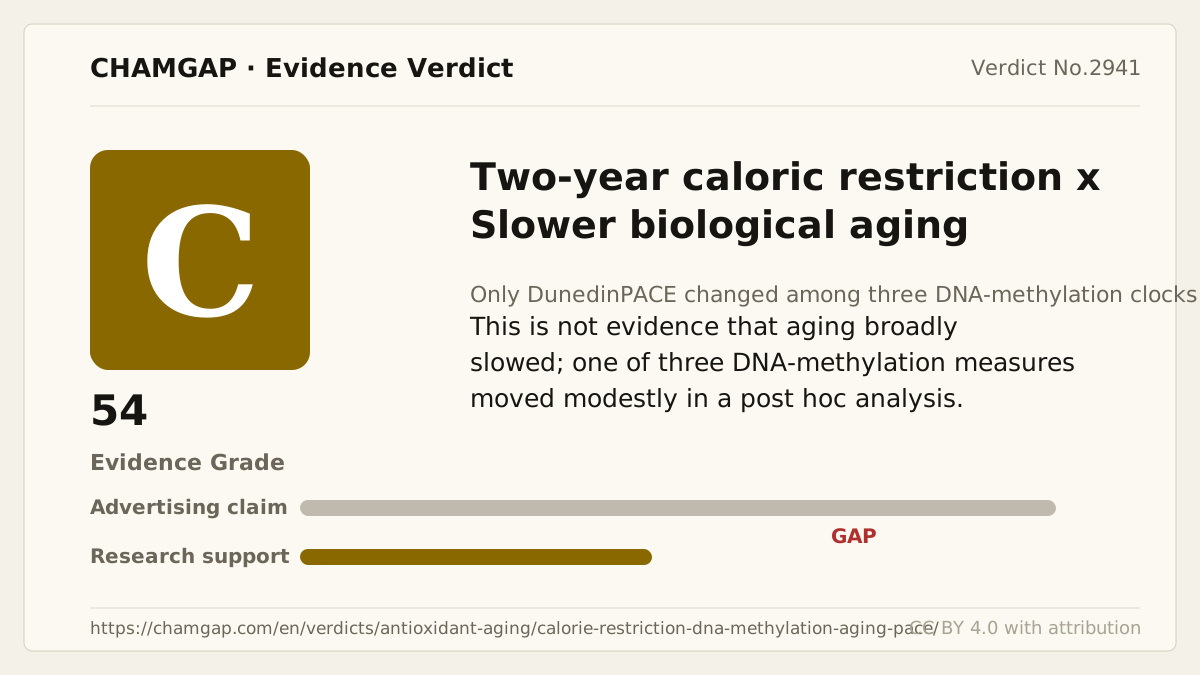
research showsThe grade is C. In this post hoc CALERIE analysis of 220 healthy non-obese adults, the target was 25% restriction but the achieved average was about 12%. Only DunedinPACE changed by roughly 2-3%; PC PhenoAge and PC GrimAge did not.
ads claimMarketing should say that one of three aging-rate measures changed by 2-3% while two did not, not that aging itself was proven to slow.
Useful facts when choosing a product
- The target was 25% restriction, but average achieved restriction was about 12%.
- DunedinPACE is a DNA-methylation surrogate rather than a clinical event.
- Safety was not an endpoint in this analysis.
Chamgap Semantic Classification Code
Candidate index · review held
D.caloric-restriction.dietary.biological-aging.reduce.UNKDietary patterns and eating practices > Caloric restriction > Dietary regimen > Biological aging > Reduction claim > Unknown
An automated migration candidate, not an issued permanent code; exact claim scope remains under review. This machine-generated migration candidate helps retrieval but is not a permanent assignment. The original verdict ID and URL remain authoritative.
What the research actually shows
This was explicitly a post hoc analysis of the 2:1 randomized CALERIE trial at three US sites. DNA data were analyzed for 197 participants with baseline and at least one follow-up sample, with laboratory analysts blinded. No clinical minimum-effect threshold or prespecified success boundary was set. Funding included NIA, American Brain Foundation, and CIHR support, while D.L. Corcoran and D.W. Belsky were inventors of the commercially licensed DunedinPACE measure that produced the sole positive result.
Why this is classified as C (54)
A single post hoc analysis of unvalidated clinical surrogates with split key measures gives C with 54 points.
Counterpoint. Whether the small DunedinPACE shift translates into longer healthy life remains unanswered.
Rejudgment record. Cross-check applied — A post hoc DNA-methylation analysis of one randomized trial found a small change in only one of three measures
| Endpoint | S | Surrogate marker - laboratory or imaging measures |
| Replication | R1 | Single confirmatory trial |
| Independence | I1 | Mixed funding sources |
| Effect size | E+ | Meets the clinically important threshold |
Stored derived and displayed grades match; this is not a current recalculation or validity check (C).
Sub-claim grades by effect
This ingredient is marketed for several effects. A single overall grade blends strong and weak claims together, so each effect is graded separately here. The overall grade reflects the strongest disconfirming or core claim.
| Effect (sub-claim) | Grade | Basis |
|---|---|---|
| Slower DunedinPACE | C | A roughly 2-3% slowing signal was observed. |
| Reduced PC PhenoAge and PC GrimAge | D | Neither measure changed significantly. |
Cross-check — AI research and Codex final gate
Evidence Table
| Study | Design | Sample | Funding | Endpoint | Result | Weight |
|---|---|---|---|---|---|---|
| Waziry R et al. 2023 CALERIE post hoc analysis | Post hoc DNA-methylation analysis of a 2:1 randomized trial | 220 randomized; 197 with longitudinal DNA data | NIA, American Brain Foundation, CIHR, and others; two DunedinPACE inventors were authors | PC PhenoAge, PC GrimAge, and DunedinPACE | Only DunedinPACE changed: d=-0.29 at 12 months and -0.25 at 24 months; the other clocks were null | Single post hoc surrogate-outcome evidence |
Receipt — 1 References
All 1 cited sources were verified for existence at the original page (as of 2026-08-26).
Final verification and publication gate: Codex · Evidence date: 2026-08-26 · Corrections: none
Cite this verdict
[Chamgap] Benefit of Two-Year Caloric Restriction for a Biological Pace-of-Aging Measure, a Surrogate Marker — Evidence Grade C·54. 1 cited sources checked. Source: https://chamgap.com/en/verdicts/antioxidant-aging/calorie-restriction-dna-methylation-aging-pace/ · CC BY 4.0CC BY 4.0 — free to use with attribution; do not distort grades, numbers, or verdict meaning.
What this document does and does not do
Chamgap is an information source. It reports what research has and has not confirmed; it does not tell readers what to take or buy. That decision belongs to readers and, when needed, medical or legal professionals. This verdict reflects literature available up to the search date and may change as new research appears. Nothing here is medical advice.