
Broad-spectrum sunscreen,
does it really help with Slower progression of ultraviolet-induced skin aging with daily use?
research showsDaily broad-spectrum sunscreen is rated B because a direct randomized trial showed slower photoaging progression. In the community-based Nambour trial, 903 adults younger than 55 years were followed for 4.5 years, and microscopic skin-surface aging was 24% lower with daily SPF 15-plus broad-spectrum sunscreen than with discretionary use (relative odds 0.76, 95% CI 0.59 to 0.98). The direct long-term skin-aging outcome establishes photoaging prevention, but the evidence rests largely on one pivotal trial and effectiveness depends on adherence, adequate application, and reapplication, so the rating is lower-middle B with 68 points rather than A. Skin-cancer prevention is a separate efficacy axis, while irritation and contact dermatitis from selected filters remain under safety.
ads claimMarketing can turn one high SPF number into all-day complete UVA and UVB protection, wrinkle reversal, or complete skin-cancer prevention. The evidence supports the narrower claim that adequately applied daily broad-spectrum sunscreen slows cumulative photoaging.
Useful facts when choosing a product
- The Nambour trial used an SPF 15-plus broad-spectrum sunscreen on the head, neck, arms, and hands every morning, with reapplication after heavy sweating, bathing, or prolonged sun exposure.
- A broad-spectrum label targets both UVA and UVB, but long-wave UVA, visible-light protection, and water resistance vary by product, so the specific label and directions matter.
- Adequate and even application followed by label-directed reapplication after swimming, sweating, or rubbing is needed to approach trial-level effectiveness.
- Sunscreen complements hats, clothing, and shade and is not equivalent to a treatment that reverses established photoaging.
Chamgap Semantic Classification Code
Candidate index · review held
UNK.broad-spectrum-uva-uvb-sunscreen.UNK.slower-progression-of-ultraviolet-induced-skin-aging-with-daily-use.reduce.UNKUnknown > Broad-spectrum UVA/UVB sunscreen > Unknown > Slower progression of ultraviolet-induced skin aging with daily use > Reduction claim > Unknown
An automated migration candidate, not an issued permanent code; exact claim scope remains under review. This machine-generated migration candidate helps retrieval but is not a permanent assignment. The original verdict ID and URL remain authoritative.
What the research actually shows
Hughes and colleagues randomized 903 community-dwelling adults in Nambour to daily SPF 15-plus broad-spectrum sunscreen or discretionary use and compared silicone impressions of the back of the hand from 1992 to 1996, with assessors masked to allocation. No detectable increase in skin aging occurred in the daily-use group, and aging was 24% lower than with discretionary use. A 2021 literature review identified this as the pivotal long-term clinical evidence for photoaging prevention while noting that protection from long-wave UVA and visible light varies among products. This verdict concerns slowing photoaging progression; skin-cancer prevention, melasma, and treatment of established wrinkles are separate claims.
Why this is classified as B (68)
A publicly funded long-term trial found 24% less direct photoaging progression over 4.5 years in 903 participants, establishing photoaging prevention, but reliance on essentially one pivotal trial and dependence on adherence and spectral product performance support lower-middle B with 68 points. Skin-cancer prevention is a separate efficacy claim, and filter irritation is an independent safety issue.
Counterpoint. Unlike oral Polypodium or tomato products supported mainly by erythema and molecular surrogates, topical sunscreen directly reduces the causal exposure and has a long-term photoaging outcome.
Rejudgment record. Cross-check revision — Prioritized the direct skin-aging endpoint and 24% relative reduction in a publicly funded 4.5-year community randomized trial, while accounting for reliance on one pivotal study and dependence on application, reapplication, and product-specific UVA coverage
Sub-claim grades by effect
This ingredient is marketed for several effects. A single overall grade blends strong and weak claims together, so each effect is graded separately here. The overall grade reflects the strongest disconfirming or core claim.
| Effect (sub-claim) | Grade | Basis |
|---|---|---|
| Slower photoaging progression with daily use | B | A 4.5-year randomized trial with a direct skin-aging outcome was positive, but adequate application and reapplication are required. |
| Slower deterioration of wrinkles and microscopic skin-surface structure | B | The evidence comes from long-term masked grading of hand-surface impressions and does not guarantee the same magnitude for every facial site or skin tone. |
| Reversal of established photoaging signs | C | The pivotal trial addressed prevention, while reversal of established wrinkles or pigmentation is limited to small studies of combination formulations. |
Cross-check — AI research and Codex final gate
Evidence Table
| Study | Design | Sample | Funding | Endpoint | Result | Weight |
|---|---|---|---|---|---|---|
| Hughes MCB et al. 2013 | Community-based randomized controlled trial over 4.5 years | 903 adults younger than 55 years | Public funding from the Australian National Health and Medical Research Council | Masked assessment of change in microscopic skin-surface topography on the back of the hand | No detectable increase in aging occurred with daily use, and aging was 24% lower than with discretionary use (relative odds 0.76, 95% CI 0.59 to 0.98). | Pivotal direct long-term clinical evidence |
| Guan LL et al. 2021 | Literature review of sunscreens and photoaging | Clinical and mechanistic literature, including the 903-person Nambour trial | Academic review; selected authors reported relationships with sunscreen companies | Photoaging, dyspigmentation, DNA damage, and wavelength-specific photoprotection | Supported photoaging prevention while noting that long-wave UVA and visible-light protection varies among products. | Contextual evidence and product-variability assessment |
Receipt — 2 References
Of 2 cited sources, 1 had limited original-page access (blocked or summary-only) and were verified via index/summary, marked partial; the rest were verified at the original page. As of 2026-07-21.
Final verification and publication gate: Codex · Evidence date: 2026-07-21 · Corrections: none
Cite this verdict
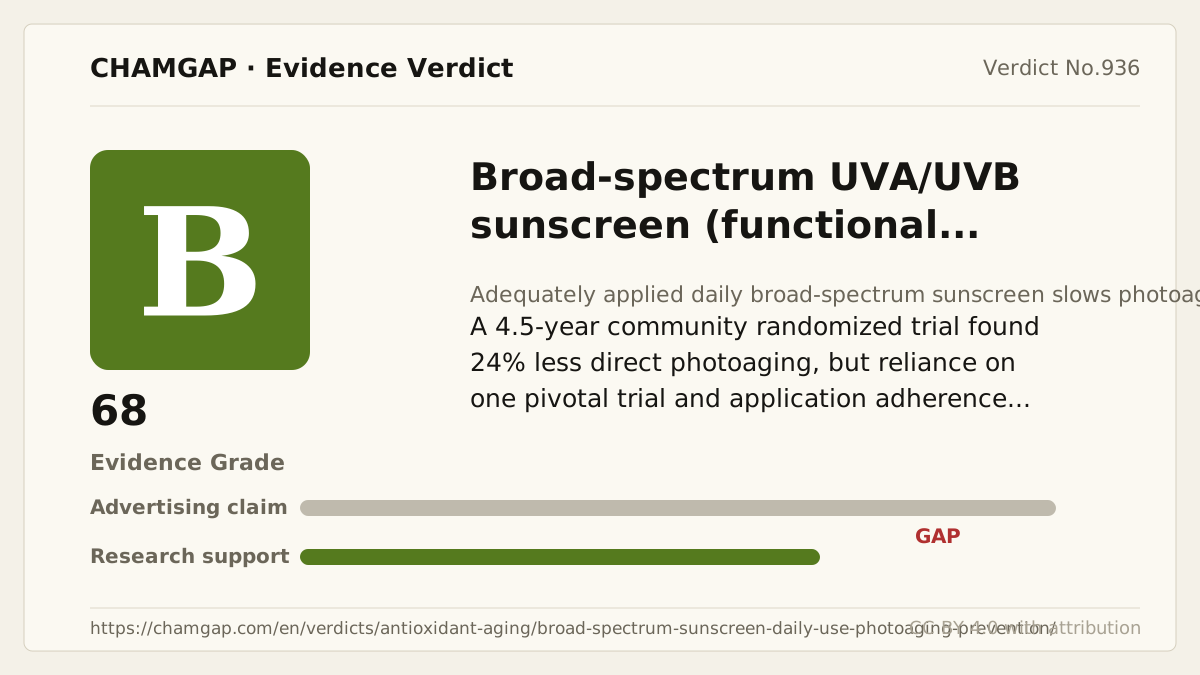
[Chamgap] Broad-spectrum sunscreen x slower photoaging progression with daily use — Evidence Grade B·68. 2 cited sources checked. Source: https://chamgap.com/en/verdicts/antioxidant-aging/broad-spectrum-sunscreen-daily-use-photoaging-prevention/ · CC BY 4.0CC BY 4.0 — free to use with attribution; do not distort grades, numbers, or verdict meaning.
What this document does and does not do
Chamgap is an information source. It reports what research has and has not confirmed; it does not tell readers what to take or buy. That decision belongs to readers and, when needed, medical or legal professionals. This verdict reflects literature available up to the search date and may change as new research appears. Nothing here is medical advice.