
Berberine,
does it really help with Slower human aging and extended healthspan and lifespan through AMPK activation?
research showsThe grade is ? because no human efficacy literature was found showing that berberine slows aging or extends healthspan or lifespan. Berberine has human research on metabolic surrogates such as glucose and lipids and is rated B for that separate axis in verdict 151, but those results cannot be transferred to long-term aging or survival. Anti-aging evidence remains in human cells, yeast, worms, naturally aged or chemotherapy-treated mice, and mechanistic inference involving pathways such as AMPK. A 2023 umbrella review of human outcomes covered metabolic, inflammatory, and disease surrogates but did not include aging rate, healthspan, or lifespan endpoints. Gastrointestinal effects, CYP interactions, and risk with glucose-lowering drugs are separated under safety.
ads claimMarketing turns AMPK activation or mechanistic similarity to metformin into a natural anti-aging and lifespan-extending claim. A molecular pathway, metabolic surrogate, or longer animal lifespan is not a long-term human clinical outcome.
Useful facts when choosing a product
- Berberine is an isoquinoline alkaloid obtained from several plants, and salt form, labeled amount, extract composition, and bioavailability can vary among retail products.
- No dose or treatment duration has been validated for slowing human aging or extending healthspan or lifespan, so doses used in metabolic-disease research are not established anti-aging doses.
- Common adverse effects include constipation, diarrhea, abdominal discomfort, and nausea, and concomitant glucose-lowering medication can raise concern for hypoglycemia.
- A human crossover study found that repeated dosing reduced CYP2D6, CYP2C9, and CYP3A4 activity, so interactions with prescription drugs metabolized by these enzymes require review.
Chamgap Semantic Classification Code
Candidate index · review held
S.berberine.UNK.slower-human-aging-and-extended-healthspan-and-lifespan-through-ampk-activation.reduce.UNKSupplements and nutraceuticals > Berberine > Unknown > Slower human aging and extended healthspan and lifespan through AMPK activation > Reduction claim > Unknown
An automated migration candidate, not an issued permanent code; exact claim scope remains under review. This machine-generated migration candidate helps retrieval but is not a permanent assignment. The original verdict ID and URL remain authoritative.
What the research actually shows
Dang et al. 2020 reduced cellular-senescence markers in human fetal-lung fibroblasts and reported longer lifespan in chemotherapy-treated and naturally aged mice. Use of human cells did not make this a human administration trial. Gasmi et al. 2024 narratively reviewed literature from 1982 through 2022 on metabolic, microbial, and aging mechanisms while acknowledging limited human aging evidence. Li et al. 2023 conducted an umbrella review of human randomized-trial meta-analyses, but outcomes centered on glucose, lipids, inflammation, and specific diseases rather than aging rate, disability-free survival, healthspan, or overall lifespan. The B grade for glucose and cholesterol in verdict 151 is not evidence for this anti-aging axis.
Why this is classified as ?
No berberine efficacy trial directly assessed human aging rate, healthspan, or overall lifespan. Cell, mouse, and worm lifespan studies, AMPK mechanisms, and human metabolic surrogates cannot be transferred to longevity efficacy, yielding ? and a null score. Product variation and gastrointestinal, CYP, and hypoglycemia concerns remain independent safety issues.
Counterpoint. This verdict does not mean berberine has no effect on human glucose or lipids. Unlike the B-rated metabolic axis in verdict 151, it means that long-term human aging, healthspan, and lifespan endpoints have not been tested.
Rejudgment record. New verdict — No berberine efficacy trial directly assessed human aging rate, healthspan, or overall lifespan; excluded cell and animal lifespan findings, AMPK mechanisms, and human metabolic-disease surrogates from anti-aging clinical efficacy
Sub-claim grades by effect
This ingredient is marketed for several effects. A single overall grade blends strong and weak claims together, so each effect is graded separately here. The overall grade reflects the strongest disconfirming or core claim.
| Effect (sub-claim) | Grade | Basis |
|---|---|---|
| Slower biological aging in humans | ? | No berberine efficacy trial in treated humans has assessed a validated biological-aging endpoint, and effects on glucose or lipids are distinct from aging rate. |
| Extended human healthspan | ? | No human efficacy literature has followed disability-free survival or healthspan. |
| Extended overall human lifespan | ? | Only cell, animal, and mechanistic evidence exists; no efficacy trial has assessed overall human lifespan or mortality. |
Cross-check — AI research and Codex final gate
Evidence Table
| Study | Design | Sample | Funding | Endpoint | Result | Weight |
|---|---|---|---|---|---|---|
| Dang Y et al. 2020 | Preclinical experiments in human cells, yeast, and mice | Human fetal-lung fibroblasts and chemotherapy-treated or naturally aged mice | Public support including the National Natural Science Foundation of China | Cellular-senescence markers, residual mouse lifespan, and behavior | Cellular-senescence measures and mouse lifespan improved, but human administration and human longevity efficacy were not assessed. | Preclinical hypothesis generation, not human efficacy |
| Gasmi A et al. 2024 | Narrative review of pharmacology, disease, and aging | Representative literature from 1982 through 2022 | Funding source not stated in the public abstract | Metabolic, microbial, neuroprotective, and aging mechanisms and models | Human aging evidence was described as limited, with preliminary model findings providing a basis for future human trials. | Evidence-gap assessment |
| Li Z et al. 2023 | Umbrella review of meta-analyses of human randomized trials | Meta-analyses of berberine health outcomes through June 2022 | Funding source not stated in the public abstract | Metabolic, inflammatory, disease-specific clinical, and surrogate outcomes | Multiple metabolic outcomes were synthesized, but aging rate, healthspan, and overall lifespan endpoints were absent. | Assessment of the scope of human literature |
Receipt — 4 References
All 4 cited sources were verified for existence at the original page (as of 2026-07-20).
Final verification and publication gate: Codex · Evidence date: 2026-07-20 · Corrections: none
Cite this verdict
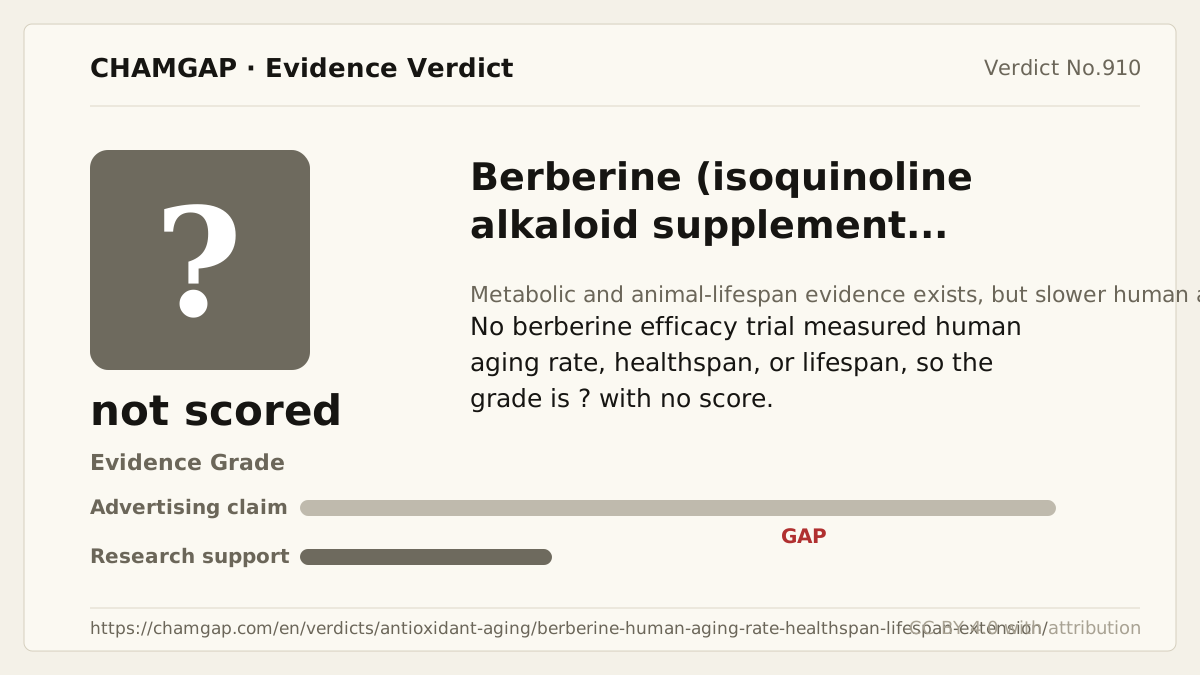
[Chamgap] Berberine x slower human aging and extended healthspan and lifespan — Evidence Grade ?. 4 cited sources checked. Source: https://chamgap.com/en/verdicts/antioxidant-aging/berberine-human-aging-rate-healthspan-lifespan-extension/ · CC BY 4.0CC BY 4.0 — free to use with attribution; do not distort grades, numbers, or verdict meaning.
What this document does and does not do
Chamgap is an information source. It reports what research has and has not confirmed; it does not tell readers what to take or buy. That decision belongs to readers and, when needed, medical or legal professionals. This verdict reflects literature available up to the search date and may change as new research appears. Nothing here is medical advice.